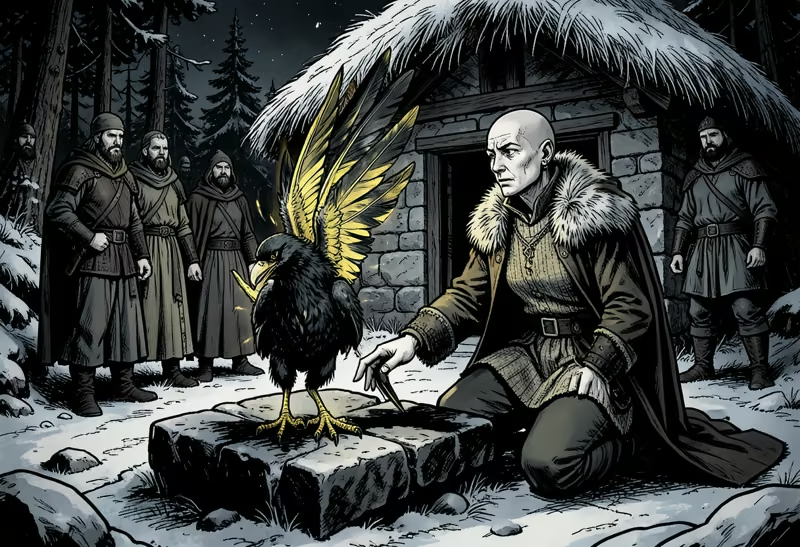
Undead Familiar
- school
- Necromancy
- range
- As find familiar
- components
- V, S, M
- duration
- Permanent
- casting time
- 6 hour ritual
- area
- Mage's familiar
- save
- Special
- attribution
- From the article 'Necromantic Familiars', which offers it as an example second-level spell
This spell allows a necromancer to turn a normal, living familiar bound to him through the find familiar spell to become undead and bestow extra abilities upon him. During the ritual, the caster's familiar is ritually "killed" with a bejewelled bone dagger (costing no less than 2500 g.p. materials, plus construction cost; which is destroyed at this point). The necromancer must then make a system shock roll to survive this (although there is no loss in constitution). If this roll is failed, the wizard dies, and the ritual fails.
The remainder of this ritual animates the dead remains and re-binds the spirit to the necromancer. Note that if the necromancer wasn't "nice" to his familiar in life, the familiar's spirit may try to resist this binding attempt. The familiar gets a save vs. death magic to resist, if it is truly deserved; this will not be the case in most instances as the necromancer and familiar usually go into this together. If the familiar does save, though, the ritual fails, the wizard's familiar is dead and the wizard loses 1 point of constitution permanently just as if the familiar had died naturally(?).
The actual type of undead the familiar comes back as depends on the other material components used in the casting of this ritual and are summarised on the table below:
| Material component | Resulting undead familiar |
|---|---|
| Earth from the grave of a now undead creature | Same as that of the undead creature (excluding the wight, wraith, lich, etc.) |
| Teeth and eyes of a vampire | Vampire |
| A piece of bandage from a mummy and a rat infected with mummy rot | Mummy |
| Ethereal cowl of a ghost | Ghost |
| Skull of a skeleton | Skeleton |
| Flesh from a "fresh" zombie corpse | Zombie |
| A bone vial containing essence of the negative material plane | Spectre, ghost, or vampire (caster's choice) |
This can produce such things as vampire cats, mummified snakes, skeletal bats, zombie toads, ghost owls, etc. It is worth pointing out, that the familiar keeps all the abilities it had in life, movement modes, special abilities, attack chances, AC, HP, etc. The mage also benefits in the same way, for example, a necromancer with an undead crow familiar still gets excellent vision and the undead crow can still fly (even if it becomes a skeleton).
In addition to all of these abilities that it bestowed, and had, in life, the familiar also gains extra abilities depending on the type of undead it has become as well as some general abilities.
- Firstly, the familiar cannot be turned by a cleric who would ordinarily be able to do so, unless the cleric rolls to turn undead equal to twice the combined hit dice of both the mage and familiar combined. If a cleric manages this, then both mage and familiar must leave the vicinity of the cleric. Neither mage nor familiar can be automatically destroyed without a saving throw vs. death magic.
- Secondly, both mage and familiar, in addition to any other benefits, become immune to all cold based, charm, hold and sleep spells, except those that are specifically designed to affect undead as stated in the relative spell/power descriptions.
Specific powers are as follows:
| Undead type | Special powers |
|---|---|
| Skeleton | No additional effects |
| Zombie | No additional effects |
| Ghoul | Mage or familiar can deliver one paralyzing attack each day |
| Ghast | Familiar can exude stench as Ghast at will. The casting mage is immune to this, and all other similar Ghast stenches. This is in addition to having a Ghoul familiar. |
| Mummy | Familiar or mage can infect one creature touched with Mummy Rot per week. No save. |
| Spectre | Familiar or caster can drain one energy level temporarily (until next full moon) from any one creature touched. They use this twice a week. |
| Vampire | Familiar can mesmerize, as a vampire, all that meet his gaze. Mage can drain levels by drinking blood of humanoids (something he will now feel compelled to do at least once per week). |
| Ghost | Familiar and mage can become ethereal at will for one turn, but cannot do it again for at least another hour. |
| Shadow | Familiar cannot become a Shadow |
| Wight | Familiar cannot become a Wight |
| Wraith | Familiar cannot become a Wraith |
| Lich | Familiar cannot become a Lich |
There are more undead types, but these have not been gone into here as the familiar cannot become them.
Undead familiars can be further enhanced by the series of familiar enhancer spells, to further enhance their effectiveness at later levels.
Note that this is a ritual spell, like many others in the PHB and other manuals. That is to say, that the caster need not be a necromancer specialist wizard, but may be of any type of mage able to cast necromantic spells. If this is the case, the familiar is unlikely to understand fully the mage's fascination with death that a necromancer's familiar would and so is more likely to resist the binding process.
Remember, if this undead "dies" or gets lost/abused, etc. penalties must be applied to the caster as for a living familiar. This also applies to necromancers who summon undead familiars.
In addition to the spell components already listed, a silver circle must be laid onto stone, various candles made of wax mixed with exotic oils must be burned, as must expensive and rare incenses and herbs. The total cost of this is a further 2000 g.p. and takes 1 hour to set up, in addition to the ritual casting time and cost of the other spell components.
If the undead familiar is acquired as a necromancer (not a specialist wizard type), a similar ritual is required (in terms of expense and time), but the necromancer need not already have an alive familiar, thus dispensing with the need for a bone dagger, and various system shock rolls and saving throws. It is, therefore, easier for necromancer to get an undead familiar. Another advantage a necromancer has over a specialist wizard who summoned a familiar, is that the necromancer can choose what type of animal to animate at the time of the casting and get the exact undead familiar animal he desires.