Physiomagical Transmutation
- school
- Necromancy
- range
- Touch
- components
- V, S, M
- duration
- Variable
- casting time
- 1 turn
- area
- 1 creature
- save
- None
By means of this spell, the caster can permanently alter the genetic makeup and innate magical traits of a creature. Any physical trait which is influenced by genetics can be altered, including (but not limited to) Strength, Dexterity, Constitution, Charisma/Appearance (for those of you not familiar with the Player's Option: Skills and Powers rules, Cha/App is also known as Comeliness, i.e. the physical attractiveness of the creature), sex, race, height, weight, metabolism, bone structure, eye color, and hair color. Physical age can also be altered. A general rule of thumb is, if it relates to physical form, it can be altered.
(Note: Innate magical traits, for the purpose of this spell, are defined as any magical abilities which are either acquired at birth or at a set age by all members of a species. Examples of innate magical abilities are an elf's infravision, a medusa's gaze attack, and a red dragon's breath weapon.)
This spell differs from spells such as polymorph any object in several ways. First, the spell recipient does indeed gain all physiomagical traits of his new form, if this is what the caster desires. Second, the spell recipient, following the completion of the Transmutation, is treated in all ways as if his current form was his original form - thus a dispel magic will not cause the spell recipient to change back to his "original" form, nor even a wish; and no powers of divination whatsoever will reveal that the spell recipient's body was not always as it is now. (A possible exception to this might be divinations to discover whether the Physiomagical Transmutation spell was ever cast upon the spell recipient.) Third, unlike polymorph other, there is no risk of the spell recipient's mind being altered - the spell recipient keeps his Intelligence, Wisdom, Charisma/Leadership (a.k.a. standard Charisma), spellcasting ability, psionic ability, personality, and all other mentally-based traits. He also retains his class (even if his new form would not normally allow it) and his current level. Fourth, the spell recipient does not radiate magic of any sort (other than magic his new form would normally radiate).
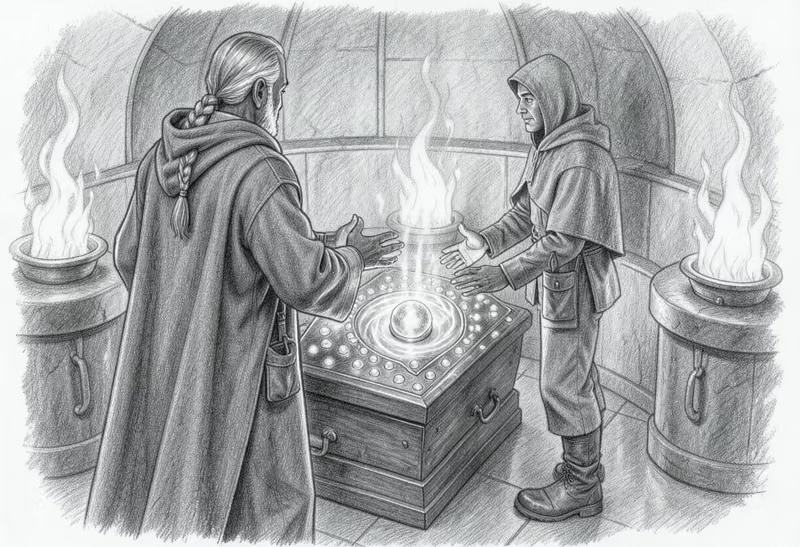
In preparation for the casting of this spell, a vessel must be fashioned to hold the body of the spell recipient. It must be shaped akin to a coffin, and large enough to hold the entire body of the spell recipient. The materials of which the vessel is constructed must be of the finest possible quality, and befitting the recipient - rare, exotic woods for an elven ranger, for example. Also, the true name of the spell recipient must be inscribed upon both the inner and outer surfaces of the vessel.
When this is completed, a gem of no less than 100,000 gp value must be embedded in the center of the top surface of the vessel. Beyond this, a number of gem holders must be placed upon the sides of the vessel. (The total number of gem holders is up to the caster, but this decision may be greatly influenced by the number necessary for the procedure the caster has in mind. (See Below)) Following this, it is necessary to trace extremely potent necromantic runes upon the outer surface of the vessel, connecting the gem with all of the gem holders.
Next, the spells enchant an item, trap the soul, temporal stasis, permanency, and wish must be cast upon the vessel. The caster must then use the psionic discipline Empower upon the vessel in order to make it an independent psionic entity. During the Empower process, the vessel must be given the psionic disciplines Contact and Molecular Rearrangement.
(Note: For the purpose of this spell, a Soul Gem is simply a gem containing a creature entrapped by means of trap the soul.)
The caster must then decide what effect he desires. If he wishes to transform the spell recipient into an exact physiomagical duplicate of another creature, he must obtain a Soul Gem containing that creature. Otherwise, if he is to alter a single physiomagical trait of the spell recipient, he must obtain a number of Soul Gems containing creatures with that physiomagical trait.
If an ability score is to be altered, the number of Soul Gems required is equal to (((desired ability score)^2) * (total number of points the original score is to be raised or lowered)).
Example: The spell recipient has a Strength of 13. A Strength of 17 is desired. The number of Soul Gems required is: (((17)^2) * (4)) = 289 * 4 = 1156 Soul Gems.
If the natural Armor Class of the spell recipient is to be altered, then each point of change would require (((10 + (10 - (desired AC)))^2) * (total number of points the original AC is to be raised or lowered)) Soul Gems.
If the innate magical traits of the spell recipient are to be altered, then the number of Soul Gems required would be 1000 for a major power, 500 for a minor power, and 100 for a trivial power. (Exactly what defines major, minor, and trivial is up to the DM.)
To alter the spell recipient's age by means of this spell, 200 Soul Gems are required for each year added to or subtracted from the spell recipient's body. Note that any Soul Gems containing mortal beings will do for this application of the spell - the creatures need not be of a certain age.
Minor changes to physical form, such as eye color, hair color, and slight alterations to bone structure, require 50 Soul Gems. Major changes to physical form, such as metabolism and moderate alterations to bone structure, require 100 Soul Gems. Vast changes to physical form, such as addition of extra limbs, complete reworking of bone structure, and changing the sex of the spell recipient, require 500 Soul Gems.
Only one major function of this spell may be utilized per casting - the caster must either choose to create a physiomagical replication of another creature, or to alter a single physical or magical trait.
As soon as the spell recipient is placed within the vessel, he is affected by a temporal stasis effect, which ends upon his removal from the vessel (typically at the end of the spell - the results of removing the spell recipient from the vessel while the spell is in effect are best not contemplated). The caster need not be the one to place the spell recipient within the vessel, nor need he be the one to remove the spell recipient from the vessel.
Upon the casting of the spell, the necromantic runes traced upon the vessel magically link the main Soul Gem with all of the Soul Gem holders. The caster must then psionically contact the vessel, and guide the process of molecularly rearranging the subject according to his desires and the physiomagical blueprints of the creatures within the Soul Gems. This process takes as long as if the caster were molecularly rearranging an object weighing as much as the spell recipient's physical form before or after the completion of the spell, whichever weighs more.
The caster must make an Intelligence check with a -1 penalty for every 100 Soul Gems used in the casting, rounded up. If this check is failed, the DM should feel free to impose any of the following effects, or create one of his own. The ill effects of a failed Intelligence check automatically apply if the caster is interrupted by any means during the casting of the spell.
Possible Physiomagical Transmutation Intelligence Check Failure Effects
- Procedure simply fails - the souls of all creatures involved in the casting are lost, including the spell recipient.
- Procedure is reversed - spell recipient keeps physiomagical form, while acquiring the mind of one of the creatures within the Soul Gems (who will probably be hell-bent on revenge!).
- Physical form is somewhat botched, exact effect up to DM.
- Physical form is totally screwed up (protoplasmic mush, inside-out, etc.). DM's are encouraged to be devious.
- Spell recipient is totally unaffected, but all the creatures trapped within Soul Gems are released and reform their material bodies on the spot, and attack the caster with a morale of 20 until they are all slain, or the caster dies.
- The caster's mind is switched with that of the spell recipient - no other effects occur.
- One (or more) of the trapped creatures is able to grasp on to the caster's life force and avoid destruction, and possesses the caster. All rules for possession apply.
- The spellcaster completely loses control of the procedure, and the vessel explodes in an utterly annihilating outpour of released magical energy, destroying everything within a radius of 1000' (including the caster) with no saving throw whatsoever, and doing 10d10 points of damage to everything within a radius of 2000'.
If a replica (see Create Replica, 10th level Wizard spell) of the caster is to be altered, the penalty is halved (rounded up). A replica of the caster altered by this spell is still a replica of the caster under the rules for replicas; it does not become a replica of another being, for example.
For purposes of creating the vessel, the caster is treated as the spell recipient.
The instant the spell is completed, every Soul Gem in a gem holder is consumed, dooming the creatures trapped within to oblivion. Nothing can restore them to life once this occurs, not even a wish. The vessel is not consumed, and may be used again for the same individual, so long as the material of which the vessel was created is still appropriate.
Obviously, this is a spell good creatures will not tolerate the casting of under any circumstances. Additionally, most deities (save the most wicked among them) look very dimly upon mortals "playing god".
This spell was researched by the psimage DarkBlade.