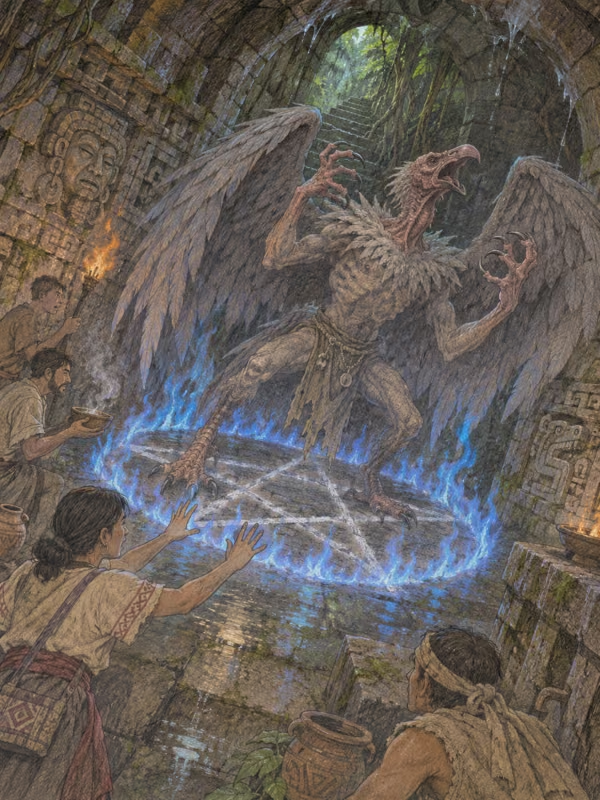
Cacofiend
- school
- Conjuration/Summoning
- range
- 10 feet per level
- components
- V, S, M
- duration
- Special
- casting time
- Special
- area
- Special
- save
- Special
This perilous exercise in dweomercraft summons up a powerful tanar'ri - any true tanar'ri, depending upon the fiend's name known to the wizard. Note that this spell is not of sufficient power to bring a tanar'ri of greater power, and lesser sorts are not called as they have no known names. In any event, the spell caster must know the name of the fiend he is summoning. As the spell name implies, the fiend so summoned is most angry and evilly disposed. The spell caster must be within a circle of protection (or a thaumaturgic triangle with protection from evil) and the tanar'ri confined within a circled pentagram, if he is to avoid being slain or carried off by the summoned fiend. The summoned fiend can be treated with as follows:
- The wizard can require the monster to perform a desired course of action by force of threat and pain of a spiritwrack (or similar) spell, allowing freedom whenever the fiend performs the full extent of the service, and forcing the fiend to pledge its word upon it. This is exceedingly dangerous, as a minor error in such a bargain will be seized upon by the monster to reverse the desired outcome or simply to kill and devour the summoner. Furthermore, the fiend will bear great enmity for the wizard forever after such forced obedience, so the spell caster had better be prepared and powerful.
- By tribute of fresh human blood and the promise of one or more human sacrifices, the summoner can bargain with the fiend for willing service. Again, the spell caster is well advised to have ample protection and power to defend himself, as the fiend might decide that the offer is insufficient - and it is easier to enjoy the summoner's slow death - and decide not to accept the bargain as offered. Although the fiend will have to abide by a pledge, as its name is known, it will have to hold only to the exact wording of the arrangement, not to the spirit of the agreement. On the other hand, only highly evil wizards are likely to attempt to strike such a bargain, and the summoned fiend might be favourably disposed towards such a character, especially if he is also chaotic.
- The summoned fiend can be the object of a trap the soul. In this case, the wizard will not speak with or bargain for the fiend's services, although the fiend might be eager to reach an accord with the wizard before it is forced into imprisonment. The trapping of the fiend is risky only if proper precautions have not been taken, for failure to confine the monster usually means only that it is able to escape to its own plane. Once trapped, the fiend must remain imprisoned until the possessor of his object breaks it, and this requires one service from the now freed monster. If the individual freeing the fiend fails to demand a service when the monster asks what is required of him, the fiend is under no constraint not to slay the liberator on the spot, but if a service is required, the creature must first do its best to perform it, and then return to the Abyss.
The duration of service of any fiend must be limited unless the fiend is willing to serve for an extended period. Any required course of action or service which effectively requires an inordinate period of time to perform, or is impossible to perform, is 50% likely to free the fiend from its obligations and enable it to be unconstrained in its vengeance upon the wizard if he is not thereafter continually protected, for a fiend so freed can remain on the plane it was summoned to for as long as 666 days.
The fiend summoned by this spell will be exceptionally strong (8 hit points per Hit Die), due to the magical processes involved in the summoning.
Casting time is half an hour per Hit Die of the fiend. If there is any interruption during this period, the spell fails. If there is an interruption while the fiend is summoned, it is 10% probable that it will be able to escape its boundaries and attack the wizard, this percentage rising cumulatively each round of continued interruption.
Each fiend is entitled to a saving throw versus this summoning spell. If a score higher than the level of the wizard summoning is rolled with 3d6 (4d6 for balors), that particular spell failed to bring the desired fiend. When this occurs, it is certain that the named fiend is imprisoned or destroyed, or the name used was not perfectly correct, so the spell caster will have to call upon another name to bring forth a fiend.
The components of this spell are five flaming black candles; a brazier of hot coals upon which must be burned sulphur, bat hairs, lard, soot, mercuric-nitric acid crystals, mandrake root, alcohol, and a piece of parchment with the fiend's name inscribed in runes inside a pentacle; and a dish of blood from some mammal (preferably a human, of course) placed inside the area where the fiend is to be held.