FAE
- school
- Evocation
- range
- 1000 feet / level
- components
- V, S, M
- duration
- Instantaneous
- casting time
- 2 turns
- area
- 200 feet/level radius
FAE is a strategic, not tactical spell. Notice that most offensive (and defensive for that matter) spells are tactical in nature. Attacks that affect a few people are classified tactical, while large-scale attacks (i.e. affecting a whole town or city) are strategic spells.
To understand this spell, one must first take a look at the history of bombs in a technically advanced society on a world called Earth within a far off galaxy in another time. During 20th century Earth, the design idea in most bombs was to include both the oxidant, and the fuel (or technically a strong oxidizer, and a strong reducer) in one shell. However, research was directed towards a bomb that might use air as the oxidant (as did some weaker black-powder explosives, though the better ones underwent a predominantly anaerobic reaction during the explosion). Then the design idea was to create a bomb that would carry that same explosive force, with half the weight. What the wise military scientists created came cosmetically close to the force of the first atomic bombs, with little or no pollution of any sort (albeit it's hard to refer to massive incendiaries as "environmentally safe") and not much heavier than conventional weapons. These FAE (Fuel-Air Explosive) bombs dispersed a gas fuel and then ignited it causing a large explosion of fire that actually sucked the oxygen right out of the air.
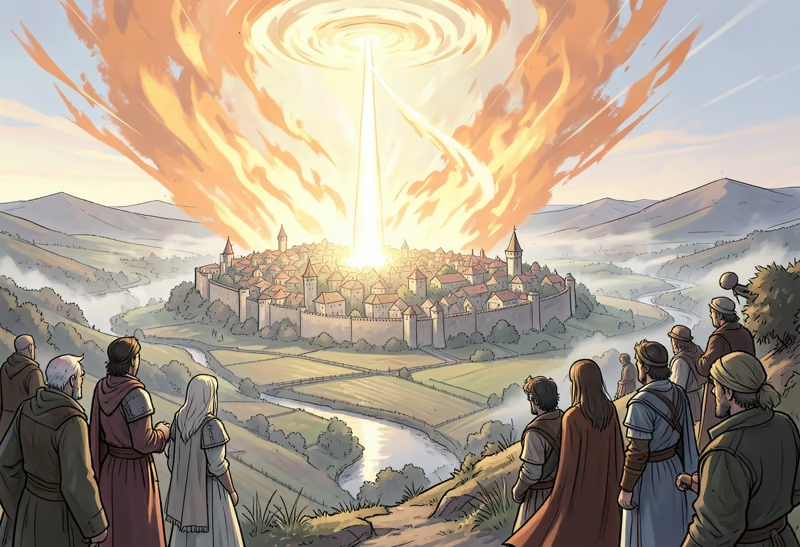
This spell simulates the devastating technological bomb of Earth. Once cast, the spell creates a large (25 feet long, 5 feet in diameter at base), indestructible, magical missile from the mage's concoction (described later) that heads to its target, better known as ground zero. The missile cannot be stopped or manipulated naturally or magically, it always gets to its destination (of course GMs may make exceptions to this rule). Once ground zero is reached, the missile lightly disperses a very strong, somewhat gaseous, magical alcohol that is then ignited causing immense damage and complete loss of oxygen in the area of effect.
The spell's range to ground zero is 1000 feet for every level of the caster. This allows an 18th level mage to center the spell as much as three miles away. This would indicate that the mage is well within enemy borders in most cases when the spell is cast, although he is still a distance from his target.
The area of effect is a sphere with a 200 feet per level of the caster radius. The caster cannot control the area of effect. Thus if the mage is 18th level, he will always cast a FAE that is 7200 feet in diameter. Given that 5280 feet comprise a mile, this is quite a distance. The mage better be decent at judging distance, or he might suddenly find himself inside the area of effect of his own spell.
Damage to the victims comes by two means. The first is the combustion/compression of the explosion which does 10d10 points of damage. Victims get no save because the area of effect is too large and the explosion is the very air around the victim, thus escape is impossible.
The second means of damage stems from the suffocation resulting from the explosion that uses up all the available oxygen in the area of effect. Every round beginning the round the spell is cast, 2d8 damage is taken from lack of oxygen. A victim that has a chance to take a large breath of air and does not perform strenuous exercise while holding his breath and is not fully encumbered can hold his breath for a number of rounds equal to 1/3 his Constitution, rounded up (nonstrenuous exercise includes such activities as normal movement, searching for secret doors, etc.). If a victim is performing strenuous exercise, the number of rounds is cut in half (strenuous exercise includes combat, attempting to subdue or move an uncooperative creature, trying to lift heavy weight, moving at high speed, etc.). If a person does not have a chance to take a deep breath before the spell takes effect, the amount of time is halved (rounded up). This halving is cumulative with that strenuous exercise. Note that anybody can always hold his breath for at least one round.
When his breath runs out, a person does not immediately suffer the 2d8 points of damage caused because of the lack of oxygen. Each round after his breath runs out, the person makes a Constitution check. The first check has no modifiers, but there is a -2 cumulative modifier each round thereafter. A failed check indicates that the victim tries to inhale oxygen, which is not there, and suffers the 2d8 points of damage. He will continue to suffer 2d8 points of damage each round until oxygen diffuses back into the area of effect or he leaves the area of effect or dies.
After detonation of the spell which rids the area of effect of oxygen, the oxygen will diffuse in at 50 feet a round.
The material components of this spell are usually rare, typically expensive, and quite bulky. During casting, the following ingredients are mixed together:
- Ten gallons of pure 200 proof alcohol is required. If there is any trace of impurity before casting, the spell will backfire causing the mage to be the center of the area of effect. Many armies have foiled many mages by sending an assassin to place a foul liquid, such as Skunk Water, in the alcohol thus causing the mage and his comrades to be victims of their own spell.
- One gallon of the highly poisonous blood of a Milwaukee is required. Many adventurers have died trying to kill a Milwaukee just to get its blood.
- One gallon of holy water created by priests of Malus Temulentia.
- A pint of blood from a 9th level priest of Ebrietas.
- All alcohol from a gland of an alcohol dragon is required. This material component is difficult to get because the gland must be filled to get alcohol from it. Thus if the alcohol dragon used its breath weapon, the gland would be empty. Only clever adventurers can kill an alcohol dragon to get the gland without having the dragon use its breath weapon. Note that capturing the alcohol from the breath weapon won't work because the alcohol enters an impure state. The pure state of the alcohol can only be found in a gland.
After the ingredients are blended together, the following items must be added to the concoction:
- One living boozeworm.
- A dash of salt and a squirt of lime.
- The ivory tusks of a Pink Elephant.
- The hide of the sinister Clydesdale breed, Pravus Clydesdale.
- The corpse of one giant alcohol black ant.
- One diamond that has a value no less than 10,000 silver pieces.
The material components are perhaps the biggest problem with the spell for without them the spell can't be cast. GMs should make the material components hard to come by and adventures should be made just for that. In fact collecting the material components, whether by the mage or other adventurers, would be a great way of introducing the alcohol guide to a campaign.
Only very rich people, like kings and other nobles, could afford to purchase some of the more exotic material components. Thus a useful partnership takes place: the ruler needs the wizard for the intense spell, the wizard needs the ruler's resources to collect the components.
This spell is a closely guarded secret by those that are fortunate to possess it. Using FAE offensively is great, but being on the receiving end of the spell is not too fun.
Is this spell too powerful?
An 18 is the minimum level the mage must be to cast this 9th spell. Hopefully, few 18th level mages are roaming around. If a GM allows a PC mage to reach 18th level, one of two points can be assumed. Either the GM has been very careful to create game balance in which case the GM will make this spell very dangerous to cast (via collecting and keeping material components, getting safely to the target area which is no doubt deep in secured enemy territory, etc.). Or the GM is an out of control Monty Haulic in which case it doesn't matter if the spell is too powerful; the argument would be "Is 9th level too high?".