Skarm's Black Redemption
- school
- Necromancy, Enchantment/Charm
- range
- 20 yds.
- components
- V, S
- duration
- Instantaneous
- casting time
- 6
- area
- One creature
- save
- Neg.
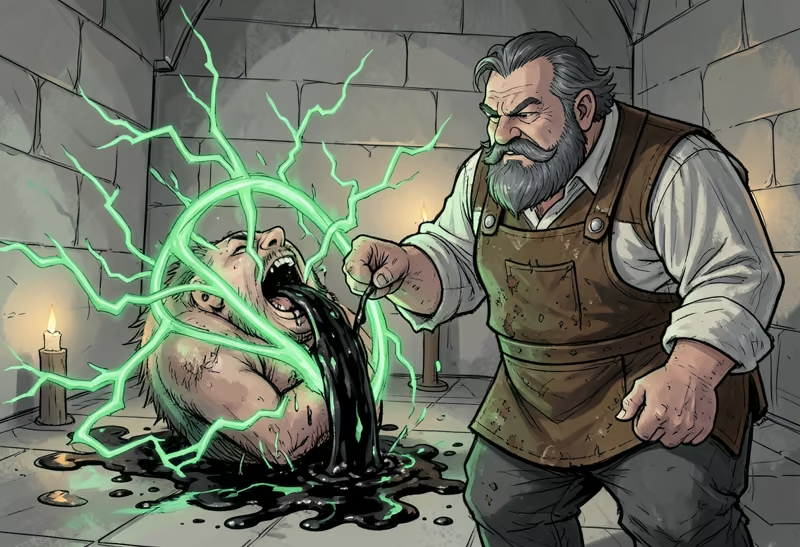
When caster casts this spell the target has to save vs. polymorph, with a –1 penalty for each four levels of the caster. If the target fails its save, it’s paralyzed and wracked by pain and unable to act for 3d3 rounds. During this period, the victim’s body is surrounded with greenish lightnings and anyone touches it takes 1d6 hp due to lightnings. After 1 round, a boiling black goo pours forth from victim’s mouth and nose. How much goo comes forth depends upon the target. In the following rounds, the goo begins to take the same shape of the victim and to solidify. The process is quite horrid, since the building of the body begins from bones and organs and all up to skin and hair! The goo, during the change, is quite dangerous to touch, since the solidifying process requires energy and should someone touch it, that energy’s not drawn from the surrounding land but from the creature touched it. That creature take 2d10 hp. After the paralysis period ends, there are two victim’s bodies. The two bodies are the same in all characteristic and powers, but hp and alignment. Indeed this spell painfully rips the victim’s soul in two, “melts” the evil part in the black goo form and draws it forth; so one body contains the dark and evil part of the target, the other the good one (in game terms, one has Evil alignment, the other Good). Since not everyone has the same shares of good and evil in him, the starting energy share of each body varies from victim to victim (see below).
| Type of Target | % Good | % Evil |
|---|---|---|
| Good-aligned deity (+) | all but 1 hp | 1 hp |
| Good absolute (celestial steward aasimon) | all but 1d3 hp | 1d3 hp |
| Good paragon (warrior aasimon) | 95% | 5% |
| Good extreme (good creature from a good race) | 75% | 25% |
| Good average (average good human) | 65% | 35% |
| Dark good (good with neutral tendencies) * | 60% | 40% |
| Enlightened neutral (neutral with good tendencies) * | 55% | 45% |
| Neutral absolute * | 50% | 50% |
| Dark neutral (neutral with evil tendencies) * | 45% | 55% |
| Enlightened evil (evil with neutral tendencies) * | 40% | 60% |
| Evil average (average evil human) | 35% | 65% |
| Evil extreme (evil creature from an evil race) | 25% | 75% |
| Evil paragon (lesser/least tanar’ri or baatezu) | 5% | 95% |
| Evil absolute (true tanar’ri, greater baatezu/tanar’ri) | 1d3 hp | all but 1d3 hp |
| Evil-aligned deity (+) | 1 hp | all but 1 hp |
(+) = Should be noted that a deity which has Good or Evil as their portfolio or area of influence, would have 0 hp in the opposite alignment. This 0 hp doesn’t mean the body’s dead, for natural healing can bring it to positive hp.
(*) = These are shades which can be chosen by Dm. Note that a extremely evil could go down in this table below its race typical level and an extremely good one could go up above that. Average “shade” range is of 1 step. Obviously the Dm can rule a creature a lot much more good that its race average or a lot more evil!
After the hp are shared, the two bodies can only heal naturally, since the “damage” is done to their souls, but they can heal up to victim’s full hps.
The reversed form of this spell, Skarm’s Soul Blend, is cast on two creatures, but caster has to touch both in that round (the spell itself allow two him touch “attacks”). The two creatures are paralyzed by pain and unable to move for 3d3 rounds. Their bodies are surrounded by blue lightnings (which work in the same way as per Skarm’s Black Redemption ). A grey goo, sparkling with multicolored lights, comes forth from the weaker (lower hp) creature’s mouth and goes into the stronger one’s mouth (higher hp). Then result creature’s alignment is found out : Sum up victims’ hp, find weaker victim hp’s percentage in it, look for the alignments’ share in the weaker one and the percentage (round up) of the most preeminent alignment minus the percentage of the least preeminent is the percentage to add to the stronger one’s alignment. Then only the stronger one’s hp remain and unchanged alignment is adjusted in order to have a 100 % percentage. Should someone touch the victim 1d4 rounds after paralysis ends, he’d be healed for weaker victim’s hp and would take the percentage of weaker victim’s transferred least preeminent alignment. The hollow body disappear when the transfer ends.
For example, Rulah meets a goblin (6 hp; LE) and a mercenary (8 hp; NG) and casts Skarm’s Soul Blend on them. Goblin is evil extreme (25% G, 75% E) and the mercenary is good average (65% G, 35% E), but goblin’s only 43 % of the sum of hp. So only 32% E is added to mercenary’s 35% E, for a total of 67% E (and automatically G shifts to 33%)...a little more evil than evil average! Then, after 3 rounds, a wounded bandit ( 2 hp, CE) touches the mercenary and is healed of 6 hp up to his full hp (6 hp), but takes even a 11% (25% x 43% = 11%) of G.