Zeet
| Statistic | Value |
|---|---|
| Climate/Terrain | Any land |
| Frequency | Uncommon |
| Organization | Clan |
| Activity Cycle | Any |
| Diet | Omnivore |
| Intelligence | Average to High (8-14) |
| Treasure | J, O |
| Alignment | Chaotic Neutral |
| No. Appearing | 5-20 (5d4) |
| Armor Class | 7 (10) |
| Movement | 6 |
| Hit Dice | 1 |
| THAC0 | 20 |
| No. of Attacks | 1 |
| Damage/Attack | 1-4 or by weapon |
| Special Attacks | nil |
| Special Defenses | immune to mind-affecting spells |
| Magic Resistance | 15% |
| Size | S (3' to 3 ½' tall) |
| Morale | Average (8-10) |
| XP Value | 120 |
Description
Zeets are a mischievous race of short humanoids who delight in causing trouble for others of their own race and, more often, for members of other races. Most other races tolerate zeets. They tend to be less bothersome to halflings than they are to the taller races.
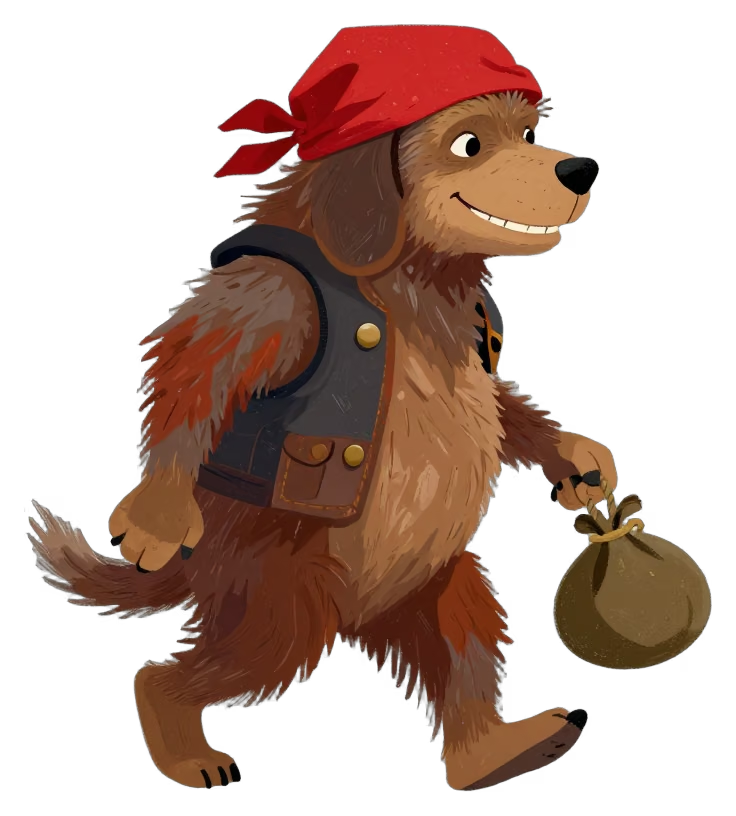
Averaging a little over 3' in height, zeets mostly resemble short, hairy halflings with dog-like heads. They walk upright, but their bodies are covered in short, brown, red, and gray fur, the colors generally in no discernable pattern. On each hand, a zeet has three fingers and an opposable thumb. They typically wear colorful, leather clothes, often tying colored bandannas around their heads. Zeets speak their own language, and most of them speak the common tongue.
Combat
Zeets prefer to avoid combat at all costs. If they can’t avoid it, then they prefer to let someone else fight for them. When forced to combat, they often use slings, daggers, spears, and nets. Weaponless, they can bite their opponents, doing 1d4 damage. When pursued, they often lead opponents into elaborate traps, which sometimes backfire on the zeets. Generally designed only to capture opponents, these traps usually turn out to be deadly for both the victim and the trappers.
In their homes, zeets will be armed with studded clubs, short swords, and axes in addition to their usual items. Occasionally, these items are magical, having been purloined from others.
Zeets have infravision up to 30’ and sharp senses of hearing and smell. Zeets are afraid of and will not ride or come near horses. They delight in capturing, tormenting, and eating cats.
Habitat/Society
Zeets usually live in well-kept caves and small, wooden hovels, with three or four families in each. A group of ten to twelve such residences forms a small town of zeets, and this is about as large as any group of zeets gets. Family membership only marginally depends on a zeet’s parents, and often traveling zeets are adopted as family members if they choose to stay in a town. Each zeet family typically keeps up to five dogs as pets.
Zeets are quick-tempered and easily insulted. They enjoy telling stories of their adventures, particularly over several rounds of ale. True to their alignment, they are unpredictable in the extreme. Zeets have been known to attack an audience for laughing at a funny story they themselves had just told.
Infant zeets look like newborn halflings, but within ten days of birth, they develop the fur and canine facial features of adult zeets. Zeets usually mature in 12-15 years, and they can live as long as 140 years. A few (1 in 15) zeets will develop solid-colored coats; such zeets are treated with suspicion by their society and families and set out on their own. Solid-colored zeets are typically antagonistic toward other solid-colored zeets of any color.
Other than infrequently encountered priests, zeets tend not to be very devout in their beliefs about the universe and existence. Most of them believe the world is composed of seven elements—air, earth, fire, water, magic, life, and thought. Zeet priests are all devoted to one or two of these elements. Many of the outcast solid-colored zeets take up the raiment of one or more of these elemental forces, although doing so makes them no more acceptable to other zeets and, in fact, makes them more hated by other zeet priests who believe having solid-colored priests blemishes the reputation of priesthoods in general.
Ecology
Zeets have no natural enemies. However, they do have an incredible knack for getting on others’ nerves, particularly humans and dwarves. Halflings find the zeets more tolerable than most; there is some speculation that halflings and zeets share an evolutionary origin.
While they cannot cast spells and their magic resistance makes using magic items unreliable, zeets are fascinated by magic and spell-casters. They typically will try to take magic items, spellbooks, spell components, or anything else magic-related out of curiosity. Their convoluted thought processes make them immune to mind-affecting magic and psionics; no zeet has ever exhibited a psionic talent.
Also in this section of the source
Legends & Lore
Tybboch (Intermediate Power)
By Erik Arneson, with additions by Robert Barton
| Statistic | Value |
|---|---|
| Alignment | Neutral evil |
| WAL | Chaotic evil or neutral evil |
| Area of Control | Disease, Decay |
| Symbol | A black rat's head with glowing, yellow eyes |
| Aliases | Lord of Decay, King of Plague, Flesheater, Rotseer. |
Few evil gods are more feared by the common people. Gods of darkness and malevolence may haunt children's tales, while deities of corruption and avarice may fill priestly sermons, but all of those evils seem distant and abstract compared to the stark, grim reality of pestilence and plague. Tybboch's name rarely touches anyone's tongue, and it is considered an ill omen for the Lord of Decay to be spoken of by a guest in one's house.
Tybboch resides somewhere in the many layers of the Abyss. He stays far away from the Blood War that racks much of the lower planes. When last seen by mortal eyes, Tybboch was in the form of a greenish-yellow cloud, with hundreds of small, glowing eyes floating within. This description has never been confirmed, and the originator died of a rotting disease not long after telling his tale. When he appears to his priests, which is only in their restless dreams, he is most often seen as a chaotic pile of rats. If Tybboch favors a priest, he may appear as a desiccated corpse with glowing, yellow eyes.
Tybboch's worshipers are always stricken with a strange, wasting disease, which slowly eats away at both the physical and mental health of its victims. The worshipers often congregate in groups of five to ten around a main priest.
It is unknown if Tybboch has an avatar.
Duties of the Priesthood
| Statistic | Value |
|---|---|
| Ability Scores | Wisdom 9 |
| Alignment | Neutral evil |
| Weapons Allowed | Scourge, scythe, sickle, sling, whip |
| Armor Allowed | Any non-magical armor, any non-magical shield (seems to decay and rust faster than normal) |
| Major Spheres | All, animal, healing (reversed only), summoning, weather |
| Minor Spheres | Combat, divination, necromancy (reversed only), protection (reversed only, where applicable) |
| Powers | Spread disease (see below) |
| Turn Undead | Command |
Priests of Tybboch are often naturally malicious and mostly insane men whose minds have been further tainted by the god's cursed touch. When they first don their priestly vestments, a wasting disease begins to eat away at the priest's body. This disease causes a priest to die slowly, and he may lose a point of Constitution every new level attained. When a priest reaches a new level, he must make a system shock roll or lose 1 point of Constitution. Once the priest reaches 0 Constitution, if he is at least 12th level, there is a chance Tybboch will take special note of the priest and raise him to an exalted status as a Mordulant. Otherwise, the priest will simply pass away in a very painful, very unpleasant manner as the disease finishes eating his body.
Because of the priest's closeness to Tybboch's spheres of influence, his personal effects and items left near him for long periods of time will decay and decompose faster than normal. While there are no game mechanics surrounding this effect, it makes a chilling addition to a setting and often aids in tracking and destroying these loathsome individuals.
Priests of Tybboch tend to be nomads until they find a town were they can preach their particular form of gospel. They tend to like isolated towns with small populations. They gravitate toward towns that have just ended a plague or pestilence. They feel they are “delivering those whom should be with Tybboch back into the fold. I am walking in my master’s footsteps, and I am reclaiming what is rightfully His. I walk His path and shall find him after my hard day is done.” If a priest of Tybboch comes upon a town in this situation, he feels it is his duty to “finish what his master started.” Few towns in this situation survive.
In communities where a priest of Tybboch has set up an altar, there is a higher chance of the community attracting some sort of plague or pestilence. This chance is two percent per week, cumulative. The percentage chance continues to grow unless the priest is absent for a week or more. For every week the priest is absent from the community, the chance decreases by four percent. When and if the priest returns, the percentage chance resumes its growth at two percent per week.
Priests of Tybboch are almost universally male, although a few females have been reported from time to time. Their vestments usually consist of forest green robes with bright yellow stoles, often reduced to rot and tatters from being in the priest's presence for so long. A priest's holy symbol is usually a flat black, rat head pendant carved from onyx or obsidian, inset with precious stones for the eyes.
There are few churches or temples set up in honor of Tybboch. Almost all priests just set up small altars in town. These are usually in rundown or abandoned buildings or shacks. Most priests, knowing their time with these people will be short, prefer not to waste time erecting buildings for their cause.
There is no formal church hierarchy for the church of Tybboch. Few priest talk to or cooperate with one another and then only if they face a powerful enemy, and this cooperation will fall apart if one of the priests sees a possibility to gain from the other’s demise. Priests of Tybboch often plot against each other for the right to be Tybboch’s chosen.
There are no holy days in the worship of Tybboch. All ceremonies are held on moonless nights, with only the priest and his most trusted disciples in attendance. This is done because they are the only people who truly understand and accept what must be done. Most ceremonies are to praise Tybboch and to ask for his “slow and creeping gift.” Rats are sacrificed as the “chosen animal and carrier of The Gift.” The bodies of any sacrifices are never burned or removed from the ceremony chamber. They are often left lying chaotically around the room.
Roleplaying Notes
Priests of Tybboch use fear as their first defense, using threats and curses to spur people on. They will never be the first into combat. Disloyal villages will be goaded into attacking and fighting first. The loyal followers will be urged to fight next. Priests will use their magic in support of the loyal people who fight for them. They will resort to melee combat only if forced to. This does not necessarily mean they are weak or ill-prepared for combat. They will throw themselves madly at any who face them. Whether directly in combat or not, they will try to infect all who face them with disease.