Uthbor
| Statistic | Value |
|---|---|
| Climate/Terrain | Forest or mountain |
| Frequency | Rare |
| Organization | Solitary |
| Activity Cycle | Any, though usually day |
| Diet | Primarily carnivore |
| Intelligence | Low (5-7) |
| Treasure | Nil |
| Alignment | Chaotic evil |
| No. Appearing | 1 |
| Armor Class | 0 |
| Movement | 14 |
| Hit Dice | 16 |
| THAC0 | 6 |
| No. of Attacks | 3 or 4 |
| Damage/Attack | 2d6/2d6/3d8, 3d6+12/3d4/3d4, or 2d6/2d6/3d4/3d4 |
| Special Attacks | See below |
| Special Defenses | See below |
| Magic Resistance | Nil |
| Size | H (14’ tall) |
| Morale | Fanatic (17-18) |
| XP Value | 10,000 |
Description
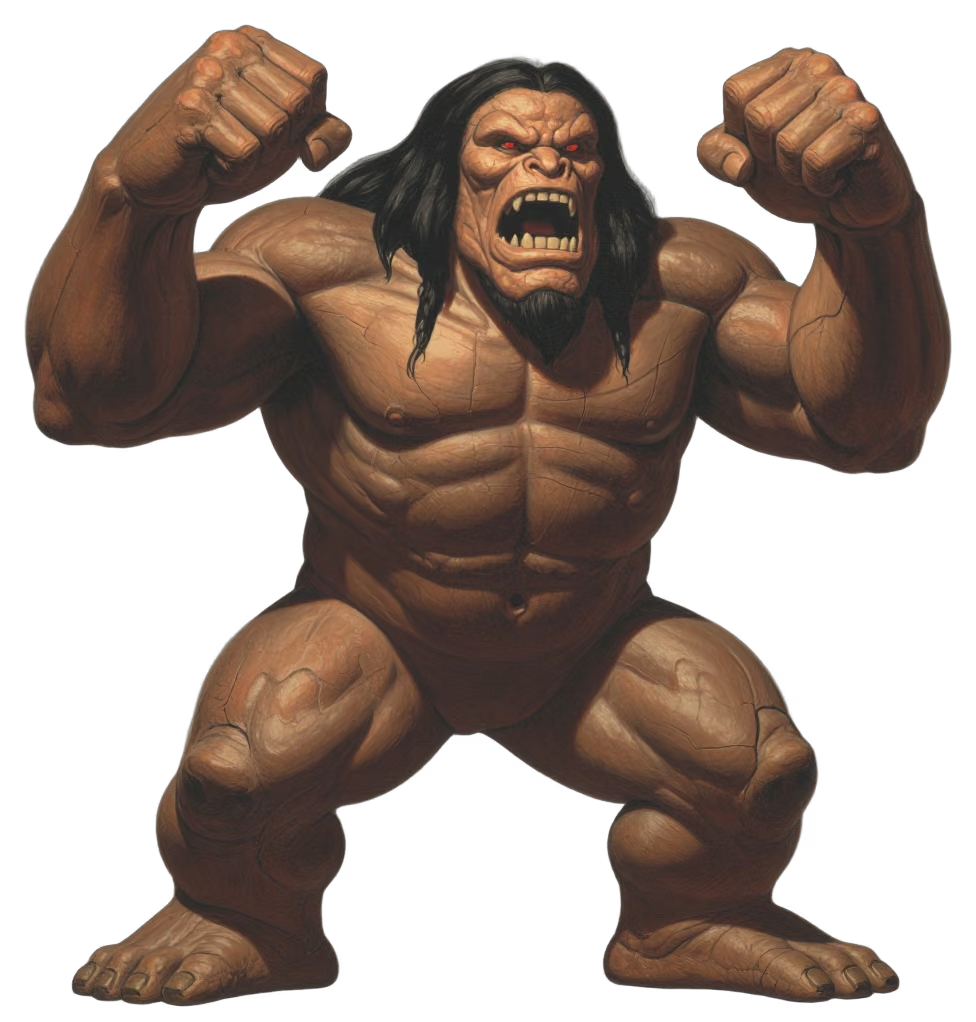
Uthbori are massive, hideous creatures to behold. They stand 14’ tall or taller, with bodily girths of nearly the same width. Their faces are horrible masks of perpetual rage, with cheekbones that jut out, leaving red eyes sunken deep under protruding eyebrow ridges. Their jaws are wider than the rest of the face and hold mouths capable of fitting around the heads of most creatures of large or smaller size, with thick, flat teeth strong enough to grind stone into powder.
Uthbori hides are thick, usually range in color from light to dark brown, and appear course and cracked like dry leather, even on their faces. Lying beneath those hides are muscles as dense as rock, and their massively powerful hands are capable of ripping apart stone as easily as a human may tear a piece of dry parchment. Thick mats of long, brown or black, greasy hair hang from the backs of their heads and from their chins, though the hair on the chin is more sparse and straggly. An uthbori smells as bad as it looks. Also, uthbori appear to have no gender at all.
Combat
When an uthbor sees a victim, it will attack immediately with a loud, booming cry that can be heard for up to a mile away, alerting all around that an uthbor is attacking. It attacks with both hands, trying to beat its prey to death or grabs the victim in a crushing grip so it can bite its victim’s head with its powerful jaws. An uthbor attacks with both fists in a round, doing 2d6 points of damage with each. If it successfully strikes a target with both fists, it has grabbed its victim and will deliver a bite for an additional 3d8 points of damage. A victim so grabbed must have a strength of at least 24 to even attempt to break free, but there is a 30% chance the uthbor will drop the victim in favor of attacking another if there are more attackers around.
An uthbor is easily enraged, and there is a 10% cumulative chance each round after the first round of melee that the uthbor will go berserk. When this happens, the uthbor will uproot the nearest tree to use as a makeshift club. It will attack with the club for 3d6+12 (due to Strength) points of damage and with crushing stomps of its massive feet, which deliver 3d4 points of damage each. If there is no tree in the area for the uthbor to uproot when it goes berserk, it will attack with both fists (2d6/2d6) and both foot stomps (3d4/3d4) each round. When an uthbor is berserk, it can attack multiple opponents in a round, dividing its attacks among as many as three or four opponents at once.
An uthbor’s hide is thick and incredibly dense, giving it a natural AC score of 0. In addition, the uthbor’s hide resists 3 hit points of damage per hit die directed against it from weapons, meaning small weapons, such as daggers, are virtually ineffective against it. Also, offensive spells which do physical damage have only a 50% chance of harming an uthbor and then do only half damage, which is even further subject to a saving throw. This protection includes resistance to magic missile, fireball, lightning, cone of cold, and any other physically damaging spell.
In addition to their powerful combat abilities, uthbori have other abilities that make them dangerous foes. Due to their heightened senses of hearing and smell, uthbori are surprised only on a roll of one, as they will generally be alerted to trespassers in their homes within a radius of 100 feet. They can track their prey unerringly and will track relentlessly, requiring that the victim must flee far outside an uthbor’s home territory or must kill the uthbor in order to escape from it. Also, uthbori have infravision which allows them to see up to 60 feet in the dark.
Habitat/Society
Uthbori are solitary creatures, attacking all they encounter, even their own kind. They wreak havoc on the environs they pass through, destroying vegetation, rock, and any other obstacles in the pursuit of their prey. Generally, an uthbor will be encountered during its feeding time, which lasts the entire day, except for a few hours of sleep. They live in secluded caves at the bases of nearby mountain ranges where there are dense woodlands. Usually, only one uthbor will be found within a 50-mile radius due to their wide ranging habits and their tendency to attack and kill other uthbori they encounter.
The mating habits of the uthbori are a complete mystery. If they do mate, it would likely be a short exchange between the male and female, if they are even delineated in such a way (the gender of an uthbor is not obvious by its appearance), and it’s quite likely any offspring would be abandoned to fend for itself at a very early age. The life span of an uthbor is unknown, and it is possible they live for tens, hundreds, or even thousands of years.
Ecology
Uthbori have ravenous appetites because of their immense size. Generally, they are carnivores, but their teeth are powerful enough to grind almost any substance, and many sages have speculated that uthbori may eat nearly any substance, even rocks, for their nourishment. An uthbor will eat its entire victim, bones, armor, and all. If it misses something, such as a dropped weapon, the item is always left right where the uthbor fed, thus there will be no treasure to find in an uthbor lair.
Legend of the Uthbori
There is an ancient legend of interest regarding these violent, solitary creatures. The legend—from where it was originally handed down no one knows—suggests the uthbori were once a race of large dwarves, though the creatures can hardly be said to resemble any known race of dwarf, who used to reside in the heavens among the gods and giants. The uthbori spent most of their time working, building both the heavens and the worlds, and grew bitter in their solitary labors. Due to their diligent work while the gods and giants grew fat and lazy in their posh castles, the uthbori grew strong. Always hot-tempered, they one day decided to rise up against the gods and rule the heavens themselves.
The uthbori wreaked great havoc in the heavens, sundering the homes of the gods, and in the end, only the mighty titans were strong enough to stop them. It is said that, though defeated, the uthbori were not broken, and the gods could see the promise of retribution remaining in their eyes. So, to protect themselves and their precious realm, the gods cursed the uthbori, casting them down from the heavens and stripping from them their ability to communicate with any creature, including each other, and making their visages so hideous they would repulse even their own kind. This, the gods thought, would ensure the uthbori would never again be able to come together as a group to challenge the might of the heavens.
What the legend also suggests is that the uthbori are more intelligent than they seem, and one day they will come together to once again rise to power. There will come, the legend says, an uthbor whose strength is unmatched even by its own kind, and it will be strong enough to subdue its brethren, lead them with an iron hand, and give them back the ability to communicate with one another. At that time, the uthbori will rise again to march upon the heavens, and this time the battle will shake both heaven and earth. It is said even the gods fear this day.