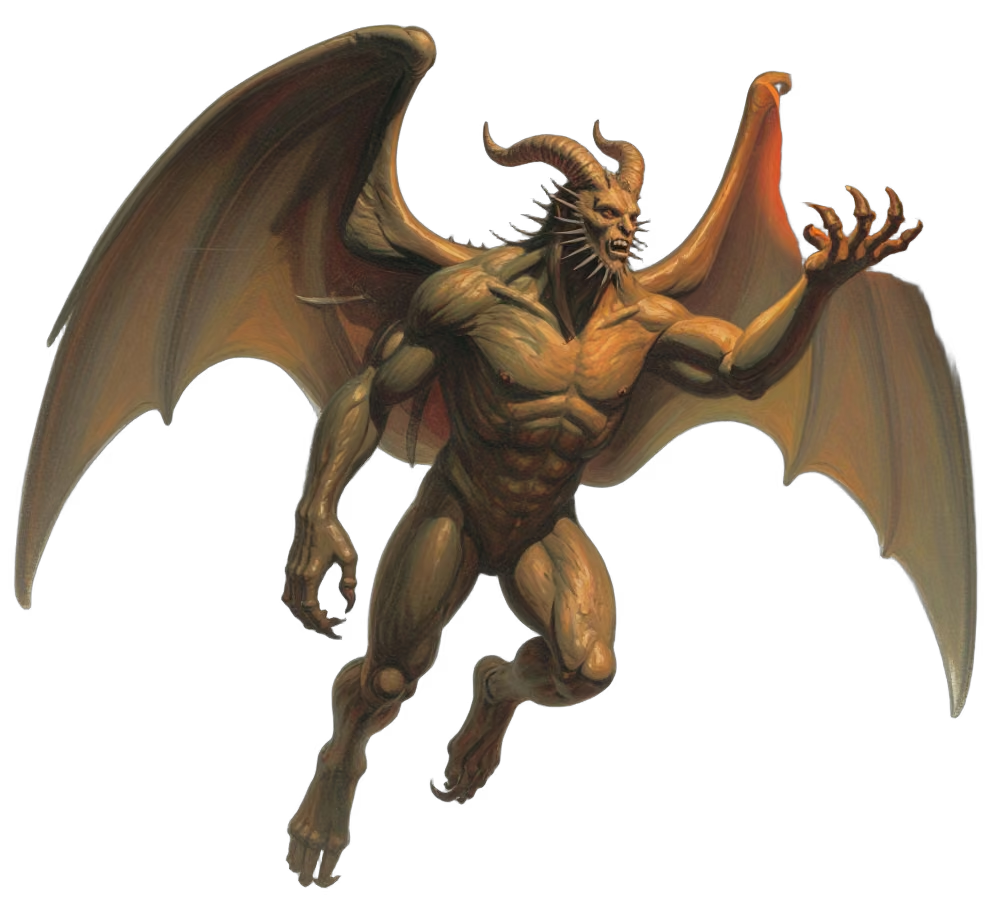
Donlor
| Statistic | Value |
|---|---|
| Climate/Terrain | Temperate Forests |
| Frequency | Rare |
| Organization | Tribal |
| Activity Cycle | Day |
| Diet | Carnivore |
| Intelligence | High (13-14) |
| Treasure | In Lair: 50% H, 25% I; On Donlor: 50% Y; 10% Z |
| Alignment | Neutral Evil |
| No. Appearing | 10-100 |
| Armor Class | 3 |
| Movement | Fl (B) 24 |
| Hit Dice | 11+5 |
| THAC0 | 8 |
| No. of Attacks | 2 |
| Damage/Attack | 3-30/3-30 |
| Special Attacks | Magic |
| Special Defenses | Hit only by magical or silver weapons |
| Magic Resistance | All clerical spells |
| Size | L (7’-8’) |
| Morale | Fearless (19-20) |
| XP Value | 12,000 |
Description
The donlor are a race of flying monsters with brown or green hides, horned faces, and long fingers. These creatures have wingspans of 8 feet. Generally humanoid in appearance, donlor have short arms and legs compared to their long, muscled torsos. At the end of their long arms, their hirsute hands lead to sharp, strong claws. They have two main horns on top of their heads, resembling those of a minotaur. Their faces are particularly gruesome, as they are covered with short, sharp, dark-colored protrusions with no apparent pattern or purpose. Rarely, a donlor that has taken damage to its head in battle may be missing some of its facial protrusions, but these will grow back within 3-6 months. When they do stand, they stand crouched over, almost on all fours.
Donlor speak only a language native to all donlor, and they see no reason to learn how to communicate in the languages of creatures they consider to be lesser beings.
Combat
Donlor generally attack with their finger claws, an attack that causes serious wounds because of the creatures’ strength and agility. They prefer to attack from the sky, as they are stealthy fliers; however, when the need arises, they are prepared to attack from the ground.
The donlor will almost always begin battle with a spell, usually fireball or stinking cloud. They cast wizard spells at 5th level proficiency and usually have four 1st level, two 2nd level, and one 3rd level spell memorized. Spells most commonly available to donlor are burning hands, charm person, detect magic, magic missile, phantasmal force, sleep, fog cloud, invisibility, Melf’s acid arrow, stinking cloud, fireball, flame arrow, fly, and Melf’s minute meteors.
Donlor are immune to the effects of any priest spell which targets them, so long as that spell is cast by a non-divine being. Additionally, donlor possess keen senses of hearing and smell, so they receive a +1 on their surprise rolls. Donlor tend to be excellent strategists, and they will use their cunning to gain the advantage in any encounter.
Habitat/Society
Donlor live in a nomadic, tribal society, possessing neither an administrative nor a religious leader. They travel the woods while improvised hunting parties seek out food for the rest of the tribe. When necessary, donlor hold councils to decide major events in the tribe. Such events include when and in what direction the tribe should move next, dealing with outside threats, and monitoring trade. The entire tribe attends the council, and any member of the tribe may call a meeting of the council.
Trade is a rare activity among the donlor, and it takes place only among donlor tribes, never with outsiders. While there have been disagreements over territory between donlor tribes, these have never progressed to war. Nonetheless, combat is an integral part of a donlor’s life, as it is the primary means by which the donlors remind the demi-human and humanoid races that the donlors are superior, and by which they check the powers of their most hated enemies, the dragons. The sighting of a dragon is sufficient reason for a donlor tribe to move in combat, and adult donlor are well versed in tactics designed to defeat these great beasts. The most common demi-human enemies of the donlor are sylvan elves and centaurs, who often compete for the same forested areas desired by the donlor.
The donlor do not use money for commerce. When they do not have a necessary item, they either make it or barter with another donlor tribe for the item. They hold councils to decide when to hunt for food, and when food is brought back to the tribe, it is shared with all tribe members equitably. Each donlor considers the next donlor an equal, but all other creatures are disdainfully regarded as tishbars (inferiors).
Little more is known of the donlor’s tribal society, as attempts to study them usually result in the death of the researcher. Donlor scouts will viciously attack any tishbar who comes within a 3-mile radius of the tribe’s current encampment.
Ecology
Donlors usually hunt in small (10-20) hunting parties. When they discover a beast of considerable mass, they plan an attack and then carry it through with great precision. Donlor hunting parties have been known to attack adult dragons, although more frequently they will return to the tribe to call for a full attack on such creatures.
The donlor do not appear to be native to the Prime Material Plane, although knowledge about their origin remains nothing more than speculation, nor do researchers have any idea why the donlor feel such enmity toward dragons.
Also in this section of the source
Dragon-Kin, Itarasaur
By Howard Shaw
The itarasaur are a race of creatures distantly related to dragons. They exhibit a range of features that appear to place them evolutionarily somewhere between reptiles and birds. They are uniformly endomorphic (warm-blooded).
Itarasaur societies center around their religion and military, which are closely intertwined. Each army is a separate society. The defining characteristic of the itarasaur is their complete dependence on law and order. When specifically following orders, itarasaur have unswerving (25) morale. If an itarasaur can avoid death without violating its orders, it will do so, but no itarasaur ever places its own life ahead of its orders.
Itarasaurs commonly serve as armies for powerful dragons. The bulk of such troops are subasits. They are intelligent and can undertake complex tasks, and they allow nothing to prevent them from executing their orders. A second subspecies of itarasaur, imquasits act in two military capacities. Some are officers, leading troops of subasits, while others form elite troops. Morally, the imquasits cover the full range of good and evil, but they never stray from strict adherence to their orders. Elite troops are normally formed of like-aligned persons, allowing the commanders free choice in the degree and manner of the impression they wish to accompany completion of a task. The dentrasits are an elite corps of fighting priests of similar rank to the imquasits. They also accompany other troops of both types as combatants and healers with the purposes of counteracting the enemy's magic and preventing damage or healing wounded itarasaurs. The tulmasits are the clerics who form the backbone of the itarasaur religion, and they act as generals over groups of the three lower castes. A few tulmasits are wizards instead of priests. The retilasits are the smallest of the itarasaur, both in number and in size. They are the most maneuverable, however, and they often act as the scouts of the army. Each retilasit has a strong bond to the particular tulmasit to whom it answers.
The itarasaur disdain most other races, considering them weak and disorganized. They do not willingly discuss their lives or religion; thus, little is known of their god. It is known that their god views dragons and the itarasaur as part of nature, and that it expects the actions and wars of the itarasaur to respect nature. It has been postulated by some sages that the god of the itarasaur might have created them to act as intermediaries in the dragon wars to prevent the immense destruction of natural resources that so often accompanies the battles between dragons. The itarasaur clearly view dragons as closer to their god than they are themselves, and they accept even chaotic dragons without qualm, perhaps because they are not within the hierarchy. As there is no being over the dragon to give it orders, they can accept from it what they would not accept in one of their own.
History
There are legends that indicate the tulmasits were the first itarasaur, created by an ancient dragon. The dragon, according to the legend, destroyed the minds of two dragons, a red male and a gold female, and through powerful magic transformed them into the first tulmasits. For a century (or several millennia, depending on which version you hear), they existed in the new forms before he allowed them to mate. By this time, the form was set. The new tulmasits regained their intelligence and later created the other itarasaur from their descendents. Outside sources have been unable to determine how much of this legend is accurate.
Dragon-Kin, Itarasaur (Dentrasit)
By Howard Shaw
| Statistic | Value |
|---|---|
| Climate/Terrain | Any |
| Frequency | Uncommon |
| Organization | Military |
| Activity Cycle | Any |
| Diet | Carnivore |
| Intelligence | High to Exceptional (13-16) |
| Treasure | By individual |
| Alignment | Any Lawful |
| No. Appearing | 2-5 |
| Armor Class | 8 |
| Movement | 14, Fl 20(C) |
| Hit Dice | 6 |
| THAC0 | 15 |
| No. of Attacks | 3 or 1 |
| Damage/Attack | 1d6/1d6/1d4 or by weapon |
| Special Attacks | Poison |
| Special Defenses | Immune to Dragon Fear, Chameleon |
| Magic Resistance | 45% |
| Size | M (4’5” to 5’5”) |
| Morale | Champion (15) |
| XP Value | 2,000 |
Standing slightly shorter than imquasits, dentrasits are humanoids with scaled skin, claws, and a balancing tail. They have large, leathery wings. Their scales and wings are pigmented in the manner of a chameleon, and when still or moving at no more than one fourth their normal movement rate, they are very difficult to detect.
Combat
Most dentrasits prefer to avoid close combat and to use their spells. However, all dentrasits are capable fighters. They fight either with a weapon or, if disarmed, with claws and spells. Their bite is used only when absolutely necessary because it cannot be used again for 12 hours. Unlike other itarasaur, dentrasits possess fangs and poison glands, and their bite will put a human-sized creature to sleep for one hour.
Dentrasits possess a chameleon-like ability to conceal themselves when in natural surroundings. While still or moving at less that one-fourth their normal movement rate, they are virtually undetectable; any character making a successful Intelligence check or declaring a specific attempt to look for dentrasits has only a 1 in 10 chance of seeing one which is trying to conceal itself. If the character observes a moving dentrasit that stops and attempts to conceal itself, the character must make an intelligence check to be able to remain aware of the creature's location.
Habitat/Society
Dentrasits take life-mates, and if an opportunity arises to revenge a killed mate, they will disobey orders to do so. This is the only situation where orders are disobeyed, and it is treated with leniency by their superiors. Dentrasit females gestate for ten weeks before giving birth to a living but incompletely developed young. The young dentrasit is taken and cared for by the tulmasits.
Ecology
Dentrasits have more refined tastes than subasits or imquasits. They like well-prepared food, and they will willingly trade for spices they do not possess. Dentrasits will often possess gold or gems for trading purposes. They tend to be very nature-conscious, and generally they will prevent imquasit from damaging the natural balance. Even evil-aligned dentrasits are protective of the natural environment, for they fear not being so will anger their god. A small number of good-aligned dentrasits are rangers instead of priests.
Dragon-Kin, Itarasaur (Imquasit)
By Howard Shaw
| Statistic | Value |
|---|---|
| Climate/Terrain | Any |
| Frequency | Uncommon |
| Organization | Military |
| Activity Cycle | Any |
| Diet | Carnivore |
| Intelligence | Average to Exceptional (10-16) |
| Treasure | By individual |
| Alignment | Any Lawful |
| No. Appearing | 1-3 |
| Armor Class | 5 |
| Movement | 12, Fl 18(C) |
| Hit Dice | 4 |
| THAC0 | 15 |
| No. of Attacks | 3 or 2 or 1 |
| Damage/Attack | 1d6/1d6/1d4 or 1d8/1d8 or by weapon |
| Special Attacks | Poison |
| Special Defenses | Immune to Dragon Fear |
| Magic Resistance | 15% |
| Size | M (5’ to 6’5”) |
| Morale | Champion (15) |
| XP Value | 650 |
Imquasits are humanoids with red scales, strong claws, and a balancing tail. They have large, black wings, and the scales on their wings resemble the scales of subasits. On the back of an imquasit's hands is a spike formed of three scales that extend beyond the knuckles. Imquasits are typically encountered as field commanders supervising large units of subasits.
Combat
The majority of imquasits specialize in at least one weapon. They fight with a weapon or, if disarmed, with claws and spikes. Their bite is used whenever they see a good chance to hit bare flesh. The relatively minor damage is secondary to the 75% chance that the bitten individual will be slowed by the poisonous saliva as if hit by the wizard spell slow. Like subasits, imquasits possess infravision up to 60‘. In addition, their forked tongues give them a 75% chance to track prey by smell. They cannot make use of this ability while flying.
Imquasits are skilled tacticians. Most of them are Lawful Neutral or Lawful Evil in alignment, and they frequently make use of lethal traps and poisons. Traps set by evil or neutral imquasit are likely to include pitfalls, nets, snares, and poisons, with ambush either from above or from subasits hidden in pits.
Habitat/Society
Many imquasits participate in long-term relationships. Like the subasits, their gestation period is only three weeks, and the resulting egg is cared for by the tulmasits; however, the relationships of the imquasit are more likely to involve love or mutual advantage, and imquasits mate less frequently than subasits.
Ecology
Imquasits have a taste for raw flesh, and evil or neutral imquasits will often pause to cut a delicacy from a freshly killed body, if doing so is unlikely to affect the outcome of a battle. When hunting, imquasits prefer to use their physical abilities to locate and kill their prey, disdaining the use of weapons. Evil or neutral imquasits may use traps for hunting. Although evil or neutral imquasits have no concern for the environment, they are generally under orders from the dentrasits or tulmasits to avoid disrupting the environment, and they will therefore remove any traps they have set before moving out of a region. Like subasits, imquasits do not build permanent settlements or structures.
Dragon-Kin, Itarasaur (Retilasit)
By Howard Shaw
| Statistic | Value |
|---|---|
| Climate/Terrain | Any |
| Frequency | Rare |
| Organization | Military |
| Activity Cycle | Any |
| Diet | Carnivore |
| Intelligence | Average (8-10) |
| Treasure | None |
| Alignment | Any Lawful |
| No. Appearing | 1 |
| Armor Class | 0 |
| Movement | 18, Fl 24(A) |
| Hit Dice | 4 |
| THAC0 | 20 |
| No. of Attacks | 3 |
| Damage/Attack | 1d4/1d4/1d4 |
| Special Attacks | Acid Spit |
| Special Defenses | Immune to Dragon Fear |
| Magic Resistance | 85% |
| Size | Tiny (1’5”-2’5”) |
| Morale | Average (8-10) |
| XP Value | 975 |
The smallest of the itarasaurs, retilasits are tiny humanoids with dull, gray-scaled skin, weak claws, and short tails. They have dull, gray, leathery wings.
Combat
Retilasits fight only if there is no other method of escape. If captured and unable to fight, their hearts stop beating and their diaphragms still. Death follows within three rounds. This is an unlikely occurrence, because retilasits have the innate ability to cause creatures to forget having seen them. It is not known if this ability has a magical, natural, or psionic basis. Any creature having natural resistance to mind-affecting magic or strong psionic ability can save vs. spell to negate the effect.
Retilasits also possess an effective spitting ability. They can spit up to 25 feet with only a 10% chance of missing, doing 2-8 points of acid damage. Retilasits have infravision to 120 feet.
Habitat/Society
Retilasits act as the scouts for the tulmasits. The tulmasit commander and his or her five highest generals each have a retilasit under his or her control. In addition, the Gray Masters (see tulmasit description below) collectively control three retilasits. There are never more than 9 retilasits in a given itarasaur society.
Ecology
Retilasits catch and eat small mammals, reptiles, and birds. They eat them whole, and cough up a pellet composed of the indigestible portions. No one is sure how retilasits reproduce, but their number generally remains constant within each itarasaur society. When one is destroyed, another soon appears to replace it.
Dragon-Kin, Itarasaur (Subasit)
By Howard Shaw
| Statistic | Value |
|---|---|
| Climate/Terrain | Any |
| Frequency | Uncommon |
| Organization | Military |
| Activity Cycle | Any |
| Diet | Carnivore |
| Intelligence | Average to High (10-13) |
| Treasure | By individual |
| Alignment | Lawful neutral |
| No. Appearing | 10-40 |
| Armor Class | 7 |
| Movement | 12, Fl 18(C) |
| Hit Dice | 2 |
| THAC0 | 18 |
| No. of Attacks | 3 or 1 |
| Damage/Attack | 1d6/1d6/special or by weapon |
| Special Attacks | Acid spit |
| Special Defenses | Immune to Dragon Fear; limited spell, psionics immunity |
| Magic Resistance | 5% |
| Size | M (5’ to 6’) |
| Morale | Steady (12) |
| XP: Value | 270 |
Subasits are reptilian humanoids with black, scaled skin, powerful claws, and a balancing tail. They have large, black-feathered wings and can fly. Their body scales are long and overlapping, and the scales might at first glance be mistaken for feathers.
Combat
In the absence of specific orders, subasits will defend themselves as any intelligent humanoid would. They will attempt to use whatever means are at hand to fulfill their orders. If their orders are to defeat an enemy, they will use the most expedient means for doing so, including traps. When fighting directly, they attack either with fair quality weapons of any piercing or slashing variety, or with their claws. They have a bite attack, but their jaws are not strong enough to cause significant damage. However, if they break the skin, there is a 25% chance the bitten character will be slowed by the poison as per the 3rd-level wizard spell slow. By concentrating for one round, they can spit an acidic saliva which will permanently scar flesh, though it does only one point of damage, or weaken a metal weapon, giving it a 1d3 x 10% chance of breaking each time it is used. Subasits possess infravision up to 60 feet, and they prefer to use night attacks against any opponents they believe likely to lack this ability.
Subasits are capable of learning to fight with skill, but will only do so if ordered. A particular troop will be composed of individuals having the same basic level of training. Troops may be encountered with training in use of indigenous weapons or fighting styles, including anti-cavalry techniques. In general, the subasit are more dependent on their intelligence and the tactical ability of their superiors than on their fighting ability.
Their unbending loyalty to their orders prevents any spells or psionics that affect the mind, either controlling or interfering, from operating successfully.
Habitat/Society
Subasits do not form long-term relationships. When a female subasit is impregnated, her ability to fight remains unimpaired until the final two days of the three-week gestation period. She then lays a single egg, which is taken and cared for by tulmasits. There is no comparative ranking within the subasit ranks, though the troops are ranked relative to each other.
Ecology
Subasits have relatively weak jaws and small teeth. They are carnivorous, but they generally eat cooked meat, and rations often include meat that has been ground, cooked, and dried.
Subasits hunt for their food, except when under orders to the contrary. Hunting is conducted in an intelligent and rational manner. Kills and traps are clean and efficient, and their impact on the surrounding environment is minimal. Subasits avoid other intelligent beings as much as possible within their orders, in recognition of the general unpredictability of intelligent beings, and therefore they have little impact on neighboring societies other than those on which they are waging war.
Dragon-Kin, Itarasaur (Tulmasit)
By Howard Shaw
| Statistic | Value |
|---|---|
| Climate/Terrain | Any |
| Frequency | Rare |
| Organization | Military |
| Activity Cycle | Any |
| Diet | Omnivore |
| Intelligence | High to Genius (13-18) |
| Treasure | By individual |
| Alignment | Any Lawful |
| No. Appearing | 1-2 |
| Armor Class | 2 |
| Movement | 14, Fl 20(C) |
| Hit Dice | 12 |
| THAC0 | 7 |
| No. of Attacks | 3 or 1 |
| Damage/Attack | 1d6/1d6/1d12 or by weapon |
| Special Attacks | Imitation dragon breath |
| Special Defenses | Immune to Dragon Fear |
| Magic Resistance | 45% |
| Size | M (6’ to 7’5”) |
| Morale | Champion (15) |
| XP Value | 6,000 |
Generally the tallest itarasaur, tulmasits are large humanoids with scales, strong claws, and a balancing tail. They have large, leathery wings. Their scales and wings are usually identical in color to those of the dragon they currently serve or most recently served. Except for gray tulmasits, tulmasits not of the dominant color are typically relegated to caring for the young. Approximately 10% of tulmasit are gray, indicating their propensity for the use of magic. These become wizards, and are called the Gray Masters.
Combat
Most tulmasits avoid close combat, focusing on their spells. However, all tulmasits are capable fighters. They fight with a weapon or, if disarmed, with claws and spells. Their bite is used whenever they see a chance to reach flesh, for their saliva has a 75% chance of paralyzing a human-sized creature for 6 + 1d6 turns.
When in the service of a dragon, tulmasits gain a special ability from their god. Three times a day, a tulmasit may shoot forth from his or her hand a magical force which precisely imitates the breath weapon of the dragon he or she is serving, as if that dragon were three age categories younger than it is.
Tulmasits have infravision to 60 feet.
Habitat/Society
Tulmasits are highly individual, and they may form transitory or permanent relationships. The half of the population matching the sex of the dragon they are serving or were most recently serving form the active command structure, while the other half raises the young of all the itarasaur.
Ecology
Like the dentrasits, tulmasits protect the environment in accordance with the wishes of their god. Their eating habits are as varied as are those of humanoids.