Arachnid, Tick
| Statistic | Red-Eyed Tick | Psi Tick | Sand Tick |
|---|---|---|---|
| Climate/Terrain | Temperate land | Any land | Desert |
| Frequency | Uncommon | Rare | Rare |
| Organization | Solitary | Solitary | Solitary |
| Activity Cycle | Any | Any | Night |
| Diet | Dreams | PSPs | Bodily Fluids |
| Intelligence | Non- (0) | Semi- (2-4) | Non- (0) |
| Treasure | Nil | Nil | Nil |
| Alignment | Neutral | Neutral | Neutral |
| No. Appearing | 1-6 | 1-3 | 1-3 |
| Armor Class | 3 | 3 | 2 |
| Movement | 3 | 3 | 2 |
| Hit Dice | 1 | 2 | 1 |
| THAC0 | 19 | 18 | 19 |
| No. of Attacks | 1 | 1 | 1 |
| Damage/Attack | 0 | 0 | 1-4 |
| Special Attacks | Poison, Fatigue | PSP Drain | Fluid Drain |
| Special Defenses | Nil | Nil | Camouflage, Poison |
| Magic Resistance | Nil | Nil | Nil |
| Size | T (1/2”) | T (1/2”) | T (1/2”) |
| Morale | Unsteady (5-7) | Average (8-10) | Unsteady (5-7) |
| XP Value | 120 | 120 | 120 |
Description
Ticks are tiny, parasitic insects that often feed on humanoid hosts. Most ticks attach themselves to their host and drain his or her blood until they are sated; however, there are variations on the types of ticks and the hungers they possess. Because of their small size, it is often easy to miss the attack of a tick, and unless adventurers regularly check each other for these dangerous insects, they are not likely to discover that they are hosts until substantial damage has been done.
Combat
Ticks generally attack by jumping onto their victim, often onto areas of the victim’s body that are covered with hair that can conceal the tick’s presence. When a tick attacks, any non-magical armor worn or shield held by the target are not used when computing the target’s armor class, as the tick is small enough to evade these defenses and get to the target’s skin. If the target has magical protection, then his or her armor class is reduced by the magical bonuses only, if any.
The initial attack of a tick generally does little or no damage to its victim, but the longer a tick remains attached to its victim, the more deadly it becomes to its host. Moreover, ticks are difficult to remove from their hosts, as described below.
Red-Eyed Ticks
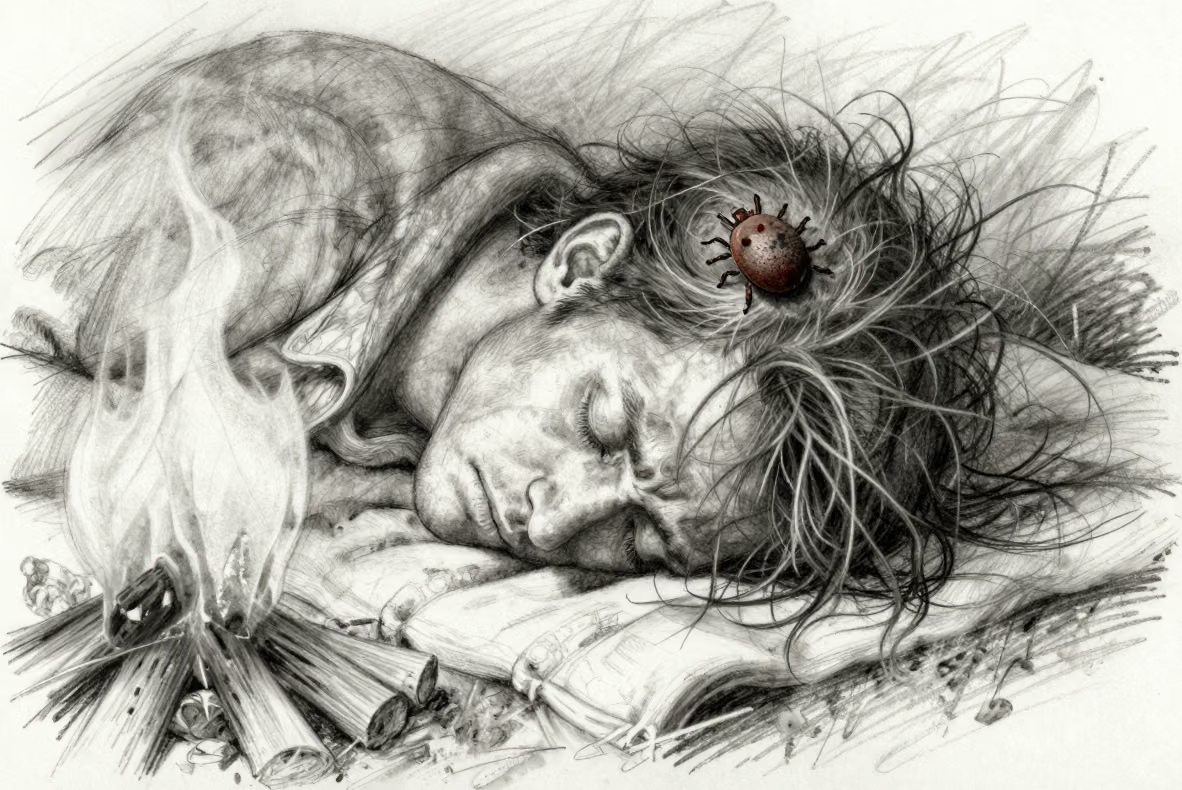
Red-eyed ticks are often found in forested areas and in wet grasslands. These ticks are very dark brown in color, and their back carapace is marked by two small red spots, one on either side of the creature. The red-eyed tick prefers to imbed itself on its victim’s scalp; however, if the victim is bald, the tick will opt for the armpit or the back of the knee. A person awake but immobile is likely (70%) to notice when a tick jumps on his or her skin; however, if a person who is asleep or moving at normal or faster speeds is not likely (5%) to notice the tick’s attack at all. Once the tick has made a successful attack, it fastens itself to its host and need make no further attack.
When the tick first attacks and every hour thereafter, the host must make a saving throw vs. poison or feel compelled to sleep a number of hours equal to his or her Constitution score subtracted from 20. The host’s sleep will be dreamless, as the tick feeds off the mystical energies that normally would be fueling the host’s dream. The host may choose to continue sleeping after the period of forced sleep; however, he or she will still have no dreams. When the host rises, he or she will feel extreme fatigue and suffer a temporary ability drain of 1d6 points. The ability drained is randomly determined by rolling a d4 (1=Strength; 2=Dexterity; 3=Wisdom; 4=Charisma) and it lasts until another failed saving throw forces the victim to sleep up to a maximum of 5 hours. For each full week a victim has been host to this parasite, there is a 5% chance per ability drain that the drain is permanent. If any ability score reaches 0, the host dies, and the red-eyed tick looks for a new victim.
Psi Ticks
Psi Ticks have black exoskeletons; many but not all have a thin blue stripe running down the middle of their back carapaces. Their origin is unknown, but they are commonly found in or near human settlements where there is psionic activity. The psi tick is able to sense the presence of persons with high psionic strength points, and it seeks out these individuals to feed its hunger. The tick’s initial attack does no damage to the victim and is unlikely to be felt unless the victim is using the heightened senses devotion when the attack occurs. If so, the victim has only a 50% chance of feeling the bite. Psi Ticks usually latch onto their victims while the victims are asleep, so as to avoid being noticed.
After the initial attack, the tick is attached to the victim and does not need to attack further. Each hour the tick remains attached to the host, the host loses 1d4 psionic strength points. PSPs can be regained normally, and the tick’s presence does not interfere in any way with the use of psionic powers. When the host is reduced to 0 PSPs, the tick will abandon the host in search of a new one. It is not uncommon for one of these ticks to go back and forth between two victims, draining one while the other recovers, with neither of them understanding why their powers are alternately weakened.
Psi ticks are the bane of psionicists not only because they drain needed PSPs but also because it is rumored that certain wizards have used parts of these ticks to create anti-psionic magical spells.
Sand Ticks
Sand Ticks live in arid deserts and are constantly on the search for liquids to keep themselves alive. They have tan exoskeletons which make them almost impossible to see among the sands of a desert. When draining a host, the sand tick prefers to nest in the small of the host’s back or behind his or her knees; however, any exposed skin will suffice. The tick’s initial bite does 1d4 damage to its victim; however, at the time of the bite, the insect also injects the skin with an anesthetic poison so the victim must make a saving throw vs. poison at -4 or the pain from the bite will not be noticed. Once its victim is bitten, the tick is attached and does not need to attack further. It does no further damage, but it does slowly begin draining the bodily fluids from its victim. After two hours, the host must make a successful saving throw vs. poison or lose 1 point of Constitution. After another hour and every hour thereafter, the host must again make a successful saving throw or lose 1 point of Constitution. For every three points of Constitution lost in this manner, the host also loses 1 point of Strength and 1 point of Dexterity. If any of the host’s ability scores reaches zero, he or she dies. Constitution points lost in this manner are permanently lost; however, other ability points lost in this manner will return at a rate of 1 point per ability every six hours, provided the tick has been removed before the host dies.
As the host loses ability points, the effects of the draining become horrifyingly apparent, as he or she rapidly emaciates, his or her skin sinking in to fill the spaces left by the drained viscera. Observers unfamiliar with the dangers of the sand tick are likely to believe the host is the victim of dehydration, but no amount of liquid the victim drinks will restore his or her drained fluids.
Sand ticks that are not attached to a host generally bury themselves in the desert sand during the day to avoid the heat of the sun. Consequently, most encounters with them will occur at night, although their presence may not be noticed until the daylight. Sand ticks are known to attack large animals, such as camels and horses, in addition to humanoids.
Removing Ticks
Removing Ticks is not a simple process. Anyone with a proficiency in healing or survival (wilderness) should be able to remove a tick successfully by inserting a small, heated metal rod (such as a sewing needle) between the tick’s mandibles and forcing its mouth away from the victim’s skin. The tick will release its hold on the victim’s skin and jump to another location on the victim, onto the person attempting to remove it, or into someplace where it can hide. Thus, it is usually wise to hold some type of container over the tick to catch it while one is trying to remove it.
A tick can also be removed by casting cure disease on its host. In this case, the tick is not killed but it is unable to reattach itself to that particular victim and seeks another.
A tick that is killed while it is attached to a victim will remain attached. A dead tick may be pulled off its victim, but there is an 80% chance that part of its mouth will remain in the victim’s skin. If this happens, the victim will have a persistent open wound which will bleed and drain him or her of 1 hit point of damage every two hours and will prevent the natural recovery of hit points through rest. A cure disease spell will favorably resolve the situation.