Zombie, Type II
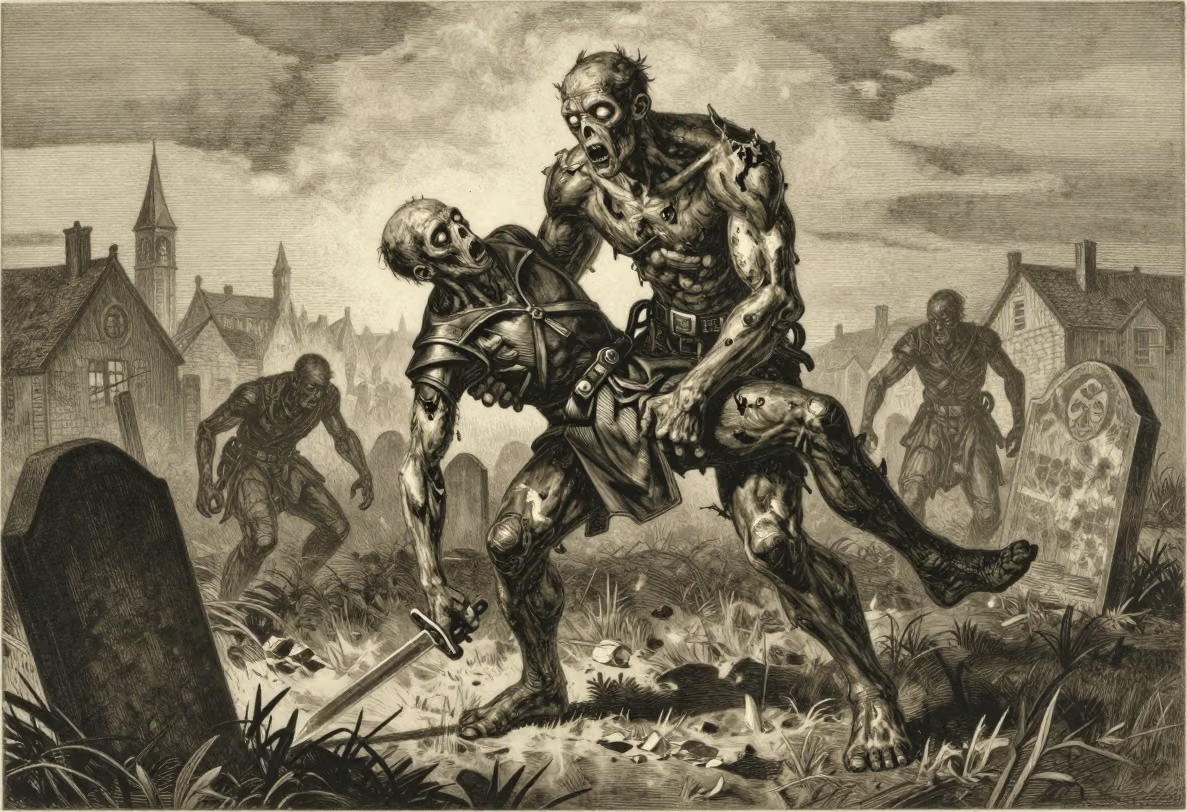
| Statistic | Value |
|---|---|
| Frequency | planned |
| # Appearing | DM Sadism X 70% |
| % In Lair | ? |
| Treasure Type | incidental |
| Alignment | Neutral (but Evil by def.) |
| Climate/Terrain | several, see below |
| HD | 5d8 (it takes the equivalent of killing five hearty men before this nightmarish creature will fall). |
| Size | usually human sized |
| AC | 8 (consistency of leather) |
| Magic Resistance | standard, unless DM is really sadistic tonight |
| No. Attacks | 1 every 2 rounds (slow movement due to stiffened limbs) |
| Attack Damage | by weapon used, or d3 if fists are used |
| Move | 6" running (running? ha!) |
| Special Defenses | only blessed weapons can actually permanently hurt a zombie - other weapons' damage is recovered at a rate of 1 hp per segment (6 seconds) or 10 hp per round. Completely killing a zombie stops it for a period of one day (or any other suitably interesting period, like 'until the next full moon' or something). Magical effects, such as fireball, will have the usual effects, however. Fire does d4 per round, and is healed much more slowly - 1 hp per hour of fire damage. |
| Special Attacks | due to their unnatural strength, zombies do +5 damage on all melee or pummelling attacks, and can crush for d8 per round if they can get a good grasp on someone. |
Description
I thunk this up in a bad mood. Zombies are always treated as second class citizens. So here's a zombie based on a direct transferral of stats from what it would really be like if zombies existed in the real world to AD&D terms.
Zombies are essentially moving corpses, with working muscle (despite rot), animate limbs, and faces capable of mild expressions (assuming they're not rotted bad enough to fall off when a zombie first cracks a smile). Of course, since zombies have little in the way of motivation or thought, the probability of seeing their faces animate is very low. However, this means two things. A) They are very slow movers. Stiffness due to ligaments and cartilage hardeningis unavoidable, and movements will be jerky and powerful. and B) They are STRONG movers. They have very little control over the more precise movements, but we're talking dead muscle here, and no nerve endings. The same effect achieved by adrenalin in living beings is a constant fact for zombies. And remember, they're dead. Fatigue has little meaning to someone who's flesh doesn't need oxygen or fuel.
In addition, many spells which are relied upon by mages and clerics will have little effect on zombies: Command, Hold type spells, Insect Plague (biting insects are NOT going to affect dead flesh much), Heat Metal (zombies have no pain sensors, 'member?), Feeblemind, Confusion, Creeping Doom, Finger of Death, Friends, any Sleep or Charm spells,ESP, Ray of Enfeeblement, Scare, Haste or Slow spells, Suggestion, Fear, Cloudkill, Cone of Cold, Death Spell, Geas, the various Power Words, Color Spray, Blindness, Deafness, hypnotic Pattern, Paralyzation, Emotion, Phantasmal killer, Chaos, or similar magicks.
This is the basic zombie, without anything fancy. It is also possible for those creating the zombies (be they cleric or mage) to imbue the zombies with little 'extras', like the following with Permanency: Detect Invisibility, Detect Magic, Infravision, Protection from Normal Missiles, etc. Of course, casting this takes off one Constitution point, but for a really good servant, why shouldn't an evil mage use another mage's spell casting abilities to benefit himself (after sufficient torture, it could be done)? Or perhaps a zombie with Permanency and Invisibility?
DMs can also gift zombies raised by a cleric of an evil god with other little bits, usually a sort of calling card for that god, such as zombies with Shocking Grasp?
Zombies should be properly horrific to mid-level characters, and a decent annoyance to higher level characters with these stats. To low level characters, meeting a few of these will be a truly terrifying experience.
Climate/Terrain
Not all zombies must be created by a mage or cleric.
How about a large burial ground in the swamps of _______, in which an ancient king, once dead, rises with his former army to fight a last battle? The king is not necessarily good, of course..
Or perhaps those who are buried in the Badlands rise from the dead due to some terrible influence there? In the movie Heavy Metal there is an effect very similar to this in the scene from World War II..
Another idea might be something similar to the Haunted Lands from The_Dark_of_the_Moon. There, that which dies does not remain dead, and those who travel through soon join them.. even a wound from the undead corpses there will cause a festering wound which will gradually drag you back to them...
A note to make is that zombies as case specific as in the above three examples would probably have some abilities unique to them. The haunts of The_Dark_of_the_Moon can cause others to become zombies as well, and have a movement rate of about 9". The zombies rising from the muck of a former kingdom and battleground might have greater facility with weapons, or be as quick and powerful as they were in life, but with the unnatural advantage of being a zombie.. The creatures in Heavy Metal were decidedly unpleasant, and all who died at their hand soon joined them.
Notes
Note 1: I know that I have not given a definite monster here, only fleshed out the basic stats and given some ideas (pardon the pun). The zombie is such a delightful creature, however, changing from story to story to horror movie to play. I tend to think that they are overlooked due to the petty part they play in Gygax's original system - HD 2d8 AC 8 creatures with no special defenses don't make for much of a threat, despite the horror that can be invoked with such a simple idea as a walking corpse. They're only real claim to fame before was a d8 punching damage. Whee.
Also in this section of the source
WERE-Creatures
The Lycanthropes I present here are a bit different. Consequently, I am including a note ahead of all of them to give the universal set of rules.
Lycanthropes are human beings infected with a disease which alters their fundamental structure. While in human form, they are virtually identical to a normal human, with a few exceptions - oftentimes they take on a few traits similar to that of the animal they morph into. This disease allows the human being to change into an animal form (controlled changes or otherwise), and this animal form, aside from unusual intelligence and its perhaps human habits, is also virtually undetectable from a normal animal. Also, lycanthropes tend to be slightly larger in their animal form than most animals of that type.
Some lycanthropes are capable of intermediate forms as well - this varies with the individual, not the species of animal. These forms range from nearly completely human to humanoid version of the animal to nearly completely animal. These intermediate forms can be quite powerful in that they offer more versatility to the lycanthrope.
Lycanthropes have no special powers, such as immunity to normal weapons; a werewolf can be hurt by silver just as easily as by steel. The main ability that they have is in their alternate form.
The animal form does begin to affect the mind - while in animal form, the character thinks in a manner similar to the animal, as well as the accustomed human modes. For example, a werewolf in wolf form will have strong feelings of hunting urges, and will notice things that a wolf would notice, such as the stance of a human being nearby in terms of hostility, rather than the more broad sense of intentions.
It is also possible to use these lycanthropes for a more supernatural basis if desired. Simply make them immune to normal weapons, etc., and give them a fw unnatural quirks, such as being able to communicate with the animal type that they change into.
All stats will be recorded as follows: human form/any intermediates/animal form.