Yet Another Dragon
| Statistic | Value |
|---|---|
| Frequency | common in most campaigns, perhaps uncommon in a world with an extreme aristocracy. |
| # Appearing | 1 per person owning one |
| % In Lair | depends on owner |
| Treasure Type | P,Q |
| Alignment | Neutral Good to Chaotic Good |
| Climate/Terrain | almost anywhere, depending on breed |
| HD | see below |
| Size | L (15-20' long) |
| AC | -2 (fast, with hard scales) |
| Magic Resistance | standard |
| No. Attacks | 5 or 2 or 1 (claw/claw/bite/claw/claw or rake/rake or breath) |
| Claw Damage | d6 (similar in size to short-sword length talons) |
| Bite Damage | d4 (large, serpent like mouth - doesn't unhinge, however) + poison |
| Raking Damage (Hind Claws) | 2d10 (great gashes) |
| Breath Damage | see below |
| Move | 24" running, 48" flight, 15" swimming |
| Special Defenses | hurt only by weapons weilded with 16+ Str, or enchanted weapons (enchantment must be towards the damaging effect, such as sharpness or the typical +1 sword). |
| Special Attacks | poison, breath, see below. |
Description
I was reading through the Net Monster Manual again, looking for ideas, and found the War dragon - instant inspiration. Dragons are such massive, powerful creatures, inspiring awe and terror in equal parts. I wanna do another dwagon! So I decided to work out another type of war dragon.. one used for interpersonal combat more than anything else.
These small, swift dragons are the result of years of breeding. They are primarily referred to as dragons because they are large reptiles with a breath weapon, and are more powerful than most human beings, but a 'real' dragon from most campaigns would eat one of these as a snack. In the world I envision them being in, however, there are no more 'real' dragons, and these are the reminders of a magnificent, dangerous past. Noblemen ride these as most would ride horses, and have duels atop these incredible steeds. They would have about the same training as a medium to heavy war horse, and indeed might have the same status as a war horse in the world.
Owning one is a mark of status, but is relatively common among the rich or noble. In fact, some of the wealthier estates might own a stable of them, breeding them as one might race horses in modern society. Contracts written out for the siring of exceptional lines would be at least as difficult to obtain as well.
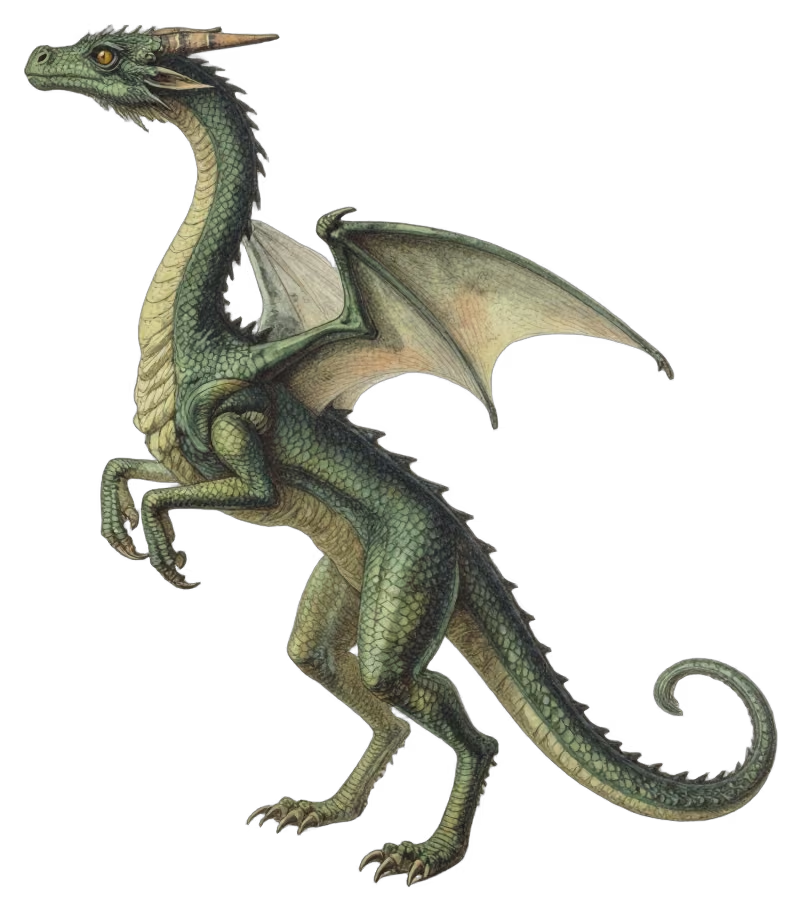
A dragon of this variety is a slender, almost delicate creature about 15 feet long, with a long neck topped by a serpentine head and jewel-like eyes. The wings are wide and fragile looking, and the arms (not front legs; arms) small and tipped with long, wicked looking claws. The hind legs resemble those of a lion, only scaled, with powerful running muscles and huge gripping claws. The legs pull up under the thick, oval torso in flight. The tail is a long, whip-like extension, as long as the rest of the body. Dragons have various colorations, but are usually a solid dark color with a lighter underbody and mild scale discoloration (the edges of the scales are of a different color than the major surface area). The heads also tend to be lighter in coloration than the rest of the body, with the flat top of the skull making a dark stripe down the forehead to lighten just between the eyes. The teeth are slender stilletos retracted into the roof of the mouth except when biting. The most common base colors are a dark green, blue, or red.
Dragons have a base of 5d8 Hit Dice, but are intelligent enough to gain levels of experience. For each level of experience beyond the first, add d4 hit points. This is to represent the ability to avoid serious damage, taking nicks and scratches a la AD&D. A dragon gains experience in the same manner as anyone else, getting the same xp as the person who rode it in a particular battle. They advance on the following table:
| Lvl | HP | XP | Thac0 | PPD | Petri | Rod | Breath | Spell | Dmg |
|---|---|---|---|---|---|---|---|---|---|
| 1 | 5d8 | 0 | 17 | 14 | 15 | 16 | 13 | 15 | +1 |
| 2 | +d4 | 2500 | 17 | 14 | 15 | 16 | 13 | 15 | +2 |
| 3 | +2d4 | 5000 | 16 | 13 | 14 | 15 | 10 | 14 | +3 |
| 4 | +3d4 | 10,000 | 16 | 13 | 14 | 15 | 10 | 14 | +4 |
| 5 | +4d4 | 20,000 | 15 | 11 | 12 | 13 | 9 | 12 | +5 |
| 6 | +5d4 | 40,000 | 15 | 11 | 12 | 13 | 9 | 12 | +6 |
| 7 | +6d4 | 60,000 | 14 | 10 | 11 | 12 | 6 | 11 | +7 |
| 8 | +7d4 | 90,000 | 14 | 10 | 11 | 12 | 6 | 11 | +8 |
| 9 | +8d4 | 135,000 | 13 | 8 | 9 | 10 | 5 | 9 | +9 |
| 10 | +9d4 | 250,000 | 13 | 8 | 9 | 10 | 5 | 9 | +10 |
| 11 | +9d4+1 | 375,000 | 12 | 7 | 8 | 9 | 2 | 7 | +11 |
| 12 | +9d4+2 | 1,125,000 | 12 | 7 | 8 | 9 | 2 | 7 | +12 |
| 13 | +9d4+3 | 1,500,000 | 11 | 5 | 6 | 7 | 2 | 6 | +13 |
| 14 | +9d4+4 | 1,875,000 | 11 | 5 | 6 | 7 | 2 | 6 | +14 |
+375,000 XP per level past 14, +1 hit point
PPD is Paralyzation, Poison, Death (but they get +2 on all saves vs. poison)
Petri is Pertify/Polymorph. Rod is Rod, Staff, Wand. Spell is just that. Breath is Breath Weapons.
Breath Weapon
The breath weapon of these dragons is a straight line of fire about 3' wide and up to 60' feet long (3 times the length of the dragon). This flame does varying damage depending on the quality of the mount, and its level (the damage bonus per level is added to its breath weapon as well).
Combat
A dragon mount has a basic selection of three modes of attack. It can close to clawing distance and claw and bite, it can keep at close distance and strike with its hind legs, or it can breath flame from a distance.
When clawing, it strikes once with each arm before biting, then again with each arm, using its superior speed to bring several hits to bear at once. For purposes of initiative, treat the first claw attacks as the beginning of the round, the bite as the middle, and the second claw attacks as the end. This type of attack does not generally do as much damage as the others, but has no penalties to hit or to AC. All of these attacks must be on one opponent.
In aerial combat, a dragon's attacks consist of engaging in a frenzied moment of almost wrestling and then disengaging, or swift passes accompanied by blast of flame. both of these assume that the opponent can fly, and is similar in maneuverability to the dragon. In combat with a creature with a lower Manueverability class, the dragon is likely to simply harry it with blasts of flame, as hovering makes it difficult to attack the creature. Against ground opponents, strafing with flames, or raking with hind legs are the primary attacks, both executed from swift passes. They cannot dive bomb.
When raking with its hindquarters, the dragon is essentially turning in midair to a near vertical stance, or jumping several feet from the ground, and putting its hindquarters in front of its abdomen, kicking hard and pulling the claws down along the body. This does tremendous damage, but adds +3 to the dragon's AC (to an AC of 1) and -3 to hit, due to imbalance.
When breathing flame at an opponent, the dragon is simply aiming the stream of fire. This has a base of +1 to hit, but is at -1 per 10 feet, rounding halves up (-2 1/2 = -3). Once it hits an opponent, the flame stops there, and spreads out, doing 1/4 damage to everyone within 10 feet to the side of the target. If fired at zero range, it backlashes, doing half damage to the breathing dragon and rider, as well as damaging the target.
For purposes of flight, a dragon has a Manueverability Class of B (this means the dragon can turn 120 degrees per round, require 36 seconds to reach full airspeed, and 30 seconds to come to a full stop. The dragon can hover in one place for extended periods of time). This is similar to the maneuverability of a giant wasp.
The dragon's bite leaves a small amount of poison in the target's blood on any successful to hit. This toxin is not lethal, but slows the opponent down. If struck on another dragon who fails the save, the dragon loses the last two claw strikes, and can only do one raking attack per round. In addition, the dragon will lose initiative automatically against an unaffected dragon. Flight speed is reduced to 12", running speed to 6", and swimming speed to 3". This is not a Slow spell! The target is weak and slow reacting, not moving through time molasses. Anything other than another dragon which is hit by this and fails the save loses one attack per round (if only one attack per round is possible, loses one every other round), divides movement rate by 4" (less than 1" is zero), and loses initiative automatically against any creature of equal or greater speed. This poison is not cumulative, but every new dosage requires a new save.
Quality
Like many steeds, dragons come in different degrees of quality, and to a certain extent, there are certain breeds. The quality levels are outlined below, as well as some more specialized breeds.
A poor quality dragon, referred to among horses as a nag, is truly a sorry sight, and is generally killed soon. Riding one marks one for more contempt than even the peasant class. The breath of such a dragon does 2d8 damage, and is almost always 1st level or less. Lower all movement rates by 6", and increase AC by +1 (to a -1). Sometimes a dragon of this quality is only such temporarily, due to some severe affliction or disease. Such dragons usually suicide unless a decent chance of saving them exists. A poor quality dragon can barely haul half its weight, and sometimes only as much as a third.
A low quality dragon is in slightly better state than a poor quality dragon. These do 4d8 damage with their breath weapon, and only decrease movement rates by 3". Lower quality dragons are often used among those families new to noble status, or with newborn wealth. Possessing one marks one with a status of the uprising lower class. A low quality dragon can generally carry its own weight or slightly more.
An average quality dragon is the standard, and is exactly as described in the above sections. It does 5d8 with its breath weapon, and has normal movement rates. An average quality dragon can carry a third again its own weight.
A high quality dragon is a beautiful specimen of dragonhood, with a healthy glow and activity. It does 8d8 damage with its breath weapon, and adds 3" to all movement rates. These dragons are usually breathtakingly beautiful as well, and show signs of high intelligence (14-15). About 2% of these dragons may also be Magic-Users (in which case all XP is divided between Dragon and Wizard). A high quality dragon can carry twice its own weight.
An excellent quality dragon is an extreme rarity. To possess one is to have previously unknown status. It does 10d8 damage with its breath, and adds 6" to all movement rates. An excellent quality dragon is usually highly intelligent as well (16+ Int), and 10% of them may be Magic Users. An excellent quality dragon can carry three times its own weight. Also, excellent quality dragons are usually slightly faster than normal dragons, and may roll for each of the following exceptional abilities:
| Exceptional Ability | Chance |
|---|---|
| exceptional strength (carry X4 own weight) | 20% |
| exceptional speed (add another 3" move) | 10% |
| exceptional reflexes (may strike 3 times with hind legs, 5 times with front claws, has -3 AC instead of -2, always gains initiative against normal dragons) | 5% |
| exceptional Intelligence (19) | 5% |
| larger than normal (+1d8 hit points) | 10% |
Some Breeds
Northern Dragon (or whatever location you want): These dragons are smaller than average, around 12' long, but quicker and more intelligent than most as well (add 3" movement rates, +1 Intelligence). They generally weigh around 500 pounds, sometimes as much as 700. They are twice as likely to be mages as the standard. Northern dragons subtract 1d8 from their HD.
Dueling Dragon: These dragons are normal sized, about 15-17' long, and much quicker! They always gain initiative against other dragon breeds, unless that particular dragon is of excellent quality and has the exceptional reflexes ability. Dueling dragons are not quite as smart as other dragon breeds, however (-1 Intelligence). If trained, this dragon breed adds +2 to hit and damage with all attacks. These dragons generally weigh around 600-800 pounds, occasionally massing as much as 900 pounds. Regardless of quality, a dueling breed of dragon will not be a wizard.
Tueron Dragon (or whatever family): named after the family that breeds them, these dragons are automatically of High or better quality. Due to extensive breeding, they are all of a gorgeous iridescent blue-green color, and are slightly larger than most (18-19' long). They generally weigh about 900-1200 pounds, sometimes as much as 1500 pounds. Tueron dragons add 2d8 to their HD.
Minidragon: These were bred for pet purposes, never intended to be ridden or used in dueling. They range from 5-8' long, and can be ridden only by AD&D halfling sized or smaller. They have a -6" to flight and -3" to running movement, but are much easier to stay on. Breath weapon does only a d8 damage, regardless of quality. They generally weigh about 200-300 pounds, rarely more than 350 pounds. Their only real attraction is their loyalty to a single person (usually the child who's pet it is) and their extreme friendliness to anyone not threatening the source of their loyalty. They make good pets, and represent high status. They do little else. A minidragon has only 2d8 base HD, rather than the usual 5d8.
Standard Breed Dragon: use the given stats, and range from about 15-16' in length. They generally weigh about 650-750 pounds, but with many exceptions.
Riding a Dragon
There is nothing particularly difficult about sitting on the back of a moving dragon, until you try to do something with it. All manuevers that the dragon does not execute itself require a Dragon Riding nonweapon proficiency or training (unless you don't use those). Any maneuver involving more than 1/2 G, or being upside down for any period of time, also require the proficiency.
There are several weapons that can be used astride a dragon. As long as it remains upright, any bow may be used, with the long bows suffering a -3 penalty to hit. Lances, whips, and various weapons such as blowgun may also be used, although the blowgun is not considered a gentleman's weapon by most. For extremely close encounters, such as when the rider sets the dragon to a claw/claw/bite attack, an exceptionally long sword referred to as a dragonsword may also be used.
Dragonsword (120 gp weight, 3d4/4d4 dmg, 7' length, 8' space required to wield, 10 speed factor).
Flying Mounts and General Data (from DMG 1st ed. p. 50+)
Dragons are fiercely loyal to their rider (or a few riders, depending), but must be trained from adolescence on. The dragons will already know they are to be trained, and it is not animal training! They are intelligent, and often view the families that own them in the same manner as the families view the dragon - they are trained in methods of keeping the rider safe, when not to obey the rider, and when to take the rider's car keys away, for example.
They require large amounts of meat, and generally prefer whole cattle on a one per week basis. In addition, most dragons also like to hoard a small amount of treasure somewhere hidden within their home.
Society
Dragons have an odd social relationship between themselves and the humanoids who 'own' them. On the one hand, dragons choose their own lives, who they ride with, who they live with, if they stay with a humanoid at all, etc. On the other hand, they are fiercely loyal to both their own family unit, and the household that they were raised in. Like daughters of the midieval era, they will 'marry off' to increase the household status and the standing of their own family. In duels and other competitive events, good performance represents high prestige for both rider (who is generally the closest friend a dragon will have) AND dragon. Not to mention the fact that winning a lot means that the dragon will be a highly prozed sire or dam - a heady prize indeed.
Most dragons also maintain a certain degree of businesslike aspects to this relationship, and are provided domestic servants, a small hoard, comforts, and food for their performance.
For a dragon, however, there are two things uppermost: their pride, which is still almost as powerful a thing as that of the ancient true dragons, and family prestige, both the humanoid adopted family and native dragon family.
Combat will not take place between dragons of the same family unless a serious breach of family honor has occurred. Also, many who own dragons will often find that they are expected to reciprocate the services - they will join their dragons in matters of honor, and fight duels with another because of the dragons' purposes rather than their own. It is a two way relationship between dragon and owner, or it is not a relationship at all.