End Of Dragons
| Statistic | Value |
|---|---|
| Frequency | uncommon in deserts |
| # Appearing | usually 1, sometimes 4d6 |
| %in Lair | 10% |
| Treasure Type | none |
| Alignment | Neutral |
| Climate/Terrain | desert, preferably with strong winds |
| HD | 1d8 |
| Size | S (about 4 1/2' tall) |
| AC | 3 while running, 6 otherwise |
| Magic Resistance | standard |
| No. Attacks | 1 if provoked (beak) |
| Beak Damage | 2d6 while running, d4 otherwise |
| Move | 48" while running, 12" otherwise (see below) |
| Special Defenses | while running, exact location is difficult to determine due to speed and dust, and it is only in the location of a still object for a miniscule amount of time before it has passed the object by. Because of this, attacking creatures must have an initiative of 1, and still have a 30% chance of attacking too late - in which case they will automatically miss. |
| Special Attacks | sand in eyes - make save vs. paralysis or be blinded for 1 round |
Description
END OF DRAGONS
Dune Runner
I am creating this creature right now just for the heck of it. It's a fun idea for DMs with a large desert segment of their world, just to add a little 'atmosphere' or perhaps an encounter for low levelers.
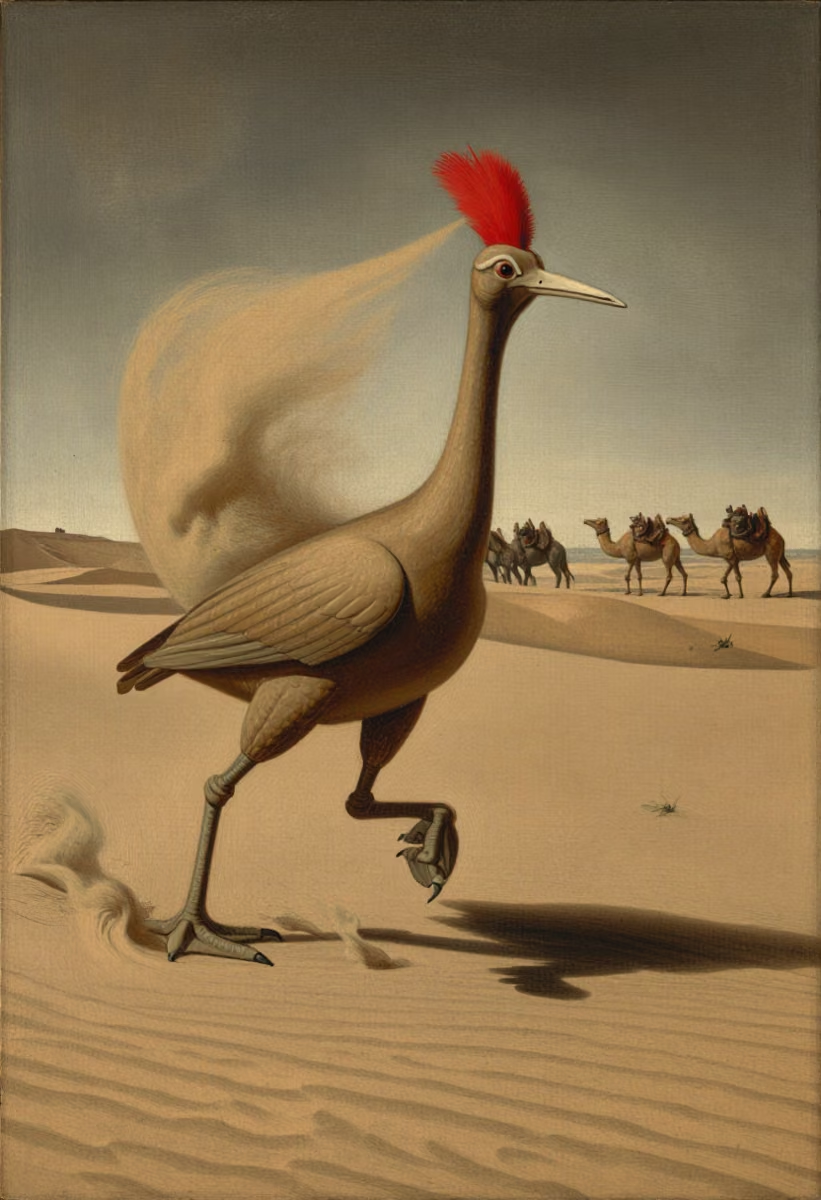
Dune runners are tall, thin birds, similar to a road runner in shape, but with large, webbed feet and long talons extending past the webs. Also, the crest is much higher and flattens while running. Dune runners are dull, sand grey or brown, with a bright crest of red or green (the crest is only visible while not running - when flattened it falls below the other feathers). Their wings are only vestigal, and are not large enough to even glide, despite top speeds.
Dune runners are semi-intelligent, being intelligent enough to enjoy running for its own sake, to have a definite hierchal social form (a pecking order - groan), and to be curious about changes in the environment (such as adventurers wandering along, hoping the DM won't notice their encumbrance numbers). Because of this, they are 30% likely to investigate, as a single bird if only one was in the area, or as a small group if there was a social gathering (think prairie dogs with a little less fear). In investigating, they are unlikely to be running, as they need a good look - they will be moving at their leisurely jog of 9-12" speed. While doing so, a dune runner looks like a curious mix between a thin, bobbing turkey, and a ducking road runner. It is also possible that adventurers will come across a social gathering in progress, with the dune runners having missed noticing them - this lack of notice will not continue if the adventurers approach, of course. Dune runners will not approach closer than 10-15 feet of anything strange, but they will trill to each other about it at great length (whether this is real communication and analysis or just 'what the hell is that?' 'I dunno, but what the hell is that thing beside it?').
If attacked (which is likely if adventurers see a dozen crested 4' tall birds running at 12" movement down the slope of a dune at them), the poor dears will just about have a fit - they will first peck at the adventurers for one round of combat, spend the second round of combat 'revving', and then take off at near ninety to nothing (full running speed). After taking off, and getting their courage back up, the dune runners will see to it that the menace to the immediate area is expunged - they will turn around, still going at full speed, and charge the characters, pecking once as they pass. Note tat if there is more than one dune runner there, they will run one at a time (two per round) through the party, the rest circling the group at about fifty yards (5"). This is so that if the threat turns out to be particularly deadly, no more than one or two of the social group will be lost at a time. If the first dune runner running through in a given round is killed, the second one will not run that round, but will be the first one on the next round. Note that if the party attempts to move in any direction, these birds will shift position slightly, keeping a constant 5" radius circle around the group. It is unlikely that the party will be able to outrun them.
There is a simple way to outmaneuver the birds, however - burying oneself in the sand until no longer visible, while demeaning (we dug into the sand so the nasty desert birds wouldn't eat us, mommy), will prevent attacks, though a few will run through a few times just to check out what happened, until the birds lose their interest and run off.
Dune runners may also be encountered in a different manner - rather than actually meeting them, the party may simply see one or a few running by at top speed, across a dune in the distance, for example. This is good for DMs who are trying for some flavor in a desert world that these strange birds fit into.
It takes a dune runner a full round to get its legs into full running speed, during which the dune runner will run in place at the equivalent of 12" move rate - near the end of the round the dune runner will suddenly disappear into the distance at 48" move rate. Note that those attacking the dune runners who have an initiative of last will be unable to strike the birds, as they are no longer within reach. A dune runner cannot run at a slower speed - it is all or nothing.
Dune runners are exceptionally maneuverable, even at top speed - they can make tight turns (turns, NOT curves) up to 60 degrees. When turning, dune runners will make the turn suddenly, then need another 6" distance before being able to turn again. This essentially means that they can turn 180 degrees within 3/8 of a round (22 seconds). This is only for TURNS and not curves - they can execute a very tight curve without any distance needed before the next curve is made. The smallest curve they can take is a 3" radius circle (6" all the way across).
Ecology
Dune runners are omnivores, and eat mostly desert plants in small amounts, along with some bugs and lizards. I think they'd fit best in the Dark Sun (Athas) setting. If put there, you may wish to give them very little need for water.
Notes
Note 1: The movement rates I am using here are being used to represent a real time movement of about 4X that of a human being at top speed, which is approaching 60 mph - think of a car whizzing by you on the highway that is only 4 1/2' tall and only about 2' long. IF you see it, it's going to be gone before you even think to get a good look.
Note 2: When initiative is spoken of, there are two exceptions - the second dune runner in a round during a circling attack, and those characters who 'set' themselves previously. For the second dune runner in a round of attacks, a low initiative is required (3 or less), but a minimum initiative is not. Also, if an attack is expected PREVIOUS to the round of combat, a character can set herself for the charge and automatically have an initiative of 1. In both cases, the 30% chance of being too late STILL apply. What this means is that if a character chooses, he can set himself every other round, meaning that he will miss his attack on each setting round, but he will not be required to make an initiative check each time.