DRAGONS, Here There Be
| Statistic | Value |
|---|---|
| Frequency | very rare |
| # Appear | no more than 3 |
| %in Lair | planned |
| Treasure Type | See Note 3 |
| Alignment | varies with individual |
| Climate/Terrain | just about anywhere, but preferably deep wilderness |
| HD | var. |
| Size | Large (var.) |
| AC | 0, see notes below |
| Magic Resistance | var. |
| No. Attacks | 1 or 3 (breath or crushing or claw/claw/bite) |
| Breath Damage | var. |
| Claw Damage | as long sword (d8/d12) (small-medium/large) |
| Bite Damage | as spear (d6/d8) (s-m/l) |
| Crushing Damage (sit on/ram/tail/etc.) | base 5d6/4d6/3d6 (s/m/l) this attack can be made against all people on the side of the dragon which the dragon is crushing with. Squishburger... |
| Move | 15" running/36" flying (if able) |
| Special Defenses | only weapons wielded with a high Strength or with a magical edge/point/force can actually penetrate the scales and do damage. |
| Special Attacks | fiery breath, see Note 1 |
Description
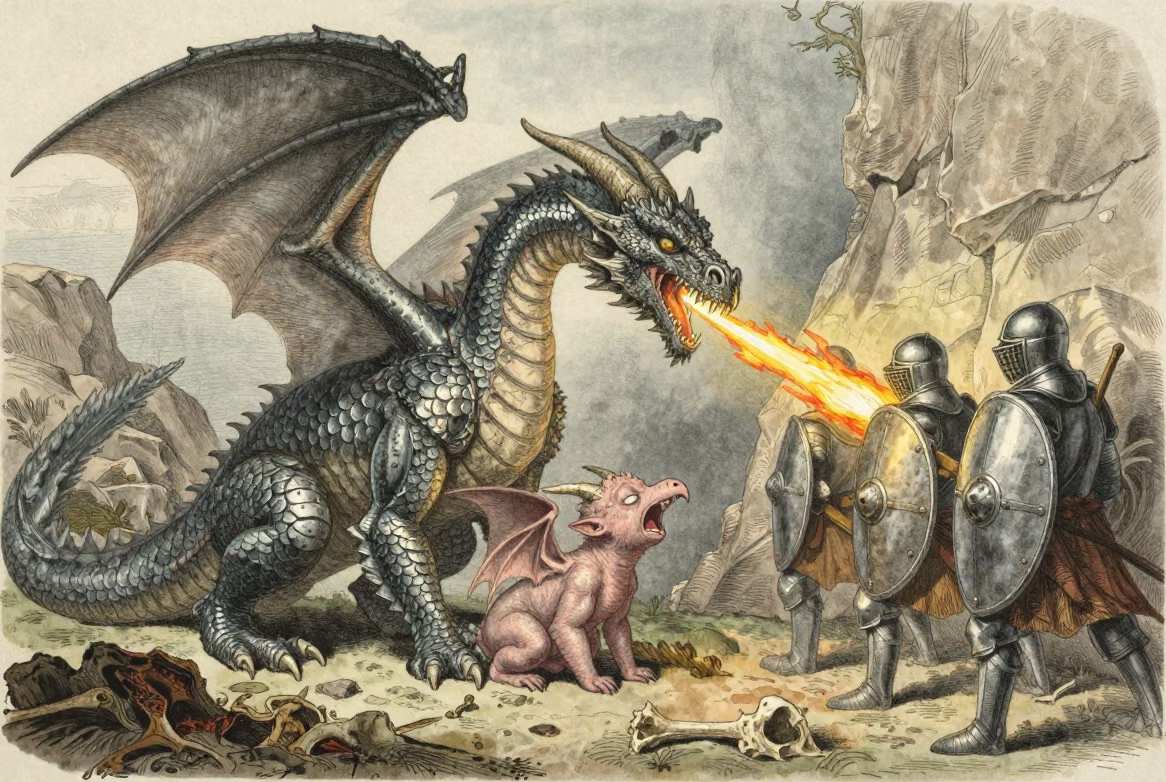
A Dragon (not metallic nor chromatic - dragons specific to my world)
I have taken dragons as nearly as I can to a measure of what the real world effects would be of having steel hard scales, etc., and translated them to AD&D. Noticeably, they are powerful.
Dragons come in three basic ages: hatchling, young, and old.
Hatchling
Hatchling is the shortest age period, lasting about twenty years, during which time the baby dragon's scales are still soft, its body still tender. As a hatchling, a dragon knows only hunger and weakness, and must be fed constantly by the parents. In general, it is the male parent who handles the bulk of feeding, as the female handles defense and/or hunting. Dragons feed their young as birds do.
A hatchling has 1-4d8 hp (no 1,2,3s), is about 10-14 feet long, and is partially blind. The breath of a hatchling does 1d6 damage, and comes only in the spat flame category. A hatchling has only marginal magic resistance (comparative to adults), at 1% per year old. Hatchlings are incapable of flight. Hatchlings have an effective strength equal to their length + 5. This strength adds damage and to hit for claws and bites. Crushing damage done by a hatchling is 1/2 normal (roll, and divide by 2).
Young
Young is the second shortest age period, mostly because 'old' can last until the dragon is killed. Generally, this is a period of about 500 years, with some dragons reaching full maturation a bit earlier or later. Young dragons are the ones most commonly killed in folk lore and legend, for they have not yet developed the degree of sentience that their elders possess, but they do have the powerful urges and strength.
A young dragon has 4d8 hp (no 1,2,3,4s) plus 1d8 per 100 years old. The length is approximately 14 feet +1 foot for every 50 years old. A young dragon just about to mature will have about 9d8 hp, and be 24 feet long. A young dragon's fiery breath does the base damages (see Note 1). Young dragons have a magic resistance of 20% +1% per 20 years of age. A young dragon MIGHT be capable of flight (30% chance). If not, the dragon will not be able to fly, but will have a higher strength. Young dragons' Strength is equal to their length, with a minimum of 19 (the Str stat will not increase for a long period of time). Dragons unable to fly will have an additional +1 to their Strength, and may get as high as 25 by the end of their young period. This Strength adds to claws and bites normally. Crushing damage done by a young dragon is done at the following ratios:
| Length | Crushing Damage |
|---|---|
| 14 feet | 1/2 damage |
| 15-20 feet | 3/4 damage |
| 21-24 feet | base damage |
A young dragon has about the same intelligence as a normal human being, but is consumed by its emotions, be they love, greed, anger, lust, or whatever. Much of a young dragon's personality is determined by which emotions are particularly dominant in the individual.
The more intelligent young dragons (Int 13-14) may be able to cast spells if they have had access to the learning necessary. The level that this is at depends on their experience and natural aptitude for it, but is usually about level 3-4 at the younger ages, and 7-10 at the older range (this may vary wildly for a campaign with different estimations of high and low level).
At this age, normal weapons, unless weilded by a Strength of at least 17, will not penetrate the hide of the dragon. This applies to both edged or piercing attacks, and crushing attacks.
Old
Old dragons are the most feared, as they are slightly more powerful than their younger members, almost always able to cast spells, and much, much more intelligent.
Old dragons have at least 10d8 hp (no 1,2,3,4,5s), +1d8 per hundred years they have survived thus far. An old dragon will be 25 feet+, most often being about 50 feet or so. An old dragon's breath does the advanced damages (Note 1). The Strength of an old dragon is 25, but with some additional bonuses. Replace the damage bonus with a bonus equal to the dragon's length, and weight allowance is equal to the dragon's length times .2 tons. Those dragons unable to fly multiply their length by 1.5 for these two calculations. Old dragons have a 50% Magic Resistance, +1% per 100 years of age total. Crushing damage is modified by the following:
| Length | Crushing Damage |
|---|---|
| 25-30 feet | base damage X 1.5 |
| 31-40 feet | X 2 |
| 41-60 feet | X 3 |
| 61-90 feet | X 4 |
| 91-150 feet | X 5 |
| 151+ feet | X 6 (if they're this long, the DM is a sadist) |
Old dragons are notoriously intelligent, and have an Int of 16-23. They often delight in games of the intellect, and may let especially clever foes go (sometimes even with a gift if the dragon learned something...). For ideas on how to handle this, think of the riddles of the sphinx, or perhaps have the demon X(A/N)th if you've read much in the Xanth series. The passions of youth have passed somewhat, though the flames still flicker.
Old dragons can cast spells. Period. If they have not learned to by now, they have most likely been killed off. The level of this is generallly about mid range (in my campaign, level 7-12 mage was typical).
At this age, any weapon wielded with a Strength of less than 18/50 +/01 per hundred years of age will not damage the dragon unless the weapon is magical in nature. Magical weapons also may not affect the dragon if it succeeds in making its magic resistance check. Note that 'magical weapon' means that the magic MUST be geared towards the purpose of weaponry, be it a finer edge, more forceful blow, or whatever. A Dagger of Accuracy will NOT damage the dragon.
Notes
Note 1: the fiery breath of a dragon can come in several forms, depending on how the dragon wishes to use it. The forms are as follows:
- Spat Flame - this is essentially a stream of flame in a straight line. it is the most basic method of spitting fire that dragons have or use, and dragons are +1 per 100 years of age to hit with it. It does a base damage of 3d6, and an advanced damage of 6d6 +3 per 100 years of age. It strikes everything in a straight line that is a distance equal to twice the dragon's length. The stream is 1/5 the dragon's length in width (25' dragon spits a 5' wide stream), and anything which is half that width or less will not stop the passage of the stream.
- Fire Ball - this is a globule of fire which explodes upon contact with a surface, hitting a large area. Dragons use the grenade-like object tables for determing hitting and location when missing. It does a base damage of 5d6, and an advanced damage of 5d6+1d6 per 200 years of age. It covers a 30' radius sphere. This ball can be targeted up to twice the dragon's length away.
- Cone of Flame - this is a cone originating at the dragon's mouth which goes a distance equal to 1/5 the dragon's length, and at the widest area covers a radius equal to 1/4 the dragon's length. It does a base damage of 2d6, and an advanced damage of 4d6 +2 per 100 years of age. So a 25' dragon would make a cone which was 5' long, and covered a circle 12' wide at the end of the cone.
All of these forms result in a liquid burning surface coating whatever was hit, and doing an additional 2d6 damage each round that it is left unchecked. It can be put out with dirt, complete immersion in water (a technique which traps you, as the substance now coats the surface of the water), some spells, or taking everything off the body (a 3-5 round process) and rolling. If left alone, it will burn out after d10+10 minutes.
Also, there is a 10% chance, plus the armor class of the character, that some of the liquid entered the eyes, in which case the character is now permanently blind (Cure spells are wonderful, however).
A dragon only has a limited amount of the necessary fuels to expend in order to fry enemies. This is expressed as a number of points equal to the dragon's length. Each method of flaming takes a certain number of these points in order to function, as follows:
| Spit Flame | Fireball | Cone |
|---|---|---|
| 4 pts. | 7 pts. | 3 pts. |
Note 2: There are many legends of the powers of dragons, and the effects of eating their heart, or bathing in their blood. Handle this as you will, but in my campaign, the blood of dragons was fairly normal. Most of the legends arose from powerful dragon spellcasters.
Note 3: The treasure of a dragon depends largely on two things - its age, and what's available in the area. Most dragons will settle down around a hoard that someone else painstakingly got together, much like Smog in The_Hobbit. Dragons, in my campaign, favor bright metals and forms of jewelry or gems. Consequently, they will have much armor, swords, coins, and gems, but little in easily marketables (other than the coins). Also, since it usually tends to be someone else's hoard, it will usually reflect the tastes of the previous owner as well.
Those dragons who accumulate their own hoard generally make it out of the armor and weapons of past victims, trophies of past accomplishments, and bits and baubles from only the gods know where.
Note 4: In some ways these dragons are far less powerful than the usual chromatic and metallic dragons - especially those I've seen in the Net Monster Manual. The breath weapon is less a nuclear holocaust than a simple flame (although I tend to see the damages used for dragon breath so far in the Net Monster Manual and other such things as fairly unrealistic to the type of damage being described). The Hit Dice are not automatically a certain number (by age), nor are the Hit Dice that high until you get into the older dragons. However, this dragon is made a bit more realistically in system terms - basically a huge, fire breathing lizard that is hard to hurt and can perform magical wonders. Obviously, it can be spruced up by those with powerful players, perhaps giving it better damages (maybe I should make a Holocaust Dragon someday?).