Tem'mat
| Statistic | Value |
|---|---|
| Climate/Terrain | Ash (Ammet Han'sha) |
| Frequency | Very rare (common in Ammet Han'sha) |
| Organisation | Guilds |
| Activity Cycle | Any |
| Diet | Omnivorous |
| Intelligence | Average to High (8-13) |
| Treasure | Nil |
| Alignment | Chaotic Neutral |
| No. Appearing | 1 or 3-7 |
| Armour Class | As armour worn |
| Movement | 12 |
| Hit Dice | By class and level |
| THAC0 | By class and level |
| No. of Attacks | 1 or by class |
| Damage/Attack | By weapon type |
| Special Attacks | None |
| Special Defences | None |
| Magic Resistance | 10% |
| Size | M (6 feet) |
| Morale | Champion (15) |
| XP Value | 670 or by HD |
Description
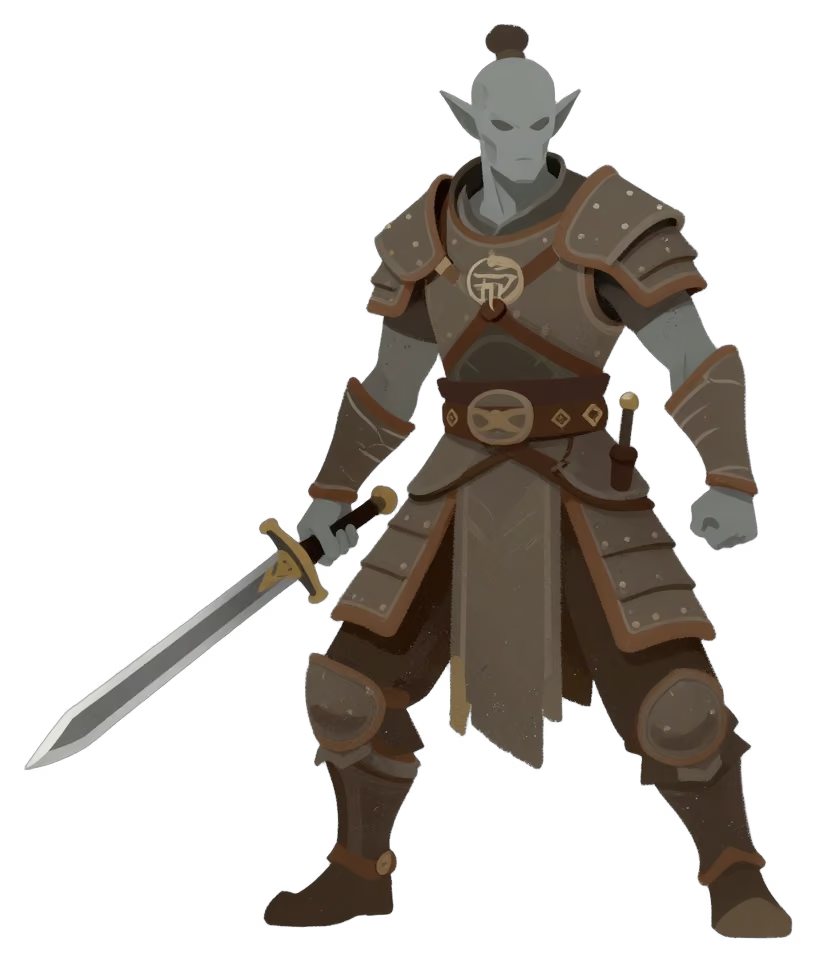
The tem'mati are a splinter race of the githzerai. No one knows how or why they ended up in a remote corner of the Inner Plane of Ash, in their fortress city of Ammet Han'sha, not even the tem'mati themselves. All that is known is that these wayward gith established themselves shortly after the branch of the race calling themselves githzerai settled in Limbo.
Physically, tem'mati are identical in nearly every way to a "typical" githzerai. The only outward difference is their skin, which instead of the standard cream to mahogany tint, is a lightly, soft gray colour. The similarities end in appearance, however. The tem'mati split from the githzerai when githzerai culture was very young, so the language, customs, and government are different (although the tem'mati have the same chaotic outlook, and a more disorganised society).
Combat
The tem'mati are a fairly vicious people (living on Ash, this is no surprise). They are very brave and capable fighters. They have the same standard classes available to normal githzerai (although due to isolation, are no longer subject to the limitations imposed by the sorcerer-king), and fight accordingly. The vast majority of tem'mat are fighters.
Typical armament includes a light chain mail suit (metal is fairly rare here, and armour is considered sacred to the warriors), and one weapon, typically some kind of axe. Although unwieldily, axes are the primary weapons of the Warrior Guild, and nearly all have one.
Warriors in defence of Ammet Han'sha always travel in squads of 3 to 7, made up of fighters or varying experience level (although it is rare to see any of higher level than 5, more experienced soldiers often have more important duties).
Habitat/Society
The tem'mati have a fairly sophisticated, if chaotic, society. Every tem'mat belongs to a Guild, and those Guilds rule themselves in a mostly democratic fashion. There are Guilds: The Warriors (charged with the defence of Ammet Han'sha and the tem'mati), The Hunters (charged with the duty of finding food), The Travellers (charged with the duty of trading with other peoples and exploring the rest of the planes), The Observers (charged with recording the history and keeping records), and The Caretakers (charged with the thankless task of upkeeping the city and stopping riots, which is actually necessary).
If a member of one guild has problems with a member of another, the offended tem'mat goes to the leaders of the offender's Guild leaders and demands punishment. Obviously, this fact and the fact that there is no central government at all, makes the Tem'mati a very fractured people. Disputes arise over crimes, territory, food rights (in the plane of Ash, food is a very large concern). The only thing, it seems, that the Guilds will unite to tackle are outsiders. The Tem'mati are very suspicious of other people, even members of other Guilds.
Ecology
The tem'mati have somehow managed to survive in the inhospitable plane of Ash. They eat primarily vermin and other native beings close to the fortress-city of Ammet Han'sha, and whatever they can get though trading. They have also found a pocket of pure Water very close to their city. All in all, they have totally adapted to this horrid place.
All tem'mati can breathe ash (and have little trouble breathing dust) as well as air, and have a very high heat tolerance. They also need very little food and even smaller amounts of water to survive.
Variants
The tem'mati are a fairly small group, so there are more or less no variants. The only thing remotely resembling a variant species are a special group within the Travellers Guild. The tem'mati seem to have lost their natural aptitude with psionics. This subgroup, known as the Ash Treaders, have developed a psionic ability they use to propel large ships through the wastes of the plane. They are a very respected group within the Travellers, but, so far, they haven't developed any other abilities.
Also in this section of the source
Ash Xorn
(Anonymous submission)
by Hadjenn, an Ash Genasi of some note
Now, one of the only societies you're likely to find in the Ash is that of the ash xorn, a peculiar offshoot of the Earth's famous race. They're not much to look at - trilateral symmetry, with a single three-flapped mouth, long arms, short legs, and huge pearls for eyes. They're ill-suited to speaking any of the Trade Tongues, but a few have learned -- you'll find one in each successful tribe -- so communication shouldn't matter unless you're a Mindlander unfamiliar with out variations of Planar Common (or, better yet, Planar Uncommon).
The Ash Xorn're found mainly in three distinct regions -- the Ash's core, which makes up most of the plane, the Wasting Place, where the Ash meets the Dust, and the Cinder Wells, where the Ash meets the Magma. They aren't a highly organised society (like, say, the efreet are), but rather are clannish, and live in small nomadic tribes. Each tribe has one concern - finding enough to eat.
You see, like the Earth's xorn, ash xorn eat minerals and gems. However, their dual nature (being that of earth and dust) forces them into a more restricted diet. They eat gems called 'Firesouls' in their language - like diamond, but much softer and made from compressed ash, and they eat smelted metal, much like the kind which can be scavenged from the shores of the Cinder Wells. Rumour has it that they also eat frozen flames from the edge of the Fire, but most I've talked to have never done it themselves, nor met anyone who has.
Because there is less food for them to scavenge, ash xorn are cannier than the Earth's xorn (one argues that the increased competition has bred more powerful minds in them), and are incredibly skilled in a mystical art which allows them to find metals and minerals from a distance, using only their minds. However, since the Ash is so sparsely populated, ash xorn're much less confrontational - there are few borders they are required to respect.
Ash xorn're on good terms with the native quasi-elementals who, in general, consider them natives and a pleasant alternative to ash mephits. Since the one doesn't eat the food of the other, they exist as separate parts of the ecosystem, and rarely clash.
If you should meet any xorn of the Ash, they're sure to ask you if you've seen 'food' - tell them of any veins of metal you've crossed, and any gems you might have found. the help of an ash xorn is far more valuable than a few baubles, and the pleasant creatures will do much to aid an honest and forthcoming employer - the life of their tribe depends on food, so they get it by any means.
The flip side, of course, is that those who refuse to help ash xorn are likely to upset not only them, but any quasi-elementals friendly to the tribe. If the xorn think a person is hiding food (through their mystical art, for example), they will probably attack to get it if polite requests are refused.
There are no ash xorn cities, to my knowledge, but there are a very few hermitic xorn to be found. The industriously inaccurate chant has it that some ash xorn have mastered a sort of magic - the truth is that they have mastered something much stranger - an art humans have called 'psionics.' Through their minds alone, these mystics can form food of their own from the land around them, which they trade to travellers in exchange for news of the multiverse, luxury goods, and training in new powers.
One last thing to remember about ash xorn - they aren't grazers like the Earth's xorn are. They are scavengers, who live by their own laws to get what they want. They may be a bit weaker, but they will ply their impressive intellects to defeat any foe they need offensive. They make excellent guides and unparalleled prospectors, but they also make fearsome enemies.
Native Sons
- Aeshar (MMC)
- Animental (PSMC3 14)
- Bulette (MM 33)
- Dragon, Brown (MM 80)
- Dune stalker (PSMC )
- Fundamental (PSMC3 46)
- Hatori (MM 185)
- Khirth (PSMC3 123)
- Koylith (MMC)
- Mephit, Dust (PSMC )
- Quasielemental, Dust (PSMC3 78)
- Rust monster (MM 305)
- Ruvoka, Gobinhu (PSMC3 90)
- Sandling (MM 102)
- Sandman (PSMC )
- Tabbitbug (PSMC3 123)
- Valkarthi (MMC)
- Verd (PSMC3 123)
- Worm, Lukhorn (MA4 91)
- Worm, Purple (MM 364)
Encounters
- Chososion (PSMC3 26)
- Entrope (PSMC3 38)
- Genie, Dao (MM 126)
- Menglis (PSMC3 60)
- Opposition explorers (PSMC3 66)
- Primal procession (PSMC3 74)
- Web, Living (MCA3 117)
The Dust Quasielemental
A Chinese Portrait (by The Dust Concubine)
| Category | Portrait |
|---|---|
| A natural phenomenon | Erosion |
| A metal | Rust |
| An animal | An ageing elephant, limping into the savannah on a broken leg |
| A colour | Gray and other pastel earth tones |
| A mythological being | Chronos |
| A human activity | Destroying a great palace |
| A work of art | Deconstructionism |
| A weapon | A battering ram |
| An object | A rotten, moth-eaten wedding dress |
Dust Quasielementals
Familiarity: To summon a dust quasielemental, an valuable object must be ritually destroyed. Crumble spirits like those unattached to material things, and vandals.
Demands: In return for continued aid, dust quasielementals ask for rare minerals, art objects, and gemstones.
Benefits: Who wouldn't want a dust quasielemental for a friend? A friendly dust quasielemental won't kill you right away, for one thing. There are even stories of shamans and sha'irs and dust priests being supplied by them with destructive spells.
History: If the mineral quasielementals build the lattices of the worlds, dust quasielementals take them apart so they can be built again. It's thought that the spirits of Dust are the older of the two, and that they selected their duty themselves.
Spiritual correspondences: Crumbling, decaying, falling apart, destruction, disintegration, ageing, and time.
Material correspondences: Dust, sand, dry rot, mulch.
Taboos: Dust quasielementals can never create anything themselves.
Attitude: They are hostile to most everyone.