Ixnae
| Statistic | Value |
|---|---|
| Climate/Terrain | Desert, Hinterlands |
| Frequency | Very Rare |
| Organisation | Tribe |
| Activity Cycle | Any |
| Diet | Carnivore |
| Intelligence | Low (6-8) |
| Treasure | Incidental (if any) |
| Alignment | Neutral |
| No. Appearing | 1-12 |
| Armour Class | 8 |
| Movement | 15 |
| Hit Dice | 2 + 2 |
| THAC0 | 15 |
| No. of Attacks | 2 |
| Damage/Attack | By weapon type |
| Special Attacks | Estrangement, concealment |
| Special Defences | Vanish |
| Magic Resistance | 40% |
| Size | S (4-5' tall) |
| Morale | Average (8-10) |
| XP Value | 2,000 |
Description
Beyond the well-honed belief-systems of the Outland Gate-Towns lie the Hinterlands -- an hypnotic vagary of hypothesis and conjecture. The ixnae embody this suspension of belief, natives of a gauze-like border between the Hinterlands and the the Ethereal Plane.
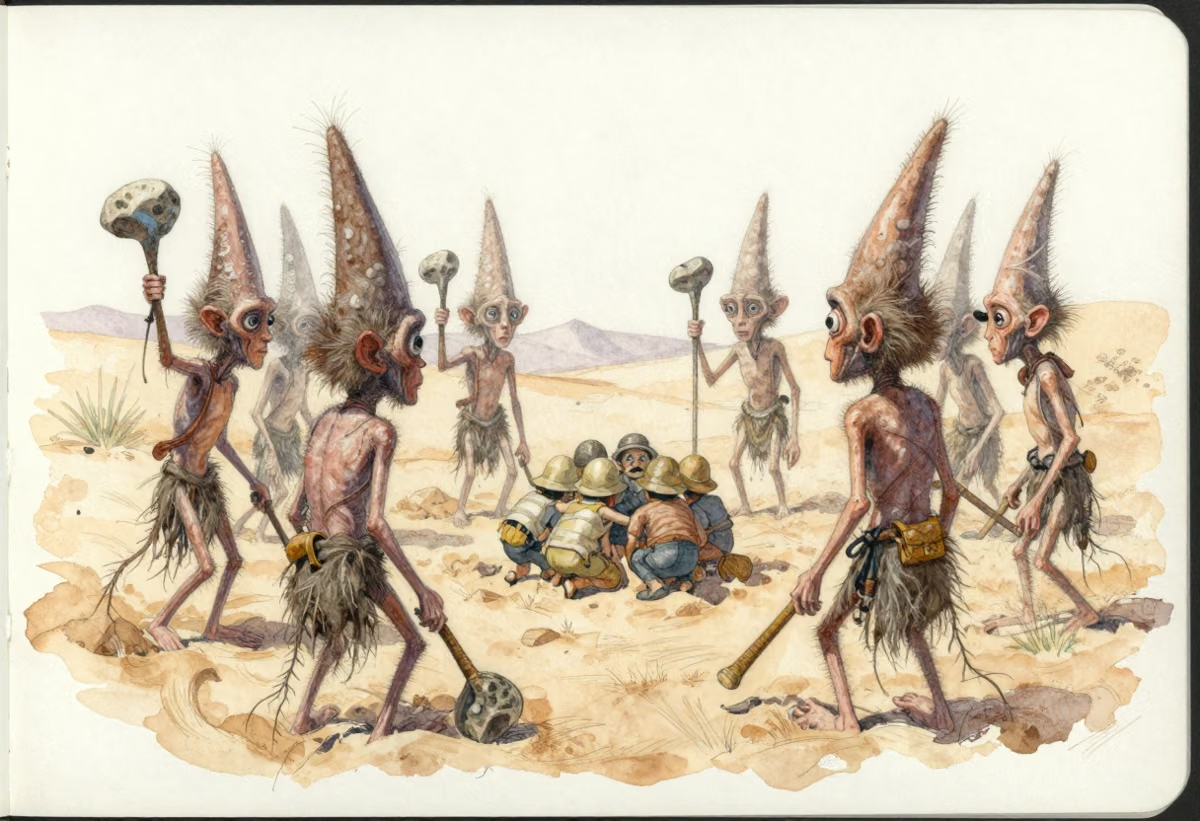
Each member of the ixnae (there is no singular noun) resembles a slender, Dwarvish humanoid. However, there is an unhealthy disproportion between the features of each individual. The heads are slightly too large, taking up almost a third of the creatures' height the arms and legs dangle beneath like taproots. The skull is more conical than round, tapering to a nobbly cluster of hair. Each enormous pair of eyes seems wet and vulnerable in the sand-swept plains, yet burns with a savage hunger for the flesh of those with conviction.
Combat
The ixnae are essentially a race of cannibalistic humanoids, and they fight in a manner torn from a colonist's nightmare. Any sentient (believing) being is potential prey to the ixnae, who often begin by circling a party of explorers and 'tightening the noose'. After an initial volley of blown darts, the Ixnae pounce collectively, wielding clubs, claws, fists or stones. However, despite their ungainly appearance and mundane arsenal, the ixnae score damage in proportion to the strengths of their victims.
To elucidate: Imagine the 'Boy's Own Adventures' popular in Victorian times. Picture the small party of knock-kneed explorers, all pith-helmets and handle-bar moustaches. Now picture a lost battalion of fiends, keyed up for the Blood-War. Now magnify the experience of the explorers so that it is proportionately equivalent to the baatezu victims.
The Ixnae also have the uncanny ability to blend into the desert around them, becoming completely undetectable until moments before the attack commences. This can also effect an escape if overpowered. Finally, the physical appearance of the ixnae is so unsettling -- so conceptually wrong -- that it can set an Ultroloth's opalescent eyeballs on edge. Sighting a member of the Ixnae warrants a save vs. Paralysation, otherwise the character is unable to act for 1d4 rounds.
Habitat/Society
Where there is a semi-mythical tribe of pygmy cannibals, there is certainly a chieftain and a witch-doctor / shaman. However, there is no individualism in the ixnae, they operate as a community. If there is a language behind their guttural grunting, no-one has yet been able to decipher it by means magical nor mundane.
Ecology
Here's the dark of the ixnae ... being a semi-tangible blend of Hinterland and ether, the ixnae exist in the heads of their victims as much as in the metaphysicality of the Outer Planes. That is not to say that the ixnae are not real ... rather they are unreal. Not having belief of their own substantial enough to enforce their existence, the ixnae feed (literally) on the belief of others by consuming their bodies. Theoretically, a lack of nourishment would cause them to fade into the sand ... but as the pulpy embodiment of established mythology, the ixnae will always be half-there.
Also in this section of the source
Butterfly, Spire
By Jon Winter, Eric Jackson, Ian Watson, Simmo, and Eliav Eini, artwork by Jeremiah Golden
Statistics
| Statistic | Value |
|---|---|
| Climate/Terrain | The Spire |
| Frequency | Common |
| Organisation | Swarm |
| Activity Cycle | Day |
| Diet | Magical energy |
| Intelligence | Semi (2-4) |
| Treasure | None |
| Alignment | Neutral |
| No. Appearing | 10-100 |
| Armour Class | 6 |
| Movement | Fl 11 (A) |
| Hit Dice | 1 hp |
| THAC0 | 15 |
| No. of Attacks | 1 |
| Damage/Attack | 1 hp per 10 butterflies |
| Special Attacks | Prance, magic missile |
| Special Defences | Drain magic |
| Magic Resistance | See below |
| Size | T (6" wingspan) |
| Morale | Elite (14) |
| XP Value | 100 |
Description
Think the Spire was just a magic-draining hunk of rock, cutter? Well, think again. There's more darks to the Spire than there are butterflies swarming around it. Butterflies, you ask? Yeah, the same. How can butterflies be mysterious, you ponder? Think on this: Of all the creatures that infest the planes, none can use their magical powers dead-centre in the Outlands, save the Spire Butterflies. How, you wonder? Berk, that's just the way things are..."
— Magnum Opus, curator of Sigil's Musée Arcane
One of the Multiverse's more perplexing mysteries, the Spire butterflies have long defied explanation by sages, mages and Guvner zoologists. Simply, their very existence see to thumb its nose at one of the Multiverse's Constants: Magic Does Not Work At The Spire. For the butterflies, it most certainly does. Spire butterflies look much like normal monarch butterflies except they're a much more vivid colour scheme; pinks, yellows, cyans and turquoise greens, every one of them changing colour as the mood suits them. They're usually found in great flocks which dance about the Spire's skies like giant multicoloured clouds.
Combat
Spire butterflies seem slightly more intelligent than most insects. They're naturally curious, so when a swarm spots a new arrival to the Spire, it's more than likely they'll flit over en masse to inspect the cutter. Except the rilmani, that is. For some strange reason, butterflies always flee at first sight of one of these bloods. But unless you've got rilmani blood, expect to be liberally visited by Spire butterflies if you ever make the long trek to the Centre of the Outlands.
Sure, these critters are little more than insects, so you'd think swatting one would be little more than a moment's work. But cutter, before you get so heavy-handed, you'd better consider that special power of theirs again. Unique amongst creatures, this species of butterflies are able to use magic at the Spire. In fact, Spire butterflies apparently feed on magical energy. Their wings crackle, glow, screech, and shine with the sights, sounds, smell, taste, and feel of various spells. Without magical energy to sustain them, their wings eventually fade away, and the butterfly is helpless until it either gains more magical energy or dies. The wings fade completely within 48 hours of its last meal, and it dies 48 hours after that.
If you thought a creature that fed on magic and lived at the Spire would get mighty hungry, you'd be wrong. Somehow, the butterflies are able to sense magic potential, and congregate towards it. This basically means that if you've got an enchanted sword, and you take it to the Spire, while it mightn't function at all, Spire butterflies can sniff it out from up to one mile away, and will pay you a visit.
That's not all. Spire butterflies can also "see" spells in the heads of wizards and priests, and it seems they're quite partial to those too. It takes one round to drain a charge from a magical item touched, and one turn to drain the highest level of magic from a wizard or priest. (This level loss can be restored with a full eight hours sleep). Spire butterflies are so light that one cannot feel the weight of one when it lands on him. From a distance, a landed butterfly might appear to be a bow or other head decoration, or perhaps a peace knot. After being drained, a cutter will feel a strange tingling sensation, and a mage or priest will be rather light-headed. The result of a butterfly's draining is similar to the effect generated by a wizard sitting on a spelljamming helm: It's as if the mage had cast all the spells they had memorised. Makes a body wonder what they make those helms from...
It only takes one 'fly to touch the magical source for the whole flock to feed. Strange, but apparently true. Spire butterflies can also absorb any spell that's cast at them, not that this happens very often. They're unaffected by any negative effects the spell may have.
If roused to anger (and that's not so difficult as you'd think, cutter) a swarm of 'flies will attack, their sharp wings and tiny talons inflicting 1 hp damage per 10 insects. Rather more fearsome, however, is their ability to sting. Like prime world bees, each butterfly can sting once and then dies. Unlike bees, their stings are basically magic missiles. They strike unerringly are 1d4+1 hit points of damage, and can be fired up to 30 feet! Imagine, then, how dangerous an angry swarm of one hundred stinging 'flies can be...
Spire butterflies also bob and weave (rilmani call it the prancing) in a strangely hypnotic way, if they so desire. Any basher who sees these colourful insects must make a save vs. spells or be charmed as if by the spell charm person. Charmed cutters can't be commanded unless they understand the 'flies strange language of dance and colour changes, but they're transfixed by the beauty of the dance and will try to protect the insects.
Habitat/Society
Spire butterflies are found almost exclusively around and on the Great Spire of the Outlands, and out as far as the second or third ring. They live as most butterflies, drinking the nectar of plants, but no matter how many flowers they visit, without magical energy, they fade away. They appear to be semi-intelligent, berks have told stories about being getting lost near the Spire and then led to safety by Spire Butterflies.
A few rumours have rattled around the Cage of late about black butterflies living inside the Spire. These stories say that they're far more intelligent than the surface 'flies and have formed their own bizarre civilisation. Of course the berks who tell these stories also spend a lot of time drooling on themselves. Getting permission from the Rilmani to investigate this story has proved as difficult as a roomful of mephits.
Ecology
Spire butterflies serve the same purpose as butterflies everywhere. They pollinate plants. Due to their small size and reliance on nectar as their only source of food, Spire butterflies pose no threat to humans or other humanoids. See one mystery, see a raft of conspiracies. At least, that's what some cutters seem to think. The Spire 'flies have been the subject of much wild speculation by the self-same sages and mages and Guvner zoologists. Like all good conspiracy theories, these rumours are based on nothing more solid than fancy...but what if they were true...?
"After thinking about the butterflies that live at the Spire... I have come to the conclusion it is likely that the larval stage of their development is in humanoid shape. By that I mean the Dabus are the larval stage, and One butterfly in every generation becomes the parent of the new generation. That parent is none other than what is generally known as The Lady of Pain. The Dabus receive life energy from their parent who is a focal point of planar energy drawn up through the Spire."
— Gothyk, a shaman-sage of the Third Ring
Whether this has anything to do with the strange aversion the 'flies have to rilmani is unknown, but some dark chant floating about reckons the rilmani have discovered a concoction of crushed butterfly that they can drink to temporarily regain the use of their own magical powers at the Spire. More screed?
Perhaps. But there are too many reports of rilmani doing things they shouldn't be able to do at the Spire to let this rumour rest in peace.
It has been speculated, however, that the butterflies are in fact agents of the rilmani, balancing the use of magic near the Spire. Legends are also told of a pit fiend who was defeated by a huge swarm of Spire butterflies. Apparently he was so ashamed he fled back to Baator and has never been heard of since.