Butterfly, Spire
| Statistic | Value |
|---|---|
| Climate/Terrain | The Spire |
| Frequency | Common |
| Organisation | Swarm |
| Activity Cycle | Day |
| Diet | Magical energy |
| Intelligence | Semi (2-4) |
| Treasure | None |
| Alignment | Neutral |
| No. Appearing | 10-100 |
| Armour Class | 6 |
| Movement | Fl 11 (A) |
| Hit Dice | 1 hp |
| THAC0 | 15 |
| No. of Attacks | 1 |
| Damage/Attack | 1 hp per 10 butterflies |
| Special Attacks | Prance, magic missile |
| Special Defences | Drain magic |
| Magic Resistance | See below |
| Size | T (6" wingspan) |
| Morale | Elite (14) |
| XP Value | 100 |
Description
Think the Spire was just a magic-draining hunk of rock, cutter? Well, think again. There's more darks to the Spire than there are butterflies swarming around it. Butterflies, you ask? Yeah, the same. How can butterflies be mysterious, you ponder? Think on this: Of all the creatures that infest the planes, none can use their magical powers dead-centre in the Outlands, save the Spire Butterflies. How, you wonder? Berk, that's just the way things are..."
-- Magnum Opus, curator of Sigil's Musée Arcane
One of the Multiverse's more perplexing mysteries, the Spire butterflies have long defied explanation by sages, mages and Guvner zoologists. Simply, their very existence see to thumb its nose at one of the Multiverse's Constants: Magic Does Not Work At The Spire. For the butterflies, it most certainly does.
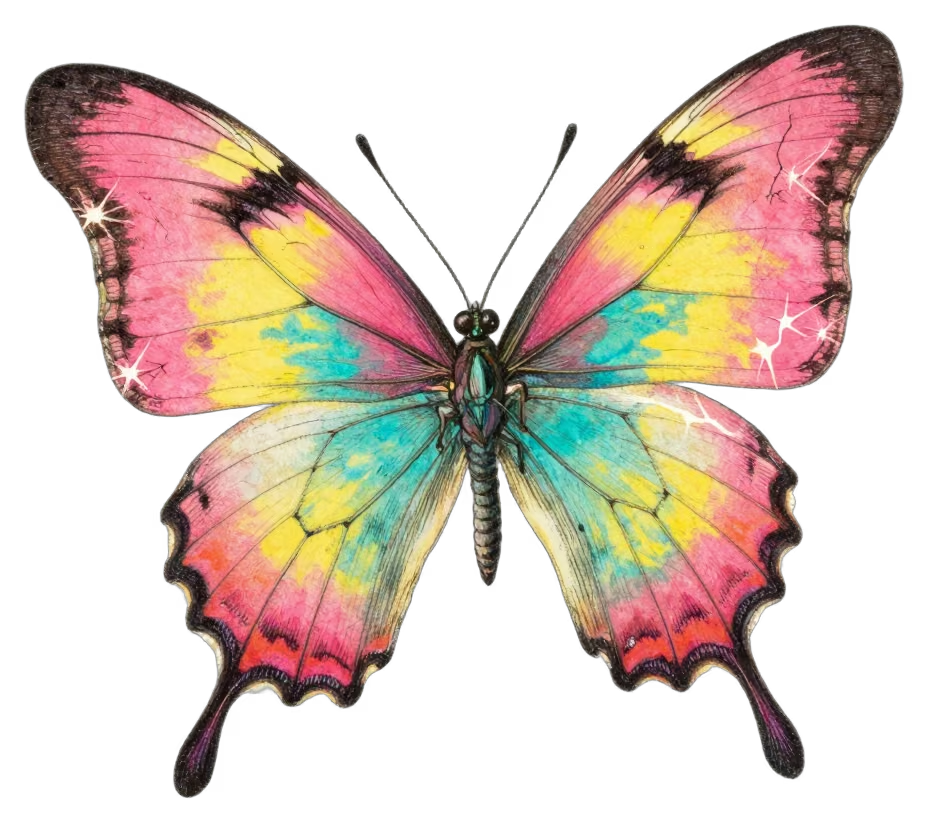
Spire butterflies look much like normal monarch butterflies except they're a much more vivid colour scheme; pinks, yellows, cyans and turquoise greens, every one of them changing colour as the mood suits them. They're usually found in great flocks which dance about the Spire's skies like giant multicoloured clouds.
Combat
Spire butterflies seem slightly more intelligent than most insects. They're naturally curious, so when a swarm spots a new arrival to the Spire, it's more than likely they'll flit over en masse to inspect the cutter. Except the rilmani, that is. For some strange reason, butterflies always flee at first sight of one of these bloods. But unless you've got rilmani blood, expect to be liberally visited by Spire butterflies if you ever make the long trek to the Centre of the Outlands.
Sure, these critters are little more than insects, so you'd think swatting one would be little more than a moment's work. But cutter, before you get so heavy-handed, you'd better consider that special power of theirs again. Unique amongst creatures, this species of butterflies are able to use magic at the Spire. In fact, Spire butterflies apparently feed on magical energy. Their wings crackle, glow, screech, and shine with the sights, sounds, smell, taste, and feel of various spells. Without magical energy to sustain them, their wings eventually fade away, and the butterfly is helpless until it either gains more magical energy or dies. The wings fade completely within 48 hours of its last meal, and it dies 48 hours after that.
If you thought a creature that fed on magic and lived at the Spire would get mighty hungry, you'd be wrong. Somehow, the butterflies are able to sense magic potential, and congregate towards it. This basically means that if you've got an enchanted sword, and you take it to the Spire, while it mightn't function at all, Spire butterflies can sniff it out from up to one mile away, and will pay you a visit.
That's not all. Spire butterflies can also "see" spells in the heads of wizards and priests, and it seems they're quite partial to those too. It takes one round to drain a charge from a magical item touched, and one turn to drain the highest level of magic from a wizard or priest. (This level loss can be restored with a full eight hours sleep). Spire butterflies are so light that one cannot feel the weight of one when it lands on him. From a distance, a landed butterfly might appear to be a bow or other head decoration, or perhaps a peace knot. After being drained, a cutter will feel a strange tingling sensation, and a mage or priest will be rather light-headed. The result of a butterfly's draining is similar to the effect generated by a wizard sitting on a spelljamming helm: It's as if the mage had cast all the spells they had memorised. Makes a body wonder what they make those helms from...
It only takes one 'fly to touch the magical source for the whole flock to feed. Strange, but apparently true. Spire butterflies can also absorb any spell that's cast at them, not that this happens very often. They're unaffected by any negative effects the spell may have.
If roused to anger (and that's not so difficult as you'd think, cutter) a swarm of 'flies will attack, their sharp wings and tiny talons inflicting 1 hp damage per 10 insects. Rather more fearsome, however, is their ability to sting. Like prime world bees, each butterfly can sting once and then dies. Unlike bees, their stings are basically magic missiles. They strike unerringly are 1d4+1 hit points of damage, and can be fired up to 30 feet! Imagine, then, how dangerous an angry swarm of one hundred stinging 'flies can be...
Spire butterflies also bob and weave (rilmani call it the prancing) in a strangely hypnotic way, if they so desire. Any basher who sees these colourful insects must make a save vs. spells or be charmed as if by the spell charm person. Charmed cutters can't be commanded unless they understand the 'flies strange language of dance and colour changes, but they're transfixed by the beauty of the dance and will try to protect the insects.
Habitat/Society
Spire butterflies are found almost exclusively around and on the Great Spire of the Outlands, and out as far as the second or third ring. They live as most butterflies, drinking the nectar of plants, but no matter how many flowers they visit, without magical energy, they fade away.
They appear to be semi-intelligent, berks have told stories about being getting lost near the Spire and then led to safety by Spire Butterflies.
A few rumours have rattled around the Cage of late about black butterflies living inside the Spire. These stories say that they're far more intelligent than the surface 'flies and have formed their own bizarre civilisation. Of course the berks who tell these stories also spend a lot of time drooling on themselves. Getting permission from the Rilmani to investigate this story has proved as difficult as a roomful of mephits.
Ecology
Spire butterflies serve the same purpose as butterflies everywhere. They pollinate plants. Due to their small size and reliance on nectar as their only source of food, Spire butterflies pose no threat to humans or other humanoids.
See one mystery, see a raft of conspiracies. At least, that's what some cutters seem to think. The Spire 'flies have been the subject of much wild speculation by the self-same sages and mages and Guvner zoologists. Like all good conspiracy theories, these rumours are based on nothing more solid than fancy...but what if they were true...?
"After thinking about the butterflies that live at the Spire... I have come to the conclusion it is likely that the larval stage of their development is in humanoid shape. By that I mean the Dabus are the larval stage, and One butterfly in every generation becomes the parent of the new generation. That parent is none other than what is generally known as The Lady of Pain. The Dabus receive life energy from their parent who is a focal point of planar energy drawn up through the Spire."
-- Gothyk, a shaman-sage of the Third Ring
Whether this has anything to do with the strange aversion the 'flies have to rilmani is unknown, but some dark chant floating about reckons the rilmani have discovered a concoction of crushed butterfly that they can drink to temporarily regain the use of their own magical powers at the Spire. More screed? Perhaps. But there are too many reports of rilmani doing things they shouldn't be able to do at the Spire to let this rumour rest in peace.
It has been speculated, however, that the butterflies are in fact agents of the rilmani, balancing the use of magic near the Spire. Legends are also told of a pit fiend who was defeated by a huge swarm of Spire butterflies. Apparently he was so ashamed he fled back to Baator and has never been heard of since.
Also in this section of the source
Malakin
By Martin Bourassa
| Statistic | Value |
|---|---|
| Climate/Terrain | Any Lower Plane and Outlands |
| Frequency | Rare |
| Organisation | Band |
| Activity Cycle | Any |
| Diet | Carnivore |
| Intelligence | High to Genius (14-19) |
| Treasure | L, T |
| Alignment | Neutral Evil |
| No. Appearing | 1-6 |
| Armour Class | 5 |
| Movement | 12 |
| Hit Dice | 7 + 3 |
| THAC0 | 13 |
| No. of Attacks | 1 or 2 |
| Damage/Attack | 1d12+6 (Mala-griff) or 1d6/1d6 (claws) |
| Special Attacks | Domination, music, spell abilities |
| Special Defences | Hit only by +1 or better weapon |
| Magic Resistance | 55% |
| Size | M (5' tall) |
| Morale | Elite (13-14) |
| XP Value | 6,000 |
The Mala'kin, or herders, are a race of nomadic fiends travelling the lower planes and the Outlands. They have no interest in the Blood War and their motives are kept mysterious. They herd petitioners like a man herds sheep (or a hag herds larvae). They keep magical controls over their "cattle" with their magical weapons called the Talons of Malar, their amulets and flutes. Mala'kin are a rather small race, averaging about 5 feet tall. They have thin long arms and most are pot-bellied. Their legs are goat-like, with sharp hooves and coarse fur. To complete their satyr-like appearance, they have short horns and goat ears.They have a long, hairless, prehensile tail. Their faces have always exagerated, grotesque features, beastlike. Their skin color vary, though always sick-looking . Do not laugh, however, for mala'kin ahey are powerful beings. They always carry a weapon called Mala-griff (talon of Malar). It looks like a pole with a mechanical claw at the top. An amulet and heavy chain usually rest on their chests.
Combat: Mala'kin prefer to attack with their Mala-griff. If disarmed, they claw at opponents with their strong arms. They have no problem with petitioners: a note on their magical flutes and the petitioners' wills are broken utterly, allowing them to be directed with the Mala-griff (save versus spell -4 to resist the effect of the flutes). Against other foes, things are different. The Mala-griff act as a trident of domination (save versus spell or helpless for 2-8 rounds). The amulet is more potent still: it act as a charm person (or monster) spell (1 time per person/week). What they can't dominate, they destroy. At will, they can summon the effects of a chromatic orb of any kind. Slow (3/day), polymorph other (1/week) and teleport without error (1/week). They don't use the last ecxept when absolutly neccessary because it lets theire herd unguarded.
Habitat/Society: Mala'kin live to herd petitioners. They're on the move constantly and never willingly step into a town. No one knows why they herd petitoners, since they do not seem to gain nothing out of it. Another thing dark about this kind is theire magical items. Maybe it's really theire patron Malar they're always talking about that give them to the Mala'kin. Baatetzu respect Mala'kins for their loyalty (that makes them easier to peel) and Tanar'ri despise them. Once a petitioner is part of a Mala'kin herd, the fiend produces a little amulet out of his own and puts it around the petitioner's neck. Then the petitioner under go a radical transformation: in 2d6 weeks he mutates into a goat-like thing. It's a slow, progressive change, but after that time he walks on all four and he is not recognizable by anyone. A goat-like petitionar is called a Malakian. If someone steals the amulet of a still living Mala'kin (any, even a Malakian), he transforms into a Mala'kin of the same rank in 1d6 days as the original withers and die. The unfortunate thief cannot get ride of the amulet. If a Mala'kin is killed, its amulet is destroyed. A herder won't make his herd fight for him, for he place its value before his life.
Ecology: Like many fiends, Mala'kin eat for pleasure only, and certainly never harm their petitoner/malakian charges. There are many rumours as to why this is, but it's a cert it's something to do with Malar the Beast Lord...
Current Chant: Mala'kin herds with the help of the Mala'dims (or brutes), strong mixting of fiend and machine. In order of promotion there are the Malakians, the "cattle", the herders, the brutes, the nomads (or warriors), the juggernaughts, the Barons, and the all mighty Malarians. The guardians are Herders who got demoted when they lose their herds. This kind is barmy by any standards (even a fiend's), they are evil and loyal, yet their not lawful. The pattern of promotion is weird indeed: the herders fear being promoted to brutes because they are far less intelligent. Once in a while, however, when a herder's herd reach a certain size, he is drawn to a place known only to them, where the promotion occurs. the Malakians life force is used to fuel the transformation. Malakians are transformed into herders and so on. The whole barmy race seems to be an operation of Malar to drain gods of their petitioners but they do nothing about it. The Herders are not welcome on Pluto, the realm of Hades.
Mock
By Martin Bourassa, art by Jeremiah Golden
| Statistic | Value |
|---|---|
| Climate/Terrain | Sigil, the Outlands, Pandemonium |
| Frequency | Rare |
| Organisation | Solitary |
| Activity Cycle | Any (night preferred) |
| Diet | Omnivore |
| Intelligence | Average to High (8-14) |
| Treasure | S |
| Alignment | Chaotic Neutral (Good) |
| No. Appearing | 1 |
| Armour Class | 4 |
| Movement | 20 |
| Hit Dice | 3 + 1 |
| THAC0 | 15 |
| No. of Attacks | 1 |
| Damage/Attack | 1d3 or by weapon type |
| Special Attacks | Backstab, gaze attack |
| Special Defences | Invisibility, thief skills |
| Magic Resistance | 20% |
| Size | S (3' tall) |
| Morale | Steady (11) |
| XP Value | 650 |
They run trough the Cage, invisible, silent as shadows, stealing bits of food here and there and bits of chant too. They brag about being the best spies of the multiverse, and that's probably true. They are the sprites of the planes; they are the mocks. If someone spies a mock when it is visible, he might see a little, hairless, grey skinned humanoid, with an elongated head and features.
They have no noses, and only a slit of a mouth. They have cat-like ears, but down-turned. Their fingers are very long; all the better for snatching things. Their feet are big and flat. If someone met a mock's gaze he'd see that its eyes were black and pupil-less, and with something vaporous shifting inside. That might be the last thing he sees.
Combat: Of course, the mock is almost always invisible, because it doesn't want to hurt or scare people. In combat, a mock's invisibility lend him a great advantage, those who want to strike it does with a -4 penalty to attack rolls. A dispel magic makes a mock visible for 1 turn if he fails a saving throw versus spells. Mocks hate combat and do fight only when cornered, which is a very rare event. It is never surprised and can see all things invisible and through illusions. If they must attack, they do it by surprising it's opponent. They can also use these thief skills:
- Move Silently: 99%
- Pick Pockets: 95%
- Climb Walls: 90%
- Find/Remove Traps: 90%
- Detect Noise: 99%
They fight with blades as daggers and short sword. They can backstab an opponents for five times the normal damage. If invisible and silent, opponents are always surprised. Their last and most powerful ability is mostly a curse for most mocks...
If someone meets a mock's gaze, he must save versus petrification or be turned into an harmless shadow, turning barmy in 1-4 days and dissipating in 1-6 days. In that state, he cannot affect physical beings or talk. He can see invisible mocks and talk to them, but most can't help. Nothing less than a wish can save a shadowed berk. They may use potions.
Habitat/Society: Mocks are a sad bunch. Forced to be lonely for all their lives, which are usually long: their life span is of 250 years in the average case. Their only pleasure in life is to play harmless pranks on unwary folks. Only the dabus truly know of the mocks' existence in the Cage, and view them as mere pests. Sometimes a mock will stroll the streets wearing a heavy cape and cowl, but underneath it's still invisible. They may be hired as spies or thieves, for they are the masters of the arts nefarious. Evil mocks may be hired as assassins.
Ecology: Many things hint that mocks are not natives of the Outer Planes, but most sages agree they are planars, plane-touched like the tieflings. They might have been Prime halflings, but they have been warped by the essence of a plane, surely Pandemonium. They have not been turned evil by the plane, but they are highly chaotic. Yet they'll do a good action instead of an evil one, sometimes saving a life and fleeing afterwards. Some mocks resent their loneliness, and take out their anger on others. These are chaotic evil mocks.
Chant: When invisible, mocks seem to slip slightly in another dimension as with the victims of their gaze. When there, they are vulnerable to the attacks of the hostile inhabitants: the whogloaks. Another rather interesting thing is that mocks don't need gate keys to operate portals in and out of Pandemonium as they seem to function as living gate keys themselves. Investigations continue...
Ixnae
By the Groke, artwork by Steve Wallace
| Statistic | Value |
|---|---|
| Climate/Terrain | Desert, Hinterlands |
| Frequency | Very Rare |
| Organisation | Tribe |
| Activity Cycle | Any |
| Diet | Carnivore |
| Intelligence | Low (6-8) |
| Treasure | Incidental (if any) |
| Alignment | Neutral |
| No. Appearing | 1-12 |
| Armour Class | 8 |
| Movement | 15 |
| Hit Dice | 2 + 2 |
| THAC0 | 15 |
| No. of Attacks | 2 |
| Damage/Attack | By weapon type |
| Special Attacks | Estrangement, concealment |
| Special Defences | Vanish |
| Magic Resistance | 40% |
| Size | S (4-5' tall) |
| Morale | Average (8-10) |
| XP Value | 2,000 |
Beyond the well-honed belief-systems of the Outland Gate-Towns lie the Hinterlands -- an hypnotic vagary of hypothesis and conjecture. The ixnae embody this suspension of belief, natives of a gauze-like border between the Hinterlands and the the Ethereal Plane.
Each member of the ixnae (there is no singular noun) resembles a slender, Dwarvish humanoid. However, there is an unhealthy disproportion between the features of each individual. The heads are slightly too large, taking up almost a third of the creatures' height the arms and legs dangle beneath like taproots. The skull is more conical than round, tapering to a nobbly cluster of hair. Each enormous pair of eyes seems wet and vulnerable in the sand-swept plains, yet burns with a savage hunger for the flesh of those with conviction.
Combat: The ixnae are essentially a race of cannibalistic humanoids, and they fight in a manner torn from a colonist's nightmare. Any sentient (believing) being is potential prey to the ixnae, who often begin by circling a party of explorers and 'tightening the noose'. After an initial volley of blown darts, the Ixnae pounce collectively, wielding clubs, claws, fists or stones. However, despite their ungainly appearance and mundane arsenal, the ixnae score damage in proportion to the strengths of their victims.
To elucidate: Imagine the 'Boy's Own Adventures' popular in Victorian times. Picture the small party of knock-kneed explorers, all pith-helmets and handle-bar moustaches. Now picture a lost battalion of fiends, keyed up for the Blood-War. Now magnify the experience of the explorers so that it is proportionately equivalent to the baatezu victims.
The Ixnae also have the uncanny ability to blend into the desert around them, becoming completely undetectable until moments before the attack commences. This can also effect an escape if overpowered. Finally, the physical appearance of the ixnae is so unsettling -- so conceptually wrong -- that it can set an Ultroloth's opalescent eyeballs on edge. Sighting a member of the Ixnae warrants a save vs. Paralysation, otherwise the character is unable to act for 1d4 rounds.
Habitat/Society: Where there is a semi-mythical tribe of pygmy cannibals, there is certainly a chieftain and a witch-doctor / shaman. However, there is no individualism in the ixnae, they operate as a community. If there is a language behind their guttural grunting, no-one has yet been able to decipher it by means magical nor mundane.
Ecology: Here's the dark of the ixnae ... being a semi-tangible blend of Hinterland and ether, the ixnae exist in the heads of their victims as much as in the metaphysicality of the Outer Planes. That is not to say that the ixnae are not real ... rather they are unreal. Not having belief of their own substantial enough to enforce their existence, the ixnae feed (literally) on the belief of others by consuming their bodies. Theoretically, a lack of nourishment would cause them to fade into the sand ... but as the pulpy embodiment of established mythology, the ixnae will always be half-there.
Aasimon, Arthurea
By Shizumaru
| Statistic | Value |
|---|---|
| Climate/Terrain | Upper Planes |
| Frequency | Very Rare |
| Organisation | Solitary |
| Activity Cycle | Any |
| Diet | Omnivore |
| Intelligence | High to Supra-Genius (13-20) |
| Treasure | Varies |
| Alignment | Chaotic Good |
| No. Appearing | 1-2 |
| Armour Class | 3 |
| Movement | 12, Fl 25 (B) |
| Hit Dice | 15 |
| THAC0 | 10 |
| No. of Attacks | 1 |
| Damage/Attack | 1d3 or by weapon |
| Special Attacks | See below |
| Special Defences | See below |
| Magic Resistance | 45% |
| Size | M (6', 9' wingspan) |
| Morale | Champion (16) |
| XP Value | 15,000 |
In the Multiverse many strange things can happen: a Dustman may found joy and love, a Hardhead might ease up persecuting Indeps or a tanar'ri might give sweeties to children. Few, however, ponder ask what might happen when a fiend falls in love with a celestial. One possible outcome when a non-evil succubus falls for a holy deva is the birth of an arthurea, a rare breed of planeborne creature.
Arthurea always spring from the union of a renegade succubus with a deva; they usually inherit the kind and compassionate nature of the deva (hence their good alignment) and the mischievousness and wildness of their fiendish blood (hence their chaotic alignment). Arthurea are unique in appearance; half of their hair is silver and the other half is black, the same goes with their wings. Even though they are considered celestials by most, other aasimon generally view them with suspicion, and archons are known to actively dislike them, probably due to their legendary disapproval or anything that can be traced back to the tanar'ri. Of all the celestial races, only eladrin and asuras really see eye-to-eye with arthurea.
Combat: Arthurea generally dislike fighting for they fear that they might loose control of themselves while in the midst of battle-lust. If pressed, however ,they fight with daggers; about 30% of them carry daggers with no less than a +2 enchantment. Unlike other aasimon, arthurea have the ability to cast both priest and wizard elemental spells. In regards to the maximum levels and number of spells they can cast, they are treated as 10th-level casters, with regards to the damage and duration of the spell however, they are treated as 20th-level casters. When an arthurea is born they are blessed with the ability to cast one of the four elemental spells, (Earth, Fire, Air or Water), and it is only in this area they may use their magic.
"From the high peak of Arcadia, Where the orb reflects light and darkness, A couple bask under its radience, One reflects the darkness of The other reflects the purity of innocence, From the centre of wavering The seed planted has blossmed into matuarity, Come forth creature of light and darkness, Come forth World Behold the creature of goodness, the Arthurea."
-- From the Birth of Arthurea, an ancient Upper Planar lyric
Arthurea also posses powers similar to that of other aasimon, such powers include: ability to assume other forms once per day, (gain special attacks but maintaining own hp, HD, intelligence..etc), cure disease (3/day), cure serious wounds (7/day), heal (3/day), the following abilities are usable once per day: detect lie, detect good, remove curse and continual light. Arthurea can also use the reversed form of their abilities where this is possible.
[NB: DMs with access to the Dark Sun accessory book "Earth, Air, Fire, Water" may use the new spells found there to add flavour to the arthurea.]
Habitat/Society: The arthurea live out with other aasimon on the Upper Planes but as mentioned above other celestials view these rare creatures with a modicum of suspicion due to the fraction of evil blood coursing through their veins. It is apparently this evil blood which causes the arthureas' legendary tempers, fits of randomness, and general weird behaviour. Deep down the creatures believe in goodness but they are sometimes rather eccentric about promoting it. For example, an arthurea detect that a cutter is telling a lie, the might pick up a holy book and whack the poor sod's head with it, screaming "Thou shall not lie!" This suits the Xaositects and the Sensates (the latter faction has the most arthurean members, although you can count them on one hand) just fine, but the Harmonium aren't too happy about them. The arthureas are extremely passionate creatures and are renowned for their dalliances with mortal and planeborne being alike. This is their succuban heritage showing through, greybeards reckon.
Ecology: It's estimated there are only some one hundred arthurea in existence, so the race generally does not have a part to play in the ecology. Individual arthurea, however, tend to be real movers and shakers; they aren't content to sit back and watch events. Generally, arthurea are fairly gregarious beings, and love hanging out with other bashers, though at times they feel the pain of their fiendish heritage and often prefer to be alone with their own thoughts.
Special Effects in Ravenloft: Effects in Ravenloft: If an Arthurea should ever finds him/herself in Ravenloft their celestial heritage will physically disrupt the fabric of the land and over time cause many natives to die. Their fiendish heritage allows them to cross any borders in Ravenloft, even closed ones; Darklords cannot keep an arthurea imprisoned when it wishes to roam. However, exercising this power calls for a Powers Checks, starting at stage one and ending with stage six (see Ravenloft materials for more info). Nothing physically happen to them until stage six, when their souls rip into two, creating a good and evil version of the arthurea. A battle to death almost certainly would ensue.
Aasimon, Twilight
By Kelly Pedersen, artwork by Chris Tan
| Statistic | Value |
|---|---|
| Climate/Terrain | Upper Planes |
| Frequency | Very Rare |
| Organisation | Solitary or small bands |
| Activity Cycle | Any (primarily nocturnal) |
| Diet | Omnivore |
| Intelligence | Exceptional (15-16) |
| Treasure | Incidental |
| Alignment | Any good |
| No. Appearing | 1-4 (Upper Planes) or 1 |
| Armour Class | 0 (-1 in shadows) |
| Movement | 12 (15 in shadow), Fl 30 (C) (Fl 36 (B) in shadows) |
| Hit Dice | 10 |
| THAC0 | 11 |
| No. of Attacks | By weapon type |
| Damage/Attack | By weapon type |
| Special Attacks | Blinding |
| Special Defences | Spell immunity, never surprised, +2 or better weapons to hit |
| Magic Resistance | 50% (60% in shadow) |
| Size | M (6 feet tall) |
| Morale | Fearless (19-20) |
| XP Value | 8000 |
Twilight aasimon have only recently been reported. Either they have been kept well hidden until now, or they were only recently created. The most prominent theory as to why they exist is that various good powers who have areas of control that deal in some way with the night wanted servants who could function effectively in it, and prove to others that darkness is not inherently evil. The result was the twilight aasimon.
Twilight aasimon are humanoid, standing about six feet tall. While they have no noticeable elven traits, like slanted eyes, or pointed ears, they also do not really look human. They are coloured the shades of the night. Their hair is a deep midnight blue, occasionally with just a touch of dawn or sunset red at the tips. Their skin is a deep gray, and their large wings are the silver of moon touched clouds. It is their eyes that proclaim their nature most noticeably, however. Twilight aasimon have no pupil, iris, or white in their eye. Instead, their eyes are dead black, scattered with glowing white point of light. In short, when one looks into their eyes, it looks like the night sky.
Combat: Twilight aasimon prefer to avoid combat as much as possible, relying on their extensive powers of stealth to get around possible opponents. However, when they do fight, they are as capable as any other aasimon.
Twilight aasimon usually carry a staff of stars, a magical +3 weapon, that does 2d4 damage. In addition to the attack and damage bonus, the staff can cast a starburst once a turn. This releases a burst of white sparks in a cone 30' long, and 10' wide at the end. Anyone caught in this cone must save vs. spells or be blinded. In addition, evil creatures native to the Lower planes take 1d6 damage, and undead take 2d6 damage. Twilights can attack twice per round with any weapon.
In addition to the spell-like powers usable by all aasimon, twilight aasimon can use the spell-like ability of darkness, 15' radius (5 times a day, twilight aasimon can still see). Also, the aasimon has night vision out to 120 feet. This allows the aasimon to see as though it was bright daylight, without penalty. Note that this is not infravision, and does not require heat sources to operate, and the aasimon is not blinded by sudden bright light.
The twilight aasimon can also hide in shadows, with an 80% chance of success. The twilight aasimon, in addition to the immunities shared by all aasimon, is immune to any attack based on blindness, and takes only half damage from spells based on shadow (this includes demishadow monster and shadow monster spells). The aasimon is generally a better fighter in shadow or in the night, seeming to draw strength from the darkness, starlight, and moonlight.
Habitat/Society: Twilight aasimon are usually solitary. They are the covert agents of the Upper planes, using what many consider the tools of evil to fight it. They are also found in the realms of good powers of the night, where they feel more comfortable than other aasimon. They have a relatively solitary society, although on the Upper planes they will sometimes band together in small groups to carry out missions to difficult for one alone.
Sometimes, a twilight will come upon a mortal in its travels that it likes. Often, such a mortal is one who uses concealment and stealth to work good. If this happens, the twilight aasimon will follow the mortal, aiding him or her secretly. If the mortal discovers the twilight aasimon, the aasimon may leave, or stay with the mortal, depending on the mortal's reaction and the aasimon's personality.
Ecology: No one knows how twilight aasimon are created. Some theorise that particularly pious petitioners of night powers are sometimes turned into twilight aasimon. Others claim that when thieves who worship no particular god die when on a mission for good, they become twilight aasimon. Some sages even claim they form spontaneously in Upper planes that are often dark. No one knows for sure.