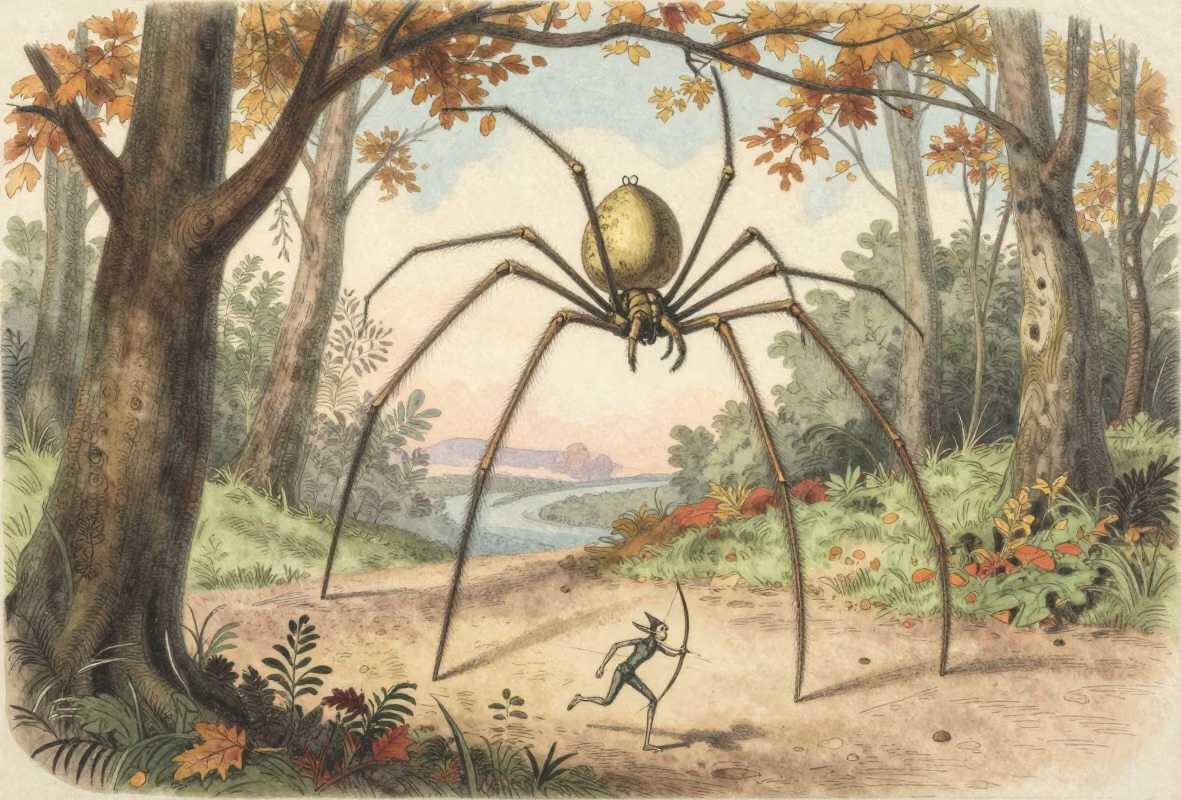
Spider, Elf-bane
| Statistic | Value |
|---|---|
| Climate/Terrain | Any frequented by elves |
| Frequency | Rare |
| Organization | Solitary |
| Activity Cycle | Any |
| Diet | Elves |
| Intelligence | Semi- (2-3) |
| Treasure | Nil |
| Alignment | Neutral |
| No. of Appearing | 1 |
| Armor Class | 2 |
| Move | 24 |
| Hit Dice | 10+5 |
| THAC0 | 9 |
| No. of Attacks | 1 |
| Damage/Attack | 1d6 |
| Special Attacks | Poison |
| Special Defenses | Shoot web |
| Magic Resistance | 10% |
| Size | H (18' tall) |
| Moral | Champion (15-16) |
| XP Value | 5,000 |
Psonics Summary
| Level | Dis/Sci/Dev | Attack/Defense | Score | PSPs |
|---|---|---|---|---|
| 1 | 1/1/3 | --/M- | 16 | 30 |
Psychometabolism--Sciences: Shadow-from; Disciplines: Chameleon Power, Displacement, Detect Elf (no cost).
Description
Unlike most spiders, which sit in wait of prey, the elf-bane spider's long legs allow it to achieve great speeds in pursuit of its prefered prey, elves. Its small beige tear-drop body (roughly 3' radius) stands atop 18' legs.
It feeds almost exclusively on elves; although it will eat half-elves if desperate. It uses its unique psionic ability, detect elf (a varient of heightened senses), to locate its prey. This ability is considered always on and is maintenance free. With it, the spider can smell any being of at least 50% elven heritage up to 5 miles distant.
Combat
This spider will always seek out and attack elves before any other creature; next it will attack half-elves (since it does not find half-elves as nutritious as full-blood elves). It can not digest those with less than 50% elven heritage, so it normally ignores them; however it will fight if threatened.
The Elf-bane spider usually uses its psionic abilities (shadow-form and chameleon power) to close to within a hundred yards of its prey. It then initiates its displacement power and dashes to the attack at full speed. It attacks with its bite, which causes 1d6 points of damage; however, its most dangerous form of attack is its poison. As soon as it has incompacitated a victim, the spider will pick the body up and move to a safe location where it can digest its meal.
The severity of a bite from an elf-bane spider varies as a function of the victim's race, affecting onset time, damage, and saving throw adjustment, see the table below. The adjustment to the victim's saving throw is cumulative with any other adjustments, such as those due to low or high constitution. For example, while Gwenn, an elf, faces immediate death (with a -4 penalty to her save) should she be bit; Halminok, a dwarf, has a good chance (+4 bonus to his save) to remain unaffected, especially if he also has a high constitution (he still takes biting damage, of course).
| Race | Class | Onset | Strenth | Adjustment |
|---|---|---|---|---|
| Elf | E | immediate | death/20 | -4 |
| Half-elf | D | 1-2 min | 30/2-12 | -2 |
| Mul | B | 2-12 min | 20/1-3 | +2 |
| Dwarf and Gnome | A | 10-30 min | 15/0 | +4 |
| Human and Others | C | 2-5 min | 25/2-8 | 0 |
The elf-bane spider does not spin a stationairy web. However, if seriously wounded (i.e., hit points fall below 25% of normal), it will attempt to flee by shooting a single 9' long strand of web at the nearest target using its normal THAC0. If the strand hits, it raps around the victim--treat as per Spider Strand spell (Dragon Kings). Any creature man-sized or smaller is immobilized and cannot move. Any large creature is impeded and moves at half rate, attacking only half as often with a -2 penalty to the attack roll. Any huge or gargantuan creature is unaffected. In order to break free of the strand, the victim must make a successful half bend bars roll for each yard of the strand (i.e., 3 seperate rolls). A large creature is no longer impeded after breaking 1 yard, a man-sized creature is no longer immobilized after breaking 1 yard and no longer impeded after breaking 2 yards, a small creature is no longer immobilized after breaking 2 yards and no longer impeded after breaking 3 yards, and a tiny creature remains immobilized until all 3 yards are broken. The strand may be cut at the rate of 1 yard per round (if the target is immobilized, he cannot attempt to cut the strand).
Habitat
The elf-bane spider is a solitary creature, pursuing its prey across the burning sands; however, it is not uncommon to find several spiders independently following the same elven tribe.
Elf-bane spiders mate twice a year, for one week immediately following High Sun and one week immediately following Low Sun. As with most spiders, the male is significantly smaller than the female, but with few exceptions (hit dice 5; THAC0 15; size M), his stats are identical to the female's. She will invariably kill him after mating if he is slow in his escape (an odd carry-over from their origins, since she cannot digest him). The female burries her fertilized eggs beneath the sand; after two months, 3d6+2 young emerge. They mature quickly, reaching full size before the next mating period.
Ecology
Scholars dispute the origin of the elf-bane spider. Some hold the view that today's spiders are the descendents of spiders originally created by the sorcerer-king Andropinis of Balic in order to protect his orange groves from elven thieves. Their psionic abilities and small amount of resistance to magic have been offered as evidence for this theory. Others believe that a long forgotten dwarven civilization bred these spiders to be used in a standing conflict with an equally ancient elven nation. The fact that dwarves are highly resistant to this spider's poison is often cited as support for this latter theory.
Elf-bane spiders do not collect treasure, and their nomadic nature prevents them from accumulating incidental valuables. They produce little of value (although some would say that killing elves is value enough); however, those skilled in herbalism or the making of poison (such as bards) can extract enough poison for 2d6 applications--the poison has the same properties as above and retains its potency for 1 Athasian week (i.e., 15 days).