Snake, Scorpion
| Statistic | Value |
|---|---|
| Climate/Terrain | Temperate forests and mountains |
| Frequency | Very rare |
| Organization | Solitary or family |
| Activity Cycle | Day |
| Diet | Carnivore |
| Intelligence | Low to Average (7-9) |
| Treasure | B |
| Alignment | Lawful neutral |
| No. of Appearing | 1-2 (if 2, 10% chance will be with 3-8 young) |
| Armor Class | 2 |
| Move | 15 |
| Hit Dice | 6-10 (1-3 for young) |
| THAC0 | 13 (18 young) |
| No. of Attacks | 4 |
| Damage/Attack | 1d6+1/1d6+1/1d8+1/1d8+1 (per 10 hit points) |
| Special Attacks | Poison, crush, rend, swallow hole |
| Special Defenses | +1 save vs fire, detect magic |
| Magic Resistance | Nil |
| Size | H (1 foot per hit point) |
| Moral | Elite (13-14) |
| XP Value | 6 hit dice: 3,000; 7 hit dice: 4,000; 8 hit dice: 5,000; 9 hit dice: 6,000; 10 hit dice: 7,000 |
Description
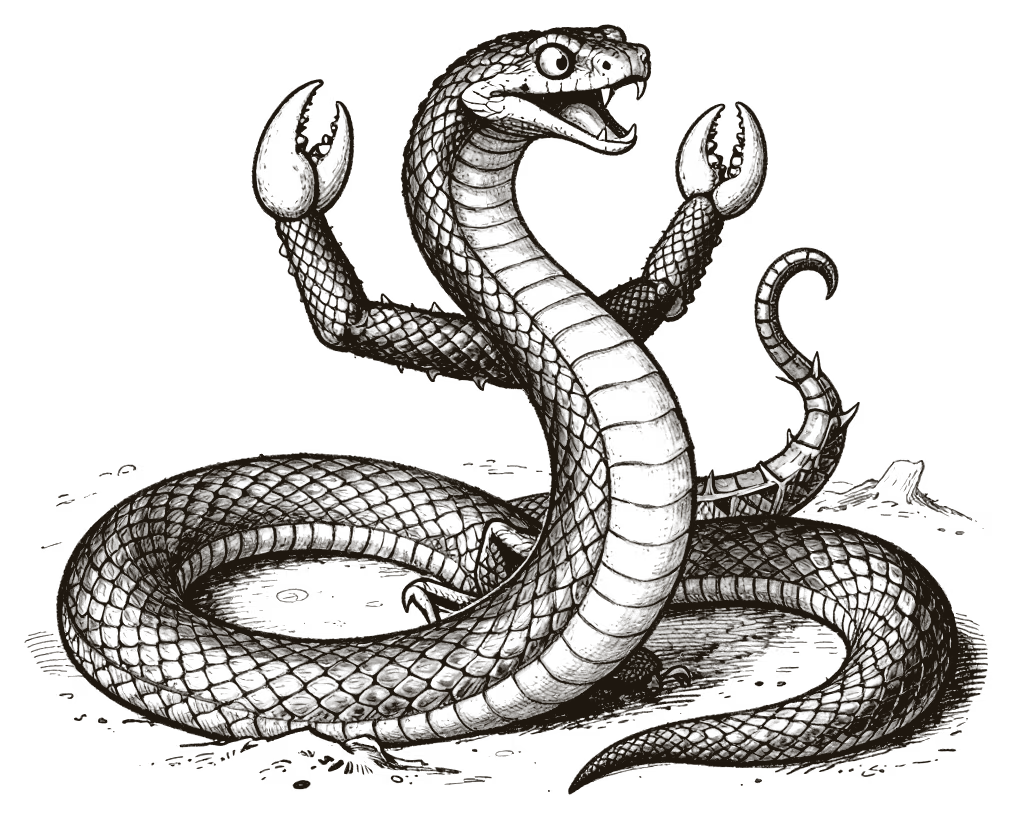
The scorpion snake is a vicious preditor inhabiting temperate highlands. This creature resembles a huge viper with green or brownish scales and a light brown underbelly. The snake has a massive set of pincers and a scorpion-like tail, making it look like a cross between a snake and a giant scorpion. These claws are not exoskeletal, however. They are covered with exceptionally thick scales, and the pincers consist of a sort of ivory instead of chitin. These creatures are highly territorial, and intelligent enough to have developed strategies to defend their territory, land which they know very well. There are reports of an arctic species with a furry hide.
Combat
This much-feared creature is cunning and dangerous in combat. It's thick scales afford excellent protection, and their intelligence often proves to be a rude, and often lethal, surprise to inexperienced foes. Their ability to detect magic (100 foot radius) and excellent senses make them difficult to surprise.
Scorpion snakes are well armed, posessing both a venomous bite and sting. Anyone bitten or stung must save vs poison at -4 or die in 2-5 rounds. If the save is successful, the victim suffers 2d8+8 points of damage, and is in pain for 1d8 hours (-4 on all rolls). The pain effects are not cumulative, but the damage is. If the snake rolls 4 above the required roll when biting a victim 2 sizes smaller, the snake has the option of swallowing the victim whole (he will suffocate unless he can escape). Scorpion snakes are immune to their own venom.
The scorpion snake's claws are almost as fearful as it's deadly venom. Any strike that hits by 3 or more above the required to hit results in the victim being grasped. The dungeon master should roll to see where the claw hits, as this will effect the characters options. The other claw (and the mouth and sting) can then hit with a +4 bonus. Any claw which has grasped automatically hits for each sucessive round. If a victim is grasped in both claws, the snake may rend on the same round and each subsequent round for 2d10 + 1/5 the snake's hit points. The snake may also constrict using whatever rules the dungeon master favors for these attacks. Any victim grasped in both claws loses all dexterity bonuses on armor class. The claws have an effective strength of 19.
Habitat
Scorpion snakes are either solitary, or mated pairs. Scorpion snakes mate for life. As was stated earlier, these creatures are territorial; when a pair are mated, they will live in the larger of the two territories. Unmated snakes will not tolerate snakes of the same sex in their territory. Territorial disputes are resolved by means of non-lethal combat (claws only) in which the first to grasp the other's head in both claws wins. The victor then either passes through unmolested, or claims all or part of the loser's territory. Territorial bounderies are marked with a special musk which identifies the owner.
Creatures smaller than a large horse are considered game, and are usually ignored unless the snake is hungry. Larger creatures are seen as territorial rivals, and are attacked without mercy. Scorpion snakes speak their own language, and can be reasoned with if a way is found to communicate.
Ecology
Scorpion snakes are likely the creation of some insane wizard. Unlike most reptiles, they are warm-blooded and can survive cold conditions. At the end or Autumn, they will go on a killing spree, stocking up on food for the winter. The meat is preserved with the same musk oil that is used for marking territory.
Scorpion snakes are much prized for their many useful components. Claw ivory sells for 10 to 60 gold pieces per hit die of the snake, depending on quality. The venom is much prized by thieves and assasins, and can also be used to produce a powerful antidote to many toxins. The musk oil can be distilled into a variety of preservatives and tanning agents. Alchemists will pay handsomely for scorpion snake venom, musk or blood. The scales and hide make excellent armor as well. Many foolhardy adventurers have gotten themselves killed trying to make a quick gold piece hunting scorpion snakes.