Macrophage, Giant
| Statistic | Value |
|---|---|
| Climate/Terrain | Swamp, aquatic, any damp |
| Frequency | Very rare |
| Organization | Solitary |
| Activity Cycle | Continuious |
| Diet | Omnivore |
| Intelligence | Non- (0) |
| Treasure | Nil |
| Alignment | Neutral |
| No. of Appearing | 1-2 |
| Armor Class | 0 |
| Move | 12 |
| Hit Dice | 40+ |
| THAC0 | 5 |
| No. of Attacks | Special |
| Damage/Attack | Special |
| Special Attacks | Engulfment, acid, degradulation |
| Special Defenses | Special, immune to mental attacks |
| Magic Resistance | Nil |
| Size | G |
| Moral | Fearless (19-20) |
| XP Value | 35,000 |
Description
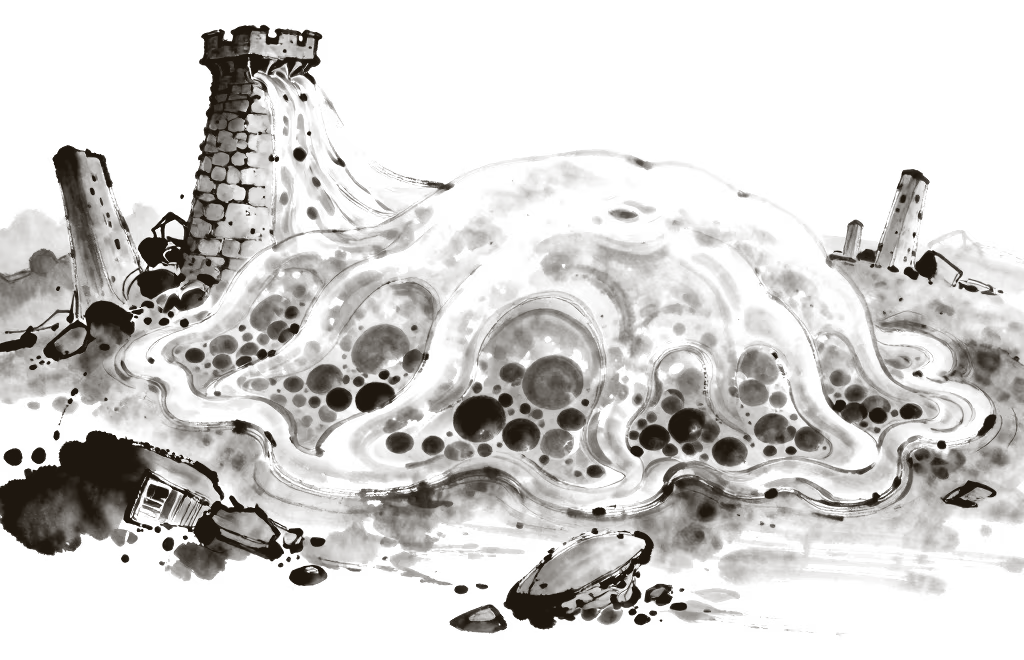
Macrophages are not natural creatures, but the result of a powerful and arrogant necromancer's experiment gone horribly wrong. Macrophages resemble huge (100+ yard dia.) ochre jellies, but that is where the resemblance ends. They are far more dangerous than any normal jelly or slime.
About a century ago, a rogue shou lung dragonship had a run in with a neogi deathspider. The shou lung ship won, but was severely damaged in the process, and most of the crew was killed or wounded. The ship made for an apparently uninhabited planetoid to make emergency repairs. Appearances turned out to be deceiving.
After a less than graceful landing which killed most of the remaining crewmen, the survivors were captured by the planetoid's owner, a necromancer named Mallek the Dark.
The ship's helmsman, Lin Shan, was a gifted wizard (only 23 years old and already 11th circle), born with unique magical properties. Mallek the Dark had not had an opportunity to work on living specimens for some years, and immediatly started to use the wounded Lin Shan in his foul experiments. Lin Shan died in agony.
One of Mallek's experiments was to enlarge certain immune system cells known as macrophages; these cells are agressive and destructive, both qualities Mallek admired. Lin Shan's rare magical properties allowed Mallek to make them enormous, far larger than should have been possible. After casting spells to enlarge the cells and allow them to function properly in the macroscopic world, Mallek made the last mistake of his life.
The macrophages he enlarged immediately started destroying everything in sight, as these cells are programmed to attack foreign (non-self) objects and life forms. Mallek's arrogance got the best of him, as he assumed he could easily destroy anything he had created. He confronted the macrophages and prepared a spell which would have killed them all if he had had a chance to complete it. Instead, he was hit by a blast of organic acid powerful enough to corrode surgical steel. By the time his body was engulfed, all that remained was acid-charred bones. Lin Shan had had his revenge.
After trashing Mallek's lab, the macrophages reproduced, spreading all over his planetoid. They finally reached his summoning chamber where he kept a Well of Many Worlds. Strangly drawn by the item's powerful magical aura, these creatures suddenly started appearing in worlds all over the multiverse. No one knows where this planetoid is, but there is a sizable reward for anyone who finds the source of the macrophages and puts an end to their migration. Needless to say, this is easier said than done.
Combat
Despite the alignment of the person from whom they were derived (Neutral Good), these giant cells will attack and destroy anything they encounter. Macrophages are mindless killing machines in an environment radically different from the one for which they were intended. They have no alignment, nor mind of any sort. They cannot be communicated, bargained or reasoned with, and they are immune to any and all mental attacks. Since nothing registers as "self", everything must be destroyed. To this end, macrophages have a formidable arsonal with which to lay waste to all that is "non-self", i.e. everything in sight. Macrophages have three different attacks they can employ: engulfment, enzyme blasts, and degranulation.
Envelopment is by far the most common attack. Any creature within 30 feet of a macrophage can be attacked once a round in this way. On a natural 20 roll against a target capable of dodging (modifiers up to DM), the victim is engulfed, and immediately starts to drown in the cell's protoplasmic fluid. A bend bars roll is neccesary each round to escape. Within 2-5 rounds of engulfment, digestion begins. The victim is placed in a lysome, a sack of powerful digestive enzymes, and sustains 10-100 hit points per round inside (no save permitted).
Macrophages can emit one acid blast per 10 hit dice per round, each inflicting 5-50 hit points to all within 30 feet of the point of origin. Save vs breath for half damage.
The macrophage's last attack is degranulation. Macrophages are filled with crystaline, watermellon-sized granules containing volitile or toxic chemicals. Each round, a macrophage fires 0-3 granules in the general direction of "non self" material, i.e in random directions. These granules can fly up to a mile before landing and detonating. There are three types, roll a 1d6 to determine the type.
| 1d6 | Type | Effect |
|---|---|---|
| 1-2 | Acid | 8d8+8 hit points to all within 20 feet. |
| 3-4 | Explosive | 8d8+8 hit points to all within 40 feet. |
| 5-6 | Poison | All within 40 feet save at -4 or die. |
Fighting macrophages.
Needless to say, a macrophage is a creature most adventurers would rather avoid, especially since any treasure they have engulfed has long since been destroyed by the cell's powerful enzymes.
Macrophages are immune to normal fire attacks and sustain half damage from magical fire. Electricity stuns them for 2-8 rounds if a save vs paralyzation is failed, and they suffer double damage from cold based attacks. Magic missiles function normally against macrophages. Disintegration inflicts 2d20 hit points of damage, half on a successful save. If the macrophage rolls a 1 on it's save, the nucleus is destroyed, and it dies instantly.
Macrophages are nearly immune to the effects of all normal weapons, and most magical ones at that; any rents in their membranes close up too quickly to result in major fluid loss. Weapons which inflict special damage, such as life stealers, frost brands etc function normally.
Any critical hit on a macrophage strikes an organelle. Roll on the table below for effect.
| Roll | Organelle | Effect |
|---|---|---|
| 1 | Nucleus | Macrophage Slowed 1d6 rounds. |
| 2-3 | Ribosome | No Effect, there are too many of them. |
| 4-9 | Endoplasmic Reticulum | Macrophage Slowed for next round. |
| 10 | Golgi Apparatus | No acid blast for 1d6 rounds. |
| 11 | Centriole | 10% Chance Macrophage may never divide. |
| 12-17 | Mitochondrion | Explosion, cell sustains 6d6 points of damage. |
| 18-19 | Lysome | Enzyme leak, cell suffers 1d6hp damage. |
| 20 | Granule | Roll for effect, cell sustains damage. |
Poison granules have no effect on the cell. DM should modify effects to fit situation. For instance, someone meleeing with a dagger is unlikely to hit the nucleus which may be 50 or more yards away (it would be a good idea to consult a diagram of cell anatomy before using this creature). Also, damage done by melee weapons may result in the character being within the area of effect of an acid blast, explosion, etc. Organells can be targeted, but they have a -10 armor class because they are deeply immersed in cell fluid.
Coating oneself with macrophage slime has a 50% chance of fooling the cell into "thinking" the character is "self". If the cell is fooled, it will neither attack the character, nor will it retaliate if attacked. Unfortunately, there is a 5% cumulative chance per round of combat that enough of the slime will wear off to negate its effects. The best time to attack a macrophage is when it is dividing. If attacked, there is a 25% chance that the division process will halt and the macrophage will return to destruction as usual; otherwise, it is helpless.
Habitat
Natural macrophages (the little ones everyone has) are part of a well-organized defensive system. These giant macrophages are out of their element and have no organization to speak of.
Ecology
Macrophages gain one hit die per day, and divide when they have doubled their hit dice. During division, the cell undertakes no action unless disturbed. The division process takes about a day and yields two macrophages with the parent's base strength. Since they destroy everything in their paths, macrophages' impact on the ecology is hardly benign.