Hiver
| Statistic | Warrior | Bearer | Nurse | Queen | Seeker |
|---|---|---|---|---|---|
| Climate/Terrain | Any desert or border desert | Any desert or border desert | Any desert or border desert | Any desert or border desert | Any desert or border desert |
| Frequency | Rare | Rare | Very rare | Very rare | Very rare |
| Organization | Hive | Hive | Hive | Hive | Hive |
| Activity Cycle | Any | Any | Any | Any | Any |
| Diet | Omnivore | Omnivore | Omnivore | Omnivore | Omnivore |
| Intelligence | Semi- (4) | Semi- (4) | Semi- (4) | Low (7) | Semi- (2) |
| Treasure | Nil | Nil | Nil | I, S | Nil |
| Alignment | Neutral | Neutral | Neutral | Neutral | Neutral |
| No. of Appearing | 3d6+3 | 1 | 2-12 | 1 | 1 |
| Armor Class | 6 | 6 | 10 | 10 | 4 (10) |
| Move | 18 | 18 | 12 | 3 | 0 |
| Hit Dice | 6+5 | 4 | 2 | 9+10 | 1-1 |
| THAC0 | 13 | 17 | 19 | 11 | Nil |
| No. of Attacks | 4 | 2 | 1 | 1 | Nil |
| Damage/Attack | 1d6+2 (x4) | 1d4+1/1d4+1 | 1d3 | 1d3 | Nil |
| Special Attacks | Nil | Nil | Nil | Nil | Nil |
| Special Defenses | See below | See below | See below | See below | See below |
| Magic Resistance | Nil | Nil | Nil | Nil | Nil |
| Size | M (7') | M (6') | M (5') | L (12') | T (2') |
| Moral | Elite (13) | Elite (13) | Elite (13) | 18 | 5 |
| XP Value | 975 | 175 | 65 | 2,000 | 35 |
(based on Man After Man: An Antropology of the Future by Dougal Dixon)
Description
Although humanoid, hivers, also called socials, live in large communities similar to those of social insects, such as ants and termites, constructing large mounds that tower many stories over the desert sands. Devoid of all individuality, each member of the community is highly specialized, fullfilling one of four functions: warrior, bearer, nurse, or queen. Hivers have formed a symbiodic relationship with a second species of humanoids called seekers.
All varieties of hiver and seekers share a common special defense. Due to their similitude to social insects, a psionicist attempting to contact a hiver suffers a -5 to his power score (i.e., treat as if contacting insect under Unusual Subjects table), unless he employs insect mind (see Dragon Kings). In addition, hivers are immune to hold person, charm person, and charm person or mammal spells, as well as other magics that affect only mammals (i.e., rings and potions of mammal control). However, most spells and psionics that affect insects, such as the psionic devotions pheromone discharge and hivemind (see Dragon Kings), also affect hivers and seekers, with the exception of giant/shrink insect.
Warrior
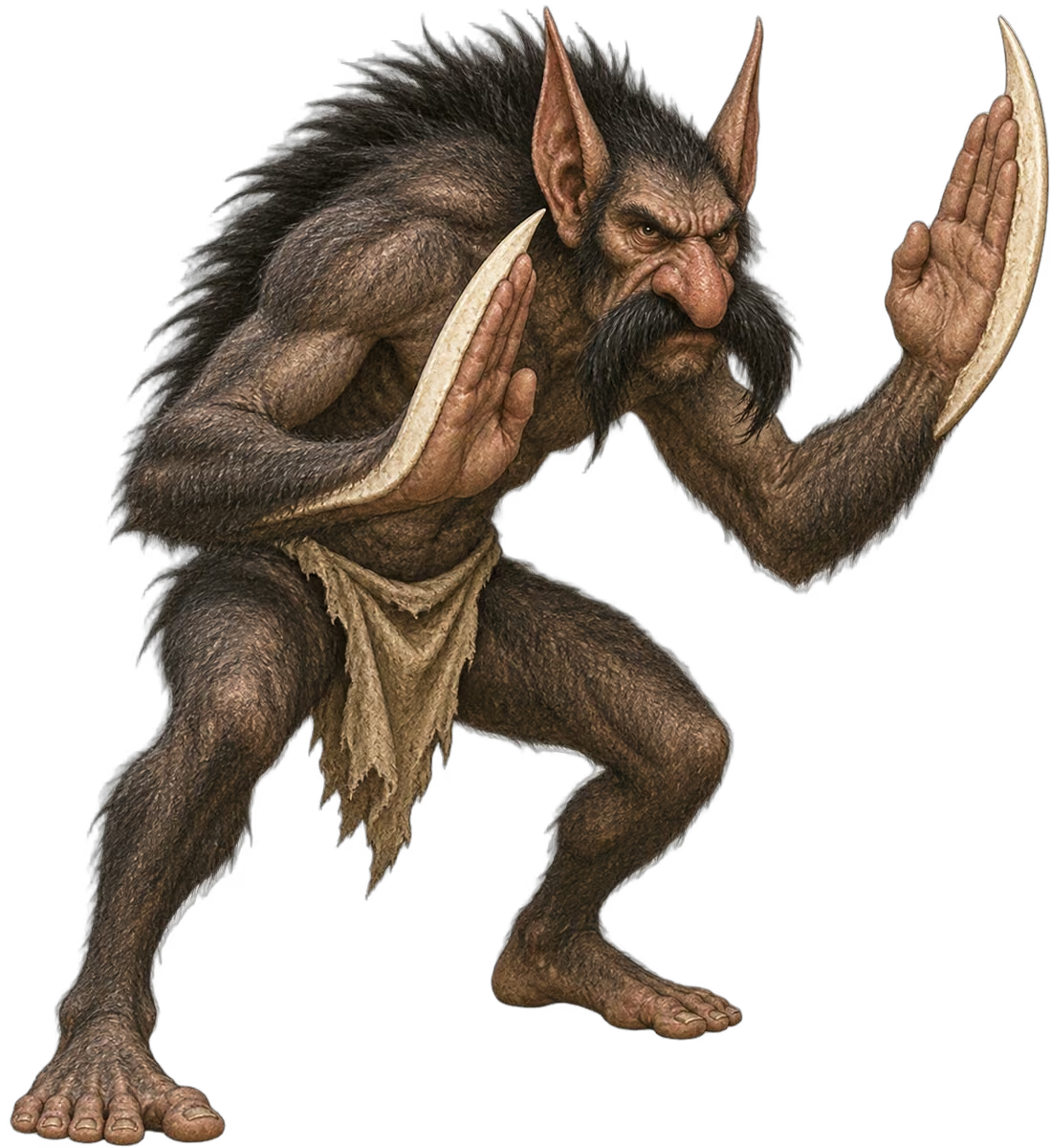
The body of the adult male, or warrior, is covered with short coarse black hair; a thick main extends from the top of the head down to the center of the lower back. A small lump runs across the back of the shoulders and neck -- it is a fatty store of nutrients. They have protruding, bushy eyebrows, large, bulbous noses, and thick moustaches, which help filter out the dust and silt of the desert. Each of their long ears comes to point several inches above the top of their heads.
Perhaps their most alarming feature is their hand blades. The outer edge of each hand is bone blade, from the wrist to the tip of the little finger (indeed, their pinkies aren't really fingers, rather fused bone). While these blades are used for foraging, they make ample weapons. In combat, warriors slash and jab with their hand blades and kick with their powerful legs; each successful attack does 1d6+2 points damage.
Warriors defend the food-gathering expeditions called strings. They also defend the hive from attack. An average hiver society has a minimum of 100 warriors (25% of population). Regardless of the number of warriors in a hive, roughly one-third remain at the hive as guards at all times.
Especially old warriors become breading drones, spending the remainder of their lives inside the colony near the queen's chamber. Drones have maximum hit points (53), but their age has reduced their agility (armor class 8), speed (move 12), and strength (damage 1d6 per attack). At any given time, a hive will contain 2d4 drones (this number is in addition to the number of warriors above).
Bearers
Bearers are specialized adult females that accompany the foraging strings. They resemble warriors in most ways, except they do not have hand blades. In addition, they have a kangaroo-like pouch in their stomach. When encountered outside the hive, a bearer will always carry a seeker in her pouch, cradling it in her arms. Bearer and seeker remain in constant telepathic contact while touching. It is through this link that the seeker communicates with the party.
A bearer's main purpose is to defend her seeker. She will always attempt to keep warriors between herself and any enemies. If attacked directly or seperated from the warriors, she will flee back to the hive. She will only engage in melee if cornered; then she recieves two kicks per round (1d4+1 each). She will die defending her seeker.
The average hive will have a minimum of 20 bearers at any given time (5% of the population).
Nurses
Most adult females are nurses, spending their lives caring for the queen, her young, and the seekers. These females, bear little resemblance to warriors or bearers. Rather, no hair covers their pink skin. Neither do they have pouches or hand-blades. Unlike bearers, nurses have well-developed mammalian glands for feeding the young of the queen and the offspring of the seekers.
Nurses are the laborers of the hive. They clean, tend the young, and cultivate the fungus gardens. Nurses are never encountered outside the twisting corridors of the hive. They will attack invaders on sight. The average hive has a minimum of 150 nurses at any given time (35% of population). Hiver juveniles of both sexes resemble smaller, immature versions of nurses. Their function is to act as food and water gatherers, accompanying the strings. When they reach maturity, they differentiate further into their adult form. The average hive has a minimum of 150 juveniles (35% of population).
Queen
At 12 feet, the queen dwarves all others. She resembles a very large nurse with grossly exaggerated hips and abdominal cavity. The length and width of her body greatly surpasses the ability of her legs and spine to support her. Using her arms, she can raise her upper body off the ground and drag herself.
The queen's sole purpose is to produce the hive's young, giving birth every 30 days to litters of 10 to 15 children (1d6+9). As such, the entire community revolves around her; the warriors and beares find food and water, and the nurses clean and feed her. Neither does she care for her children; rather this task falls to the nurses.
Finally, a queen's physical and psionic abilities represent an evolutionary adaptation to the prodigious demands of near constant childbirth. She has an effective constitution of 20, which gives her the following benefits: all 1's rolled for HD are automatically considered 2s; she saves vs. poison with a +1 bonus; and she regerates lost hit points at the rate of 1 per 6 turns. Her psychometabolic powers allow her to undergo the trauma during the birthing process and to heal quickly after, as well as fight infection and disease. In dire times, she can even supress her bodily needs. She will never use these powers to benefit anyone but herself, as she is the single most important member of the community.
Queens are never encountered outside the hive. She will attack invaders into her chambers on sight by swinging one of her hands at them (she will use the other to support herself). The average hive will have 1 queen at any given time; occasionally, 1d4 additional immature queens will be present.
Psionic Summary
| Level | Dis/Sci/Dev | Attack/Defense | Score | PSPs |
|---|---|---|---|---|
| 2 | 1/1/5 | --/M- | 20 | 120 |
Psychometabolic Sciences: complete healing;
Devotions: adrenalin control, biofeedback, cell adjustment, mind over body, suspended animation.
Seeker
The seekers are a degenerate humanoid species that is entirely dependent on hivers for their care. Their arms and legs have attrophied into shriveled appendages, so they cannot feed, move, or clean themselves. They cannot even mate without assistance. Due to complete reliance on psionic abilities (feel light and feel sound, which are considered always activated and maintenance free), their eyes and ears have become useless also; indeed smooth skin covers their eyeless sockets, and small external ears hide a lack of both middle and inner ears. Unlike hivers, their small pink bodies are mostly devoid of hair, except for the tops of their heads, which is usually black or dark brown.
At first glance, these defenseless creatures (AC 10 when not being carried) might seem to be the sole beneficiaries of their symbiotic relationship with hivers. However, seekers use their considerable innate psionic abilities to locate food and water for the hive. While being carried by a bearer, a seeker maintains a continuous mindlink with her, directing the foraging group toward these valuable resources. Furthermore, it can employ additional powers to aid these expaditions. For example, weather prediction helps warn of approaching storms, know direction and radial navigation help ensure a safe return to the hive, and danger sense and life detection warn of potential hazards.
When not being carried be their bearers, Seekers are usually kept within a central chamber of the hive where nurses care for their many needs. The average hive will have 5d6 adult seekers at any given time.
Psionic Summary
| Level | Dis/Sci/Dev | Attack/Defense | Score | PSPs |
|---|---|---|---|---|
| 6 | 3/3/11+bonus | --/IF,MB,M- | 17 | 200 |
Clairsentience Sciences: clairvoyance, sensitivity to psycic impressions;
Devotions: danger sense, feel light (no cost), feel moisture (DK), feel sound (no cost), know direction, poison sense, radial navigation, weather prediction (DK).
Telepathy Sciences: mindlink (no cost with bearer);
Devotions: contact (no cost with bearer); life detection.
Psychometabolic Sciences: none;
Devotions: heightened senses (limited to smell and taste)
Bonus Hivemind (metapsionic devotion, DK).
Habitat
While mammals, hiver society and mentality mirror that of social insects, and they respond accordingly; they have a structured and highly centralized society and no individuality. Hivers communicate by a complex combination of grunts, hand and body jestures, and phermones.
They construct gigantic mounds, many stories high. These hives are architectural marvels -- massive rock-like structures complete with breathing chimneys, thick vented walls, and flat slopping roofs with overhangs providing shade. Tunnels underneath reach deep into the water-table where food is kept cool, and fungus gardens are cultivated. Each hive defines a territory surrounding its mound. Members from another hive entering this territory are attacked.
Occasionnally, a Hiver community will assualt a rival's hive. These wars end when the attackers are driven back or the besieged queen is killed. If the queen is killed, the invaders will claim the hive as their own, transport an immature queen and some seekers from their original hive, and establish a new community.
Each day, strings leave the hive shortly before dawn in search of food and water (note number of expiditions is limited by the numbers of bearers and seekers in the hive). An randomly encountered string consists of 3d6+3 warriors, 1 bearer, 1 seeker, and 5d4 juveniles. The male with the most hit points is the stringmaster, commanding all other string members. Juveniles carry simple baskets and jugs to transport food and water back to the hive.
While hivers will eat small prey and carrion, they do not normally attack larger creatures. If attacked, a string forms a circle around the bearer and seeker. The warriors comprise the outer ring, with juveniles between them and the bearer. All members of the string will fight to the death to protect the seeker.
Ecology
While hivers may be found anywhere on Athas, they are more common in the great sandy wastes to the south of the Tyr region. Many larger preditors prey on individual members of strings, or even entire strings, but few are able to infiltrate the hive itself.
While hivers tend to collect shiney items, which they place in the queen's chamber, hivers produce nothing of value, except maybe the hive itself. Abandoned hives may provide excellent shelter for many creatures, such as gith, belgoi, and even slave tribes. It is rumored that a queen's blood can be used to cure infertility.