Grendel
| Statistic | Value |
|---|---|
| Climate/Terrain | Temperate |
| Frequency | Uncommon |
| Organization | Solitary |
| Activity Cycle | Any |
| Diet | Carnivore |
| Intelligence | Animal to Low (1-5) |
| Treasure | Nil |
| Alignment | Neutral |
| No. of Appearing | 1 or special |
| Armor Class | 2, -2, -6 |
| Move | 45, 95, 190 |
| Hit Dice | 12 |
| THAC0 | 8, 11, 14 |
| No. of Attacks | 6, 12, 24 |
| Damage/Attack | 1d6/1d6/1d6/1d6/2d10/2d12 |
| Special Attacks | Frenzy (Haste) |
| Special Defenses | Speed |
| Magic Resistance | Nil |
| Size | M or L |
| Moral | Fanatic (18) |
| XP Value | 14,000 |
(from "Legacy of Heorot" by Larry Niven, Steven Barnes, and Jerry Pournelle)
Description
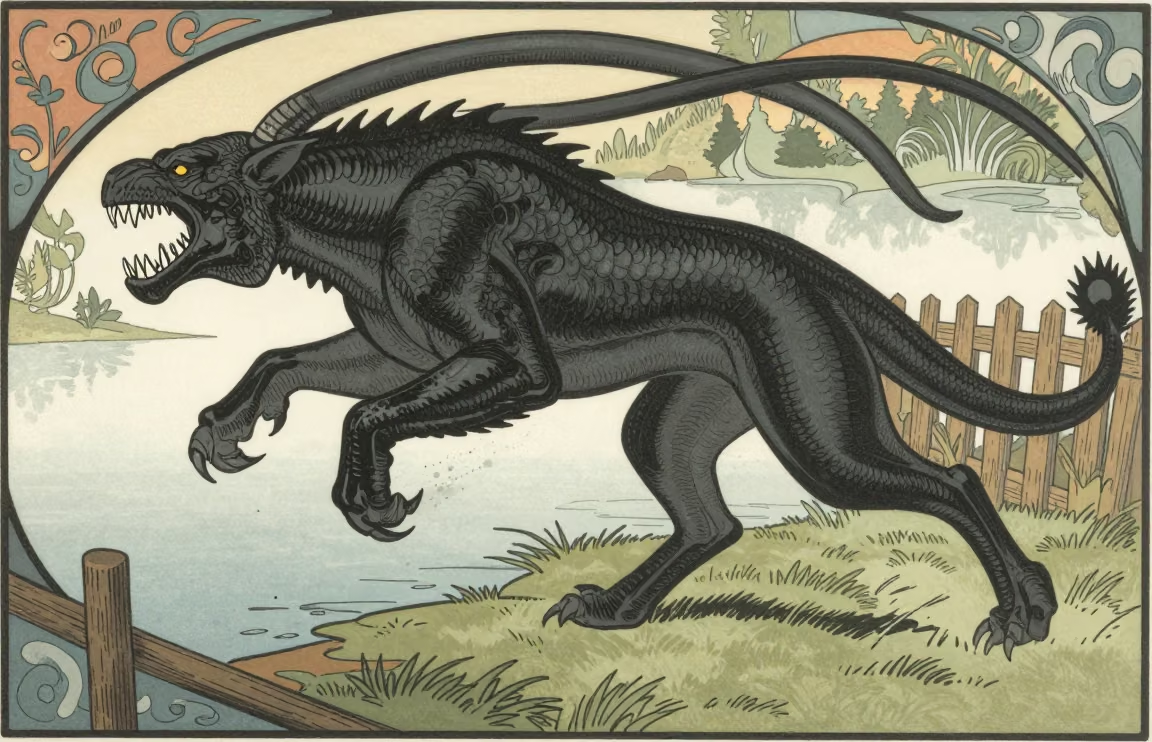
Slung low to the ground, the grendel is built for speed. It has very muscular hind legs, as well as strong, but smaller forelimbs. Its feet are webbed claws, and it is covered with jet black scales. Its head is dominated by a muscular jaw lined with rows of razor sharp teeth. Its tail is long and sinuous and is tipped with a ball of spikes. There is also a small tube at the top of its head used for breathing underwater.
Combat
A grendel's main asset is its tremendous speed. When first encountered, if not attacked, it will move stealthily and tend to observe its potential attackers. When attacked, the grendel will use its great speed to aid its attack, striking with a claw, claw, claw, claw, bite, and tail bash routine. If driven by desparation or hunger, the creature will immediately haste itself, doubling its number of attacks and its movement. If further driven, it will haste itself again, giving it a total of 24 attacks/round and a movement rate of 190 (approx. 65mph). However, for each haste it uses, its suffers a -3 penalty to attacks. This is the only instance of cumulative haste spell usage. The haste is not a magical function, but a biological one, and does not age the grendel. The grendel can also chosse to haste itself twice in the same round.
Use of its abilities creates a tremdous amount of body heat, and if it does not find some way to dump its heat, through jumping into a river or snowbank, it will overheat 6 rounds after its first haste usage. It can continue to move, however, but suffers 1d12 hit points of damage per extra round. After dumping its heat, it can return to battle in 1d10 rounds.
When a Grendel reaches between 1 to 10 hit points, it will stop all motion and remain still for 1d4 rounds, appearing as if dead. However, aftwards, it will resume it berserk motions and attempt to escape.
Habitat
Grendels are solitary creatures, simply because the presence of other grendels in the area will cause a fight to the death between them for rights of territory. Grendels, because of their voracious appetites due to their high energy uses, require a large hunting ground, approximately 625 square miles for each grendel. Mostly, this will consist of large open areas, with a main river or lake to serve as a home and heat sink. Grendels never stray very far from water, unless it is raining or winter, as the need to eliminate heat overrides all other considerations. It is not unusual for a number of grendels to share a river, so long as they are widely separated from each other.
Ecology
Grendels are carnivorous, and will eat any form of meat, including each other. However, they will eat anything else before resorting to deliberate cannibalism. They are the main predators in any ecology, unless there are large numbers of well organized enemies in the area, as they will not cooperate with other grendels.
Grendels begin life as an egg, hatching in a river or stream. They then grow to a large fish form, a harmless herbivore, for 3 months. They then undergo a transformation into the large adult form. Reproduction is asexual, as the grendel young (samlon, because of their similarity to salmon) are male, and change to the female adult form. Because of the adults' voracious appetites, the number of young that survive to adult form is very small, as the adults use the young as a main food source. The elimination of all adults in an area will cause a massive resurgence of the grendel population, as more than the usual amount of young will reach adulthood in that area.
Grendels have no natural enemies, but have a hatred for fire-based using creatures.