Ghole
| Statistic | Value |
|---|---|
| Climate/Terrain | Scrub planes, rocky badlands |
| Frequency | Common |
| Organization | Packs |
| Activity Cycle | Any |
| Diet | Carrion |
| Intelligence | Animal (1) |
| Treasure | M, O |
| Alignment | Neutral |
| No. of Appearing | 4-16 (4d4) |
| Armor Class | 5 |
| Move | 9 |
| Hit Dice | 2 |
| THAC0 | 19 |
| No. of Attacks | 1 |
| Damage/Attack | 3d4 |
| Special Attacks | Disease |
| Special Defenses | Nil |
| Magic Resistance | Nil |
| Size | S (3' long) |
| Moral | Unsteady (5-7) |
| XP Value | 65 |
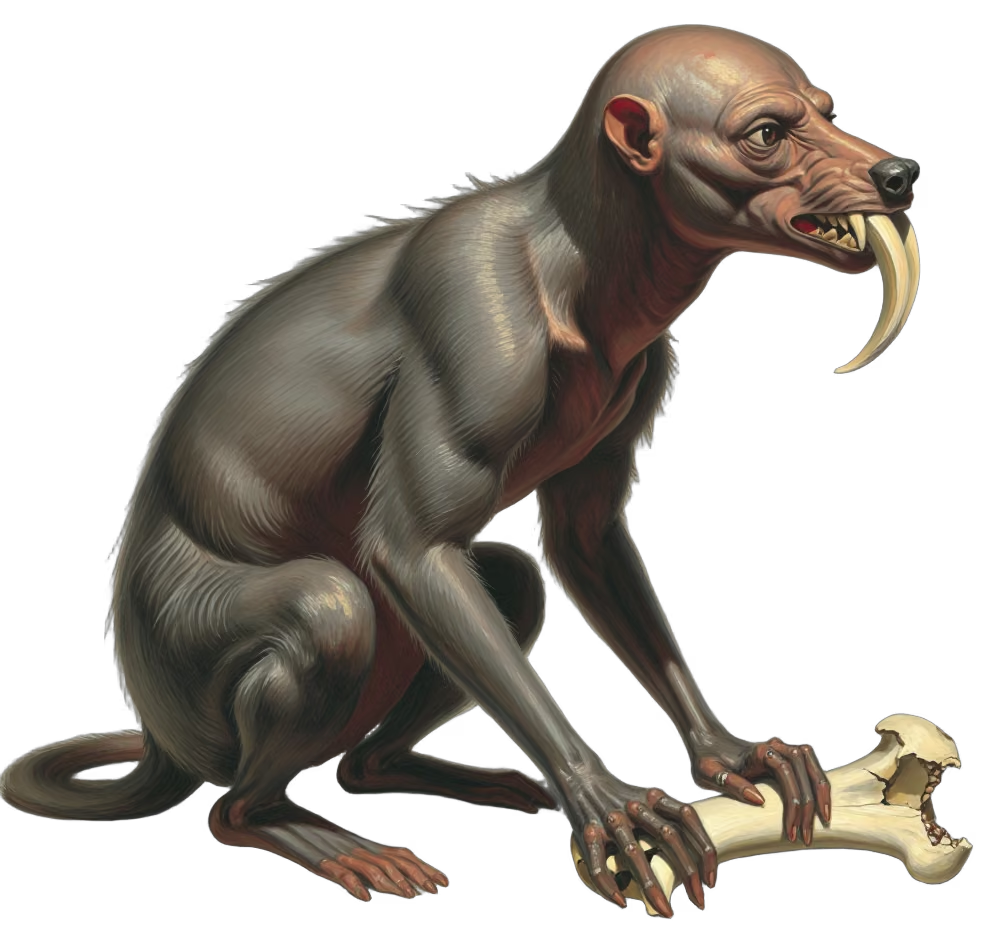
(based on After Man: A Zoology of the Future by Dougal Dixon)
Description
The ghole resembles a large mongoose. It's long neck, head, and feet are almost totally devoid of hair; course gray hair covers the remainder of its body and tail. Massive canines and molars protrude from its mouth, which it uses to crack open bones for the marrow. It is a model scavenger, feeding mostly on skeletal remains left by larger predators.
Combat
Gholes do not usually engage in combat, preferring to retreat; however they are not defenseless and will attack if pressed. Their crushing bite does 3d4 points of damage. Their speed accounts for their low armor class. Given the nature of their diet, a Ghole is 10% likely to carry a serious disease that can be transmitted via its saliva (Dungeon Master only needs to check once for each animal encountered--not every bite). A diseased victim will gradually become debilitated and die over the course of 1d3 Athasian weeks (i.e., 15-45 days) if not cured.
Habitat/Society
Gholes live in small packs. They have formed a symbiodic relationship with shelf termites. As most termites, these build massive mounds; however, the shelf termite mound includes a horizontal shelf several feet off the ground. This shelf provides the gholes with shade during the hottest part of the day. In return, the gholes frequently drag portions of carrion underneath the shelf to feed. The termites eat the miniscule portions that the gholes cannot.
The sexes are almost indistinquishable. If gholes are encountered near their termite mound, there is a 3 in 10 possiblity that they will have 1d6+2 young. The young remain beneath the pack's termite mound, waiting for their parents to return with food.
Ecology
As carrion eaters, gholes tend to be despised even though they provide an important link in the Athasian food chain. Calling somebody a ghole is considered an insult.
Gholes's teeth are occassionally used for small ivory items, such as dice and jewelery. Its pelt is worthless. While they do not collect treasure, valuable items are sometimes dragged beneath the pack's termite mound along with portions of the owner's remains.