Dragon, Elemental
| Statistic | Value |
|---|---|
| Climate/Terrain | Special |
| Frequency | Rare (native plane); Very rare (prime plane) |
| Organization | Solitary |
| Activity Cycle | Any |
| Diet | Special |
| Intelligence | Average (8-10) |
| Treasure | Nil |
| Alignment | Neutral |
| No. of Appearing | 1-2 |
| Armor Class | 0 (base) |
| Move | Air: 10, Fl 40 (A); Earth: 10, Fl 20 (D), Br 10; Fire: 12, Fl 28 (C); Water: 6, Fl 18 (D), Sw 20 |
| Hit Dice | 14 (base) |
| THAC0 | 7 (base) |
| No. of Attacks | 3 + special |
| Damage/Attack | 2-20/2-20/2-20 (2d10) |
| Special Attacks | Special |
| Special Defenses | Variable |
| Magic Resistance | Variable |
| Size | H (24' base) |
| Moral | Fanatic (17-18) |
| XP Value | Variable |
Description
| Age | Body Length | Tail Length | AC | Breath Weapon | Spells Wizard/Priest | MR | Treasure Type | XP Value |
|---|---|---|---|---|---|---|---|---|
| 1 | 2-4 | 1-2 | 3 | 2d8+1 | Nil | Nil | Nil | 1,400 |
| 2 | 4-10 | 2-6 | 2 | 4d8+2 | Nil | Nil | Nil | 2,000 |
| 3 | 10-18 | 6-12 | 1 | 6d8+3 | Nil | Nil | Nil | 3,000 |
| 4 | 18-30 | 12-20 | 0 | 8d8+4 | Nil | Nil | Nil | 5,000 |
| 5 | 30-40 | 20-26 | -1 | 10d8+5 | Nil | 35% | Nil | 7,000 |
| 6 | 40-46 | 26-32 | -2 | 12d8+6 | Nil | 40% | Nil | 9,000 |
| 7 | 46-54 | 32-40 | -3 | 14d8+7 | Nil | 45% | Nil | 10,000 |
| 8 | 54-62 | 40-47 | -4 | 16d8+8 | Nil | 50% | Nil | 11,000 |
| 9 | 62-70 | 47-54 | -5 | 18d8+9 | Nil | 55% | Nil | 13,000 |
| 10 | 70-78 | 54-60 | -6 | 20d8+10 | Nil | 60% | Nil | 14,000 |
| 11 | 78-85 | 60-64 | -7 | 22d8+11 | Nil | 65% | Nil | 15,000 |
| 12 | 85-94 | 64-68 | -8 | 24d8+12 | Nil | 70% | Nil | 16,000 |
There are four types of elemental dragons: fire, water, air, and earth. Each sub-species is native to its corresponding elemental plane, and are most often encountered there. However, an elemental dragon is capable of travelling to, and existing on the prime plane as well (see Habitat for more information.)
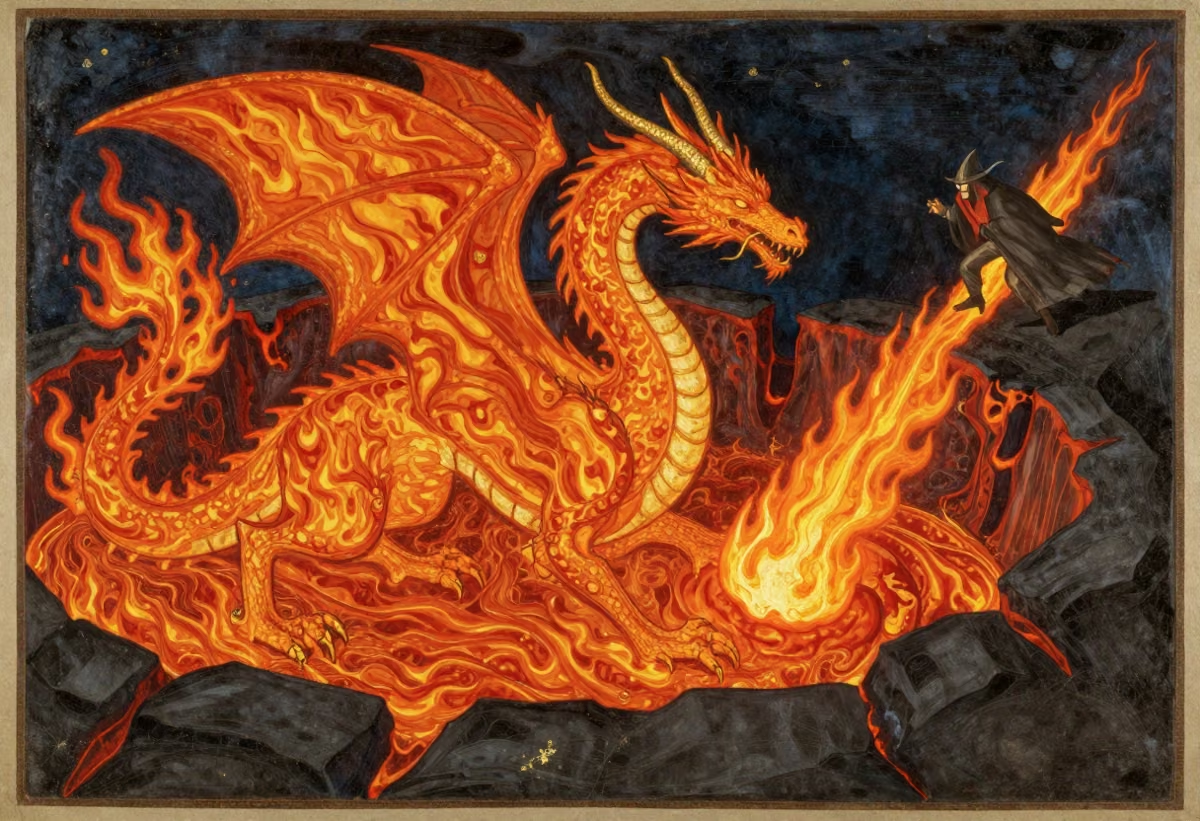
Each elemental dragon is made up of the appropriate elemental substance, and is similar in appearance to the "common" elemental, although it takes on more of a dragon-like appearance instead of a humanoid form.
It is not known if elemental dragons are capable of speaking humanoid languages or the tongues of other dragons, but they are able to communicate with most other elemental creatures native to their home plane.
Combat
Elemental dragons are quick to anger and will attack with the least provocation; any perceived threat is a fair target. These creatures have most of the combat tactics and behavior of their more common elemental cousins.
While an elemental dragon has attacks that originate from the creature's "head" and "claws," these do not actually represent a "claw/claw/bite" routine; instead, all three attacks are composed of the dragon's native element (similar to a common elemental's attacks) and therefore deliver identical damage.
Breath Weapon: Each sub-type of elemental dragon has a breath weapon composed of its corresponding element:
| Element | Breath Weapon | Dimensions |
|---|---|---|
| Air | Blast of compressed air | 90' long x 5' wide x 30' wide |
| Earth | Cone of rocks and debris | 85' long x 5' wide x 30' wide |
| Fire | Cone of flames | 90' long x 5' wide x 30' wide |
| Water | Cone of scalding water and steam | 80' long x 5' wide x 35' wide |
All four types inflict an identical amount of damage, as indicated on the table above. A successful saving throw vs. breath weapon reduces the damage by half (saves are at -2 on the elemental dragon's home plane.)
Elemental dragons have no spell-casting capabilities or spell-like powers, but each has an immunity to attacks composed of their native element. All sub-species may be hit only with a weapon of +2 or better enchantment, and a creature with fewer than 5 hit dice cannot harm an elemental dragon without some sort of magical assistance. All elemental dragons earn a +2 to hit and a +4 to damage when fighting in their native element (not just in their home plane.)
Habitat
While elemental dragons are native to the various elemental planes, they are able to travel to the prime planes at will. They may exist there for one day per age category of the dragon; if this limit is exceeded, the dragon's material shell is destroyed, forcing it to return to its plane of origin. In addition, while on the prime planes, an elemental dragon may not stray from an area of its native element for more than one hour per age category of the dragon, as this too will lead to its material demise. It is not suprising then, that elemental dragons will most often be encountered in or near their native element when existing on the prime plane.
An elemental dragon may not be summoned or controlled like a normal elemental, as there are no known magic devices or spells that will allow this.
Ecology
Elemental dragons do not fit into the normal ecological system, as they are extra-planar beings. They sustain themselves on a diet consisting of their native element.
Elemental dragons of opposing planes are bitter enemies and will attack each other on sight; these battles usually result in the death of one or both of the combatants.