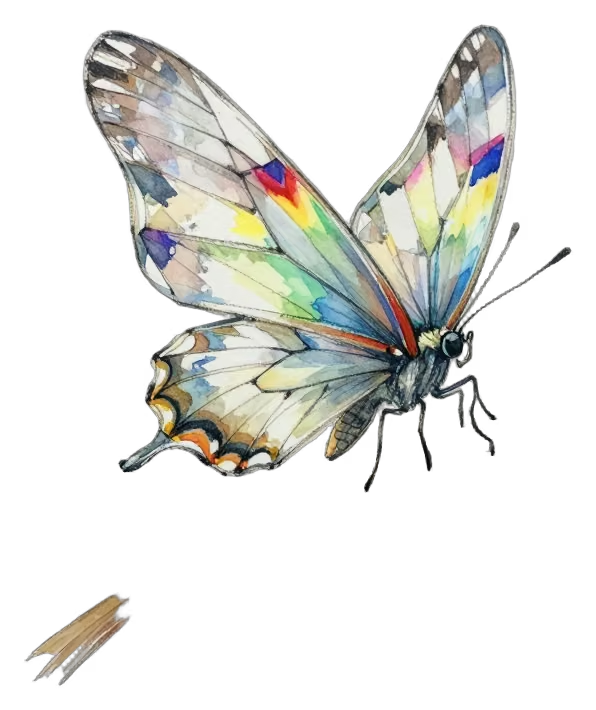
Butterfly, Crystal-wing
| Statistic | Value |
|---|---|
| Climate/Terrain | Forest and Oases |
| Frequency | Very rare |
| Organization | Swarm |
| Activity Cycle | Day |
| Diet | Herbivore |
| Intelligence | Non- (0) |
| Treasure | Nil |
| Alignment | Neutral |
| No. of Appearing | 1,000-100,000 (1d100 x 1,000) |
| Armor Class | 10 |
| Move | Fl 15 (A) |
| Hit Dice | 1 hp / 10 butterflies |
| THAC0 | Nil |
| No. of Attacks | Nil |
| Damage/Attack | Nil |
| Special Attacks | Nil |
| Special Defenses | See below |
| Magic Resistance | Nil |
| Size | T (5" long) |
| Moral | Unreliable (3) |
| XP Value | 35 (per 100 butterflies) |
Description
Even a desolate world contains beauty. On Athas, one of the most beautiful creatures is the crystal-wing butterfly. The prism-like wings of these insects reflect the rays of the sun into startling sprays of color; at night, they glow with the soft luminescence of stored sunlight. Unlike most insect swarms, such as locust and minikanks, crystal-wing butterflies are relatively harmless, posing little direct threat to animals or crops.
Combat
These diminutive creatures have no form of attack; however, when in large numbers (greater than 1,000), their defenses are considerable. Any creature approaching within 50' risks startling the swarm. Unless the creature makes a conscious effort to move cautiously, the swarm automatically startles on a failed morale check. In game terms, to avoid this result a player needs to explicitly state that his character intends caution. Then, for every round spent within 50' of the swarm, a creature must make a successful dexterity check with a +1 penalty for every additional creature in the area of effect (e.g., comrades and mounts) to a maximum of +4; the first failed check startles the swarm. In addition, any loud noise or sudden moves maked is automatically considered a failed check.
If the swarm is startled during the day, the sunlight passing through their fluttering wings causes a captivating spray of colors to fall on any creature within 50'. This defense is similar to a rainbow pattern spell except the effect is maintained as long as the swarm flies, plus 2 rounds thereafter, and there is no limit on the number of levels of creatures affected. A creature is allowed a saving throw versus spells with a -1 penalty per 20,000 insects (-1 at 20,000; -2 at 40,000; etc.) to avoid the effects of the pattern of colors. Creatures who can not see are not affected.
If the swarm is startled during the night, the luminescence of their fluttering wings causes a ghostly glowing pattern affecting any creature within 50'. Treat as a hypnotic pattern spell with the following exceptions: effect is maintained as long as the swarm flies, plus 2 rounds thereafter; there is no limit on the number of levels of creatures affected; creatures must save versus spells with a -1 penalty per 20,000 insects.
Once startled, the swarm stays agitated as long as any creature (except other crystal-wing butterflies, of course) remains in motion within 50'. During this time, their special defenses are active. After all motion ceases, the swarm returns to rest in 4d4 rounds +1 round per 20,000 insects (+1 at 20,000; +2 at 40,000; etc.), at which point, their defenses are inactive.
Every point of damage inflicted on a swarm kills 1d10 butterflies.
Habitat
Crystal-wing butterflies cross wide areas of open desert along well-defined migration routes, linking sheltered clearings in hidden groves. These flower-rich clearings and surrounding groves serve as breeding sites where the butterflies' eggs hatch into brown caterpillars with green flecks. Several migration corridors are known, one of the largest originates in the Forest Ridge north of Ogo, and terminates deep in the Crescent Forest between Gulg and Nibenay. Oases along these routes serve as resting sites; one of the largest is Lake Pit.
During the day, a distant migrating swarm of crystal-wing butterflies appears as a low-flying cloud that sparkles with all the colors of the rainbow. Due to cold temperatures, swarms rarely migrate across the desert at night.
Ecology
Despite their defenses, crystal-wing butterflies do fall prey to predators, most relying on sound and scent rather than sight. Crystal-wing butterflies neither collect treasure nor produce anything of value. However, since many larger predators, such as the Kirre, welcome prey immobilized by the butterflies' defenses, it is not uncommon to find incidental treasure near sites frequented by these butterflies. In addition, the dried, undamaged wings of a crystal-wing butterfly may serve a substitute for material components of many spells relying on light, such as glitterdust, hypnotic pattern, and rainbow pattern.