Bandor
| Statistic | Value |
|---|---|
| Climate/Terrain | Temperate and sub-arctic forest |
| Frequency | Rare |
| Organization | Family |
| Activity Cycle | Day |
| Diet | Omnivore |
| Intelligence | Very (11-12) |
| Treasure | Special |
| Alignment | Neutral Evil |
| No. of Appearing | 1-2 (2-6) |
| Armor Class | Variable |
| Move | 12, Fl 30 (C) |
| Hit Dice | Variable |
| THAC0 | Variable |
| No. of Attacks | 3 + special |
| Damage/Attack | 1-8/1-8/2-20 |
| Special Attacks | Breath Weapon, spell use, hug |
| Special Defenses | Nil |
| Magic Resistance | Variable |
| Size | H (16' base) |
| Moral | Champion (15-16) |
| XP Value | Variable |
Description
| Age | Age Category | Age Modifier | Hit Dice | THACO | Combat Modifier |
|---|---|---|---|---|---|
| 1 | Very Young | 0-5 years | 6 | 14 | None |
| 2 | Young | 6-16 years | 7 | 13 | +1 |
| 3 | Adult | 16-30 years | 8 | 12 | +2 |
| 4 | Mature Adult | 31-50 years | 9 | 11 | +3 |
| 5 | Old | 51-75 years | 10 | 10 | +4 |
| 6 | Very Old | 76-100 years | 11 | 9 | +5 |
| Age | Body Length | Tail Length | Armor Class | Breath Weapon | Wizard Spells | Magic Resistance | Treasure Type | XP Value |
|---|---|---|---|---|---|---|---|---|
| 1 | 2-5' | 1-2' | 5 | 2d6+1 | Nil | Nil | Nil | 1,400 |
| 2 | 5-10' | 2-4' | 4 | 4d6+2 | Nil | Nil | Nil | 2,000 |
| 3 | 10-14' | 4-6' | 3 | 6d6+3 | 1 | 10% | E | 3,000 |
| 4 | 14-18' | 6-8' | 2 | 8d6+4 | 1 1 | 15% | E, S | 5,000 |
| 5 | 18-22' | 8-10' | 1 | 10d6+5 | 2 1 | 20% | E, S, T | 8,000 |
| 6 | 22-26' | 10-12' | 0 | 12d6+6 | 2 2 | 25% | E, S, Tx2 | 10,000 |
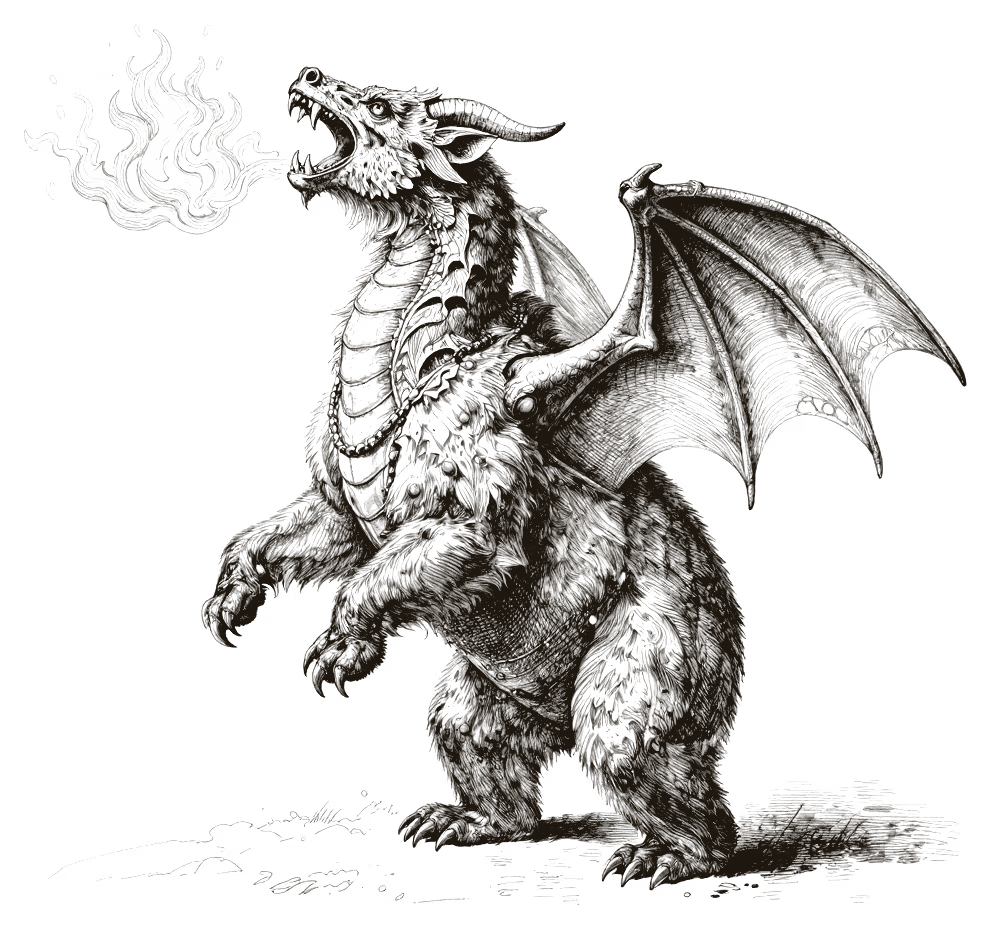
A bandor is the result of ancient genetic experiments by a crazed wizard. To create a bandor, a cave bear of the largest size was cross-bred with each of the five types of evil dragons. Therefore, there are five sub-species of bandors: black, white, blue, green, and red. A bandor has the head, neck, tail, and wings of its respective dragon, and the body of a cave bear, although dragon scales are interspersed throughout the body fur. These scales grow more abundant as the bandor ages, but do not generally show through the fur until the mature adult stage is reached.
A bandor is wingless at birth; as the wings grow throughout the first two stages of life, they are too small to enable flight. A bandor is able to fly only upon reaching the adult stage (age 16.)
Bandors of all sub-species speak a tongue common to all bandors, a tongue common to all evil dragons, and 12% of very young bandors have an ability to communicate with any intelligent creature. The chance to possess this ability increases 5% per age category of the bandor.
Combat
Bandors are generally aggressive and will attack most anything that is a threat to their territory. These creatures are intelligent enough to decide when bite and claw attacks will be sufficient, or when it is necessary to employ spells and/or breath attacks; these latter two attack forms are reserved for very powerful opponents. If a bandor scores a hit with a paw on an 18 or better, it also hugs for 2-16 (2d8) points of additional damage. Bandors will continue to fight for 1-4 melee rounds after reaching 0 to -8 hit points; at -9 or fewer hit points, they are killed immediately.
Breath Weapon: Each sub-species of bandor has a breath weapon identical in shape, size, and composition to that of their respective dragon; however, damage of all types is identical, as per the table above. Any creature who makes a successful save vs. breath weapon only suffers 1/2 normal damage.
A bandor has no fear aura or other special magical abilities that dragons do, but they are immune to attacks with the same composition as their breath weapon. Bandors cast their spells at 6th level, plus the combat modifier.
Habitat
Bandors live in thick forests in temperate and sub-arctic regions. Their lairs are usually in large, well-hidden caves in the center of their territory.
Bandors live alone or in families; if two bandors are encountered together, there is a 20% chance of there being 1-4 cubs (age category 1 or 2) present as well. Bandors are very protective of their young, and will attack anything attempting to harm them. Bandors are normally at odds with other forest-dwelling creatures due to their aggressive nature. A green bandor will sometimes ally itself with a green dragon, but the other sub-types do not get along with dragons.
Ecology
Bandors are omnivorous, but prefer to eat meat. They hunt woodland animals such as bears and deer, and have even been known to attack centaurs and elves, the latter of which they consider to be a delicacy.