Monsters for AD&D - Sharod
| Statistic | Value |
|---|---|
| Climate/Terrain | Arctic or Ice Para-Elemental Plane |
| Frequency | Rare |
| Organization | Clan |
| Activity Cycle | Any |
| Diet | Carnivorous |
| Intelligence | Average (8-10) |
| Treasure | Q, (U) |
| Alignment | Lawful Evil |
| No. Appearing | 2-12 |
| Armor Class | 4 |
| Movement | 12" |
| Hit Dice | 8 |
| THAC0 | 13 |
| No. of Attacks | 2 |
| Damage/Attack | 1-8/1-8 |
| Special Attacks | Cold weapons |
| Special Defenses | See below |
| Magic Resistance | Nil |
| Size | L (10' long) |
| Morale | Elite (14) |
| XP Value | 2,000 |
Description
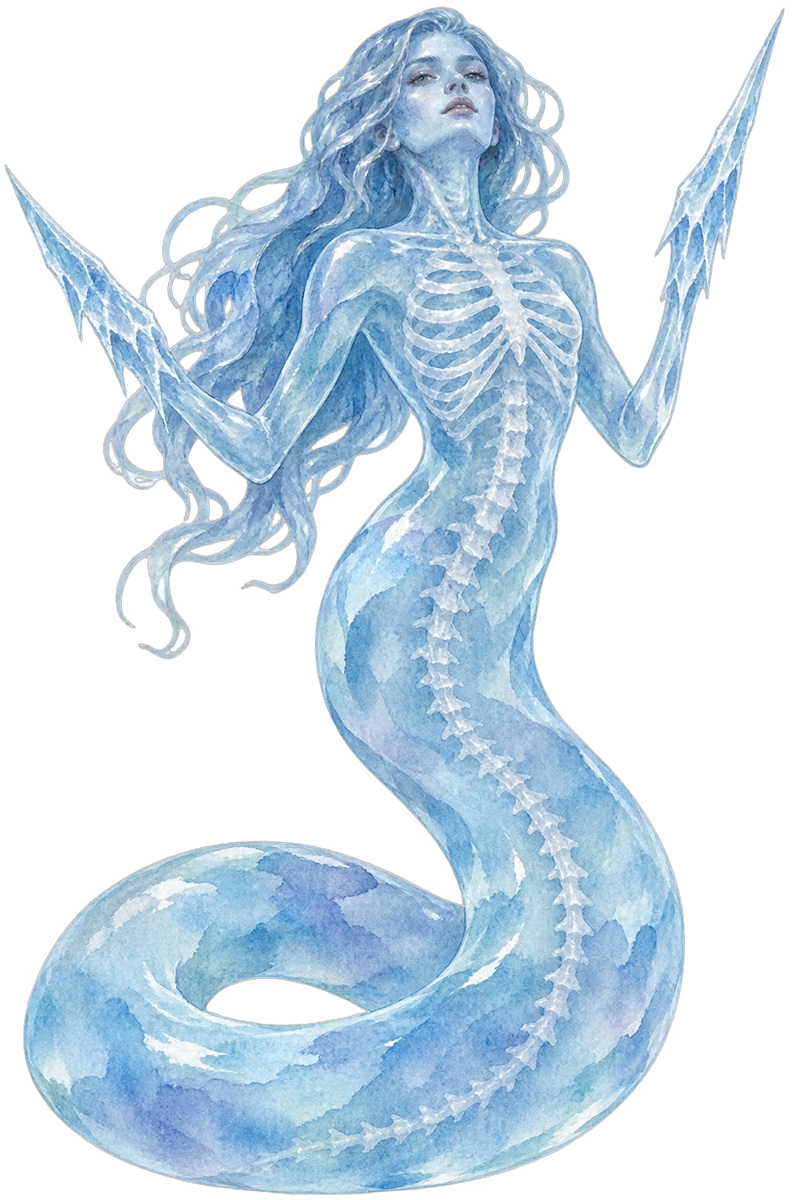
The body of the Sharod consists of a thick, serpentine tail attached to a humanoid upper torso, head and two arms. Due to their appearance, these creatures have often been called an Ice Naga. Such a name is a misnomer, however, as they are purely an elemental being. Most of their body is composed of a blue, watery liquid that acts as a powerful anti-freeze. Even in the most extreme cold temperatures the liquid body of a Sharod stays fluid. The body is held together by an icy skeletal structure that is clearly visible through their liquid form. This ice is tougher than bone and is very difficult to hit or damage.
Combat
While they appear unarmed, the Sharod is able to form icy appendages at the end of their arms that serve as weapons. These appendages can be a sword, hammer, hook, or club. All such do 1d8hp of physical damage when they strike a foe, plus +2 cold damage from each attack. The balance provided by heavy tail allows the Sharod to perform an attack with each of their arms during the same round.
Because most of the body of a Sharod is liquid, piercing weapons only inflict half their normal damage during an attack. Blows struck against a Sharod cause the body to turn slushy, slowing the creature down and making it easier to hit. For every 10hp of damage suffered by a Sharod their Armor Class is penalized by 1 and it is at -1 to hit.
When in temperatures below freezing, a Sharod will regenerate any damage at the rate of 1hp per round. For every 9hp of damage, however, the rate of regeneration will slow down an extra round. Thus after suffering 18hp of damage a Sharod will require 3 rounds to regenerate 1hp. If the Sharod ever drops below zero, its body will collapse in a pool of blue water, leaving only an icy skeleton.
Due to their fierce combative natures, the Sharod are particularly resistant to mind effecting spells. They gain a +2 bonus to any saving throws versus mind-effecting spells. They also receive an unmodified saving throw once each round against any mind-effecting spells that currently control their actions.
The Sharod dislikes bodies of liquid water and suffers 1hp of dissolving damage per round it is immersed. Mist or fog has no effect on this creature, however. Any cold-based attacks against a Sharod have their damage dice reduced by one. Fire or heat has the opposite effect, however, and all damage dice from such an attack is increased by +1.
Habitat/Society
The Sharod forms an elite warrior force on the Ice Para-Elemental plane. They are completely loyal to their current master and will fight until death to protect their ward. They normally form tight-knit clans that will defend each others’ honor to the last drop of their bodies. They are known to hold grudges for many generations, and it is not unknown for Sharod clans to eradicate each other over a "blood" feud. Sharod are cruel and ruthless warriors, and they gleefully enjoy tormenting their foes.
They reproduce by merging the bodies of a male and female and then splitting into a clutch of 5-8 hatchlings. Thus each hatchling has a memory of its ancestors stretching back many centuries. A mental tie known as the Khadol allows each of the clutch members to know the position and physical health of its fellows. This tie can last for many years, although it usually only lasts into adulthood for the closest of siblings.
Ecology
These watery creatures like to draw certain nutrients from the bodies of their fallen foes. They usually allow the body to freeze and then dissolve the precious nutrients by wrapping it in their body.