Mountain Creeper
| Statistic | Value |
|---|---|
| Climate/Terrain | Mountains |
| Frequency | Rare |
| Organization | Solitary |
| Activity Cycle | Day |
| Diet | Carnivore |
| Intelligence | Non- |
| Treasure | Nil |
| Alignment | Neutral |
| No. Appearing | 1-4 |
| Armor Class | 5 |
| Movement | 4" |
| Hit Dice | 5 |
| THAC0 | 16 |
| No. of Attacks | 1 |
| Damage/Attack | See below |
| Special Attacks | See below |
| Special Defenses | Nil |
| Magic Resistance | Nil |
| Size | M (4 to 10 feet in length) |
| Morale | Fanatic |
| XP Value | 200 |
Description
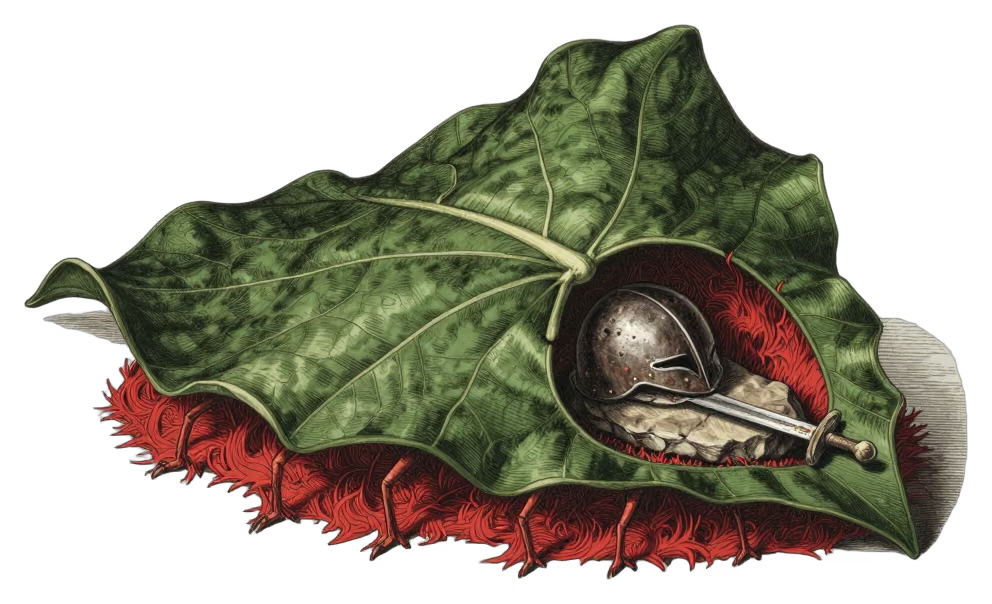
Another strange discovery of the high mountains (as well as some areas of tundra) of Dalvashia is the mountain creeper, distantly related to such creatures as black pudding and gray ooze. A thin, sheet-like red-blooded creature, it looks something like a rhododendron leaf, only with the underside covered with a forest of tiny legs. It slithers along the ground, during the day, fond of crawling on top of rocks where its large surface area warms it quickly. At night it rolls into a ball in a crack to minimize its surface area and thus its heat loss.
The small ones are the size of playing cards and as thin as ¼ inch in thickness. Essentially shrew-like in their habits, they are not dangerous, feeding on still smaller mountain creepers, insects, and the like. Larger varieties are as big as plates and tables. The variety most dangerous to the adventurer are the table sized ones, who normally hunt and eat corkbugs via a trapper-like enveloping attack. They do not distinguish between food sources, and will gladly eat a human or a halfling.
Their attack form is the much the same as a trapper; they wait until the prey is near the center, and then suddenly close themselves upon the unsuspecting victim. The mountain creeper then crushes them by doing a base damage of 2 plus the armor class of the victim per turn of crushing. Those entrapped (only two people at most in most mountain creepers) are unable to use weapons. Prey will be smothered in 6 melee rounds regardless of the damage sustained. It must be killed to make it release its prey.