Meaching
| Statistic | Value |
|---|---|
| Climate/Terrain | Arctic tundra |
| Frequency | Common-Uncommon |
| Organization | Clan |
| Activity Cycle | Any |
| Diet | Herbivore |
| Intelligence | Average (8-10) |
| Treasure | None |
| Alignment | Neutral or Neutral Good |
| No. Appearing | 4-80 (4d20) |
| Armor Class | 6 |
| Movement | 10 |
| Hit Dice | 1-2 |
| THAC0 | 19 |
| No. of Attacks | 1 |
| Damage/Attack | 1-4 or by weapon type |
| Special Attacks | Nil |
| Special Defenses | Nil |
| Magic Resistance | Nil |
| Size | 3 (about 2 to 4 feet in height) |
| Morale | Average (8-10) |
| XP Value | 200 |
Description
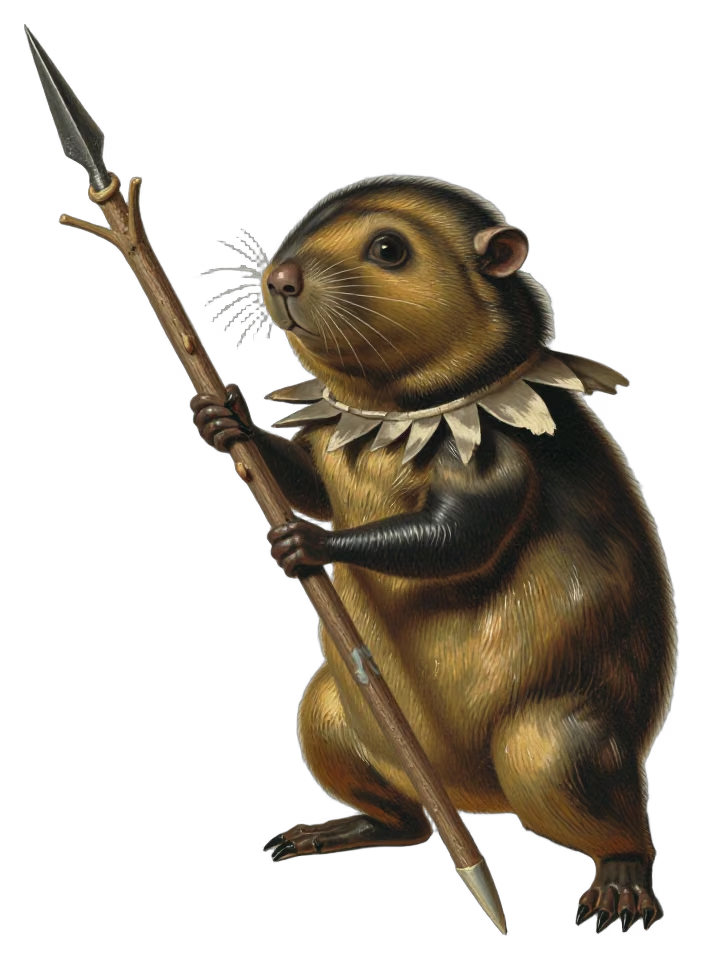
The meaching is one of the main life forms of the arctic tundra of the world 50 million years hence, and in a fantasy campaign might be on the road to intelligence and civilization (it is fantasy after all).
Descended from the lemming, they exist in colonies on the frozen tundra. To protect them from their many predators as well as the frosts and snows, they construct fortresses of sorts. As the constantly frozen ground of the tundra makes digging through the soil impossible, these fortresses are constructed above ground. These fortresses exist as gigantic mounds of matted vegetable matter, through which numerous tunnels and passageways have been constructed. The interior of the fortress is very complex and consists of a network of passages and tiny chambers - one for each individual. During the winter each rodent is fully insulated and kept warm by the rest of the colony.
As the meaching became better at constructing fortresses and getting along with its fellow colony members, an intelligence has developed. To aid them in defense of the fortress, some meachings have replaced a reliance on a bite attack with the use of clubs and spears, generally made from tree branches, old bones, and the like. Doing half-damage of a human-sized weapon, the meachings have begun to experiment with the ideas of tactics and coordinated attacks.
Rare extraordinary meachings have begun to dabble in the very long lost magical arts, and any meaching fortress encountered has a 25% chance to have a druid, of levels 1-4, and a 5% chance to have a actual wizard, of levels 1-2.
Such innovation is greatly needed, as the meachings are subject to a great deal of predation. Chief among them are the polar ravine, the bootie bird, and the gandimot. The polar ravene is the fox-like predatory rat similar to the temperate ravene described in the falanx entry. They have been known to attack meachings by digging into the fortress with their front paws.
The bootie bird is a descendent of the crow. Still black in color, the bootie bird is more heron like in form now, with a long neck and bill and long legs. In the summer months the bootie bird behaves as a heron, dipping into streams and shallow pools for fish, but in the winter months it uses its long neck and beak to probe into the fortress for hapless rodent folk.
The gandimot is another avian predator, descended from the magpie which it still resembles (though with a hooked beak and pointed wings). Unable to reach the meachings inside their fortresses, this hawk-like predator attacks the meachings when they migrate to new territories. The meaching have a very high birthrate, to compensate for the harsh climate and the large number of predators, but on occasion population explosions result, forcing meaching colonies to move to new areas, sometimes splitting up, others times moving as a whole. At this time, the swooping, diving gandimot is a major threat (along with the bootie bird and the polar ravene).
The mechings have no comprehension of any other form of sentient or semi-sentient life, and to encounter such would be a source of amazement to them - if they did not avoid them thinking they were yet another predator.