Dark Starling
| Statistic | Value |
|---|---|
| Climate/Terrain | Any |
| Frequency | Rare |
| Organization | Flock |
| Activity Cycle | Day |
| Diet | Omnivore |
| Intelligence | Animal |
| Treasure | Nil |
| Alignment | Neutral |
| No. Appearing | 20-200 (+) |
| Armor Class | 7 |
| Movement | 2/18 |
| Hit Dice | 1 to 2 hit points |
| THAC0 | 20 |
| No. of Attacks | 1 |
| Damage/Attack | 1 |
| Special Attacks | See below |
| Special Defenses | Nil |
| Magic Resistance | Nil |
| Size | S (a foot wingspan at most, usually much smaller) |
| Morale | Average (8-10) |
| XP Value | 15 |
Description
The dark starling is related to the standard or "European" starling, in the same way a winter wolf is related to the normal wolf; the magics of the world have twisted this creature, perhaps amplifying natural tendencies, or maybe adding new qualities.
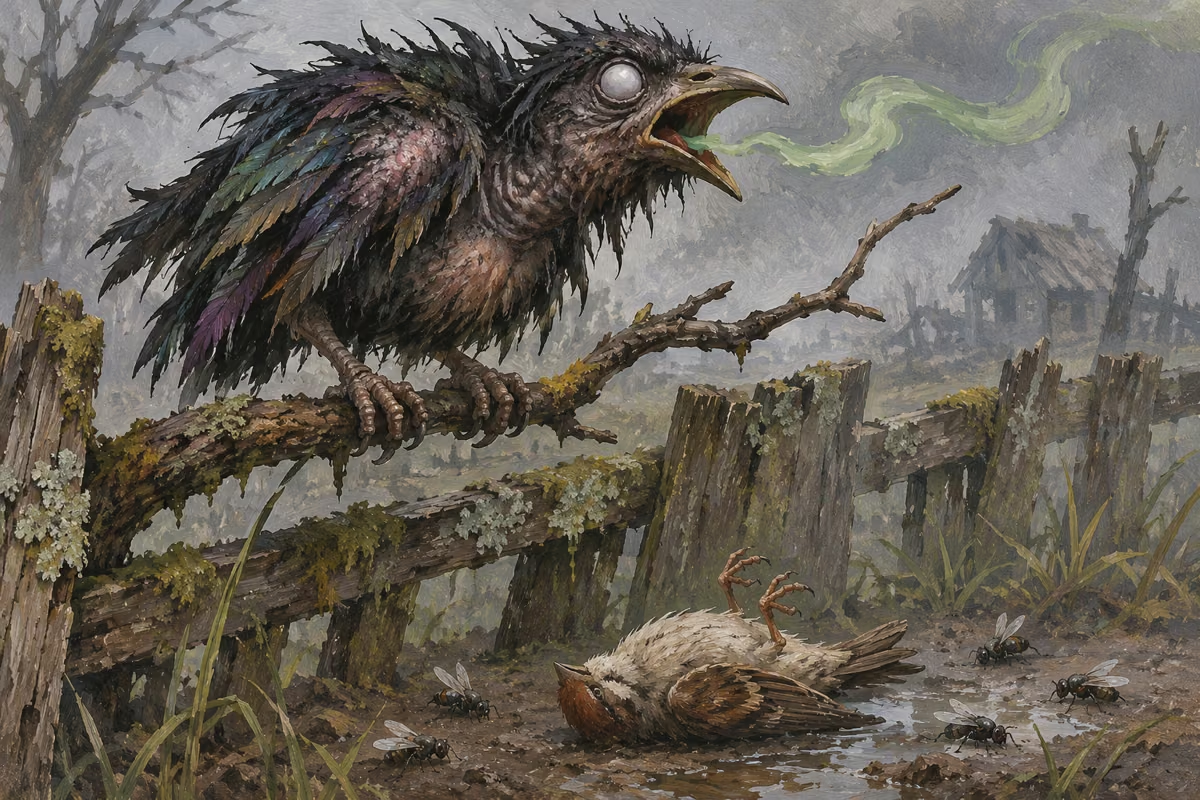
In appearance, the dark starling looks much like the common starling, basically a stocky, medium-sized perching bird with a short tail. Generally about the size of a robin, the dark starling can be distinguished from its relatively harmless kin by its plumage, which is an iridescent black rather an black with purple and green, and its legs are of a black rather than a reddish color.
The chief claim to fame for the dark starling is that it is a flying bag of disease. Any wound caused by a dark starling has a 25% chance in resulting in a serious disease, generally of a cardiovascular nature, with a 50% chance for being terminal, otherwise lasting 1-12 days. Further, any individual within 200 feet of a flock of these birds (or 20 feet of an individual bird) stands a 30% chance for contracting a respiratory illness, which will cause the permanent loss of 1 point of strength and 1 point of constitution if it does not kill (20% chance for that), which will occur in 1-12 months. In both instances a successful saving throw versus poison will indicate the individual in question is safe from infection.
The arrival of a flock of dark starlings generally brings about a precipitous decline in local wildlife (if not local citizens), which is fine for them as they feed on the deaths they cause. The dark starlings are unable to stay in an area more than a few weeks, lest they wreck the local ecology beyond repair, or more to the point run out of things to eat.