Corvay, Desert
| Statistic | Value |
|---|---|
| Climate/Terrain | Semi-arid forests, desert areas, mountains |
| Frequency | Uncommon |
| Organization | Flock |
| Activity Cycle | Day |
| Diet | Omnivore |
| Intelligence | Very (11-12) |
| Treasure | None |
| Alignment | Chaotic good |
| No. Appearing | 2-200 |
| Armor Class | 6 |
| Movement | 4" / 25" |
| Hit Dice | 1-1 |
| THAC0 | 20 |
| No. Of Attacks | 1 |
| Damage/Attack | 1-4 |
| Special Attacks | Nil |
| Special Defenses | Nil |
| Magic Resistance | None |
| Size | S (4 feet) |
| Morale | Unsteady (5 to 7) |
| XP Value | 30 |
Description
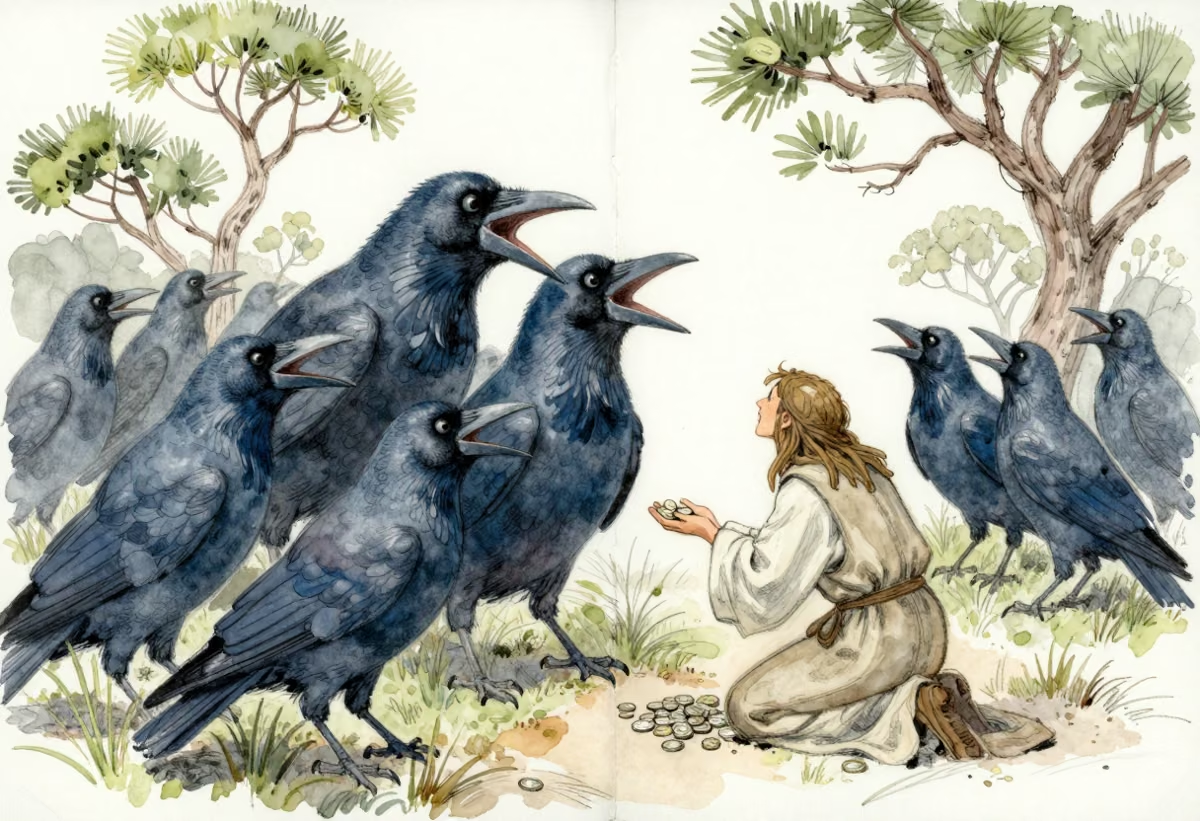
The desert corvay bears a great deal of resemblance to its distant relative, the pinyon jay. The much smaller and non-sentient pinyon jay resembles a small , chunky blue crow, a highly gregarious creature that lives in large, noisy flocks in the pinyon and pinyon-juniper woodlands of deserts, notably in northern Maztica, around the desert of Anauroch, and in the wilder areas of Calimshan. These creatures might be found in similar arid regions on other worlds.
The desert corvay looks like a pinyon jay, but is larger (about 4 feet long) and has a larger head in proportion to its body (presumably to contain the larger brain) though by no means is this enlargement gross. It is also similar in habits, the desert corvays not existing as family units, but instead as nomadic, roaming flocks. Unlike the distantly similar aarakocra, the desert corvay does not have developed arms, nor can it grasp things in its hind limbs with the skill of the aarakocra.
Although often flighty, a smart person can approach a flock with care. If one approaches over open ground towards them, obviously alone and unarmed, slowly and deliberately, one can engage the flock in conversation. Though the flock has no leader and any potential speaker might be met with a cacophony of voices, he or she might be able to gain valuable information. Flocks generally pick up the language of the nearby human tribe, village or city. The corvays have their own language, but it is difficult if not impossible for humans and demihumans to use it.
Although the flock will not share information on new sources of food, they may share news on water sources, on local groups of other sentients, or on local dangerous predators. Before this information is imparted though, the would be petitioner must offer something in return; perhaps a large supply of pinyon nuts, basketfuls of fresh fruit, or the all time favorite, something shiny. A flock will go crazy if someone offers some shiny trinket, with each member of the flock trying to be the most helpful and pleasing in order to obtain it. Particularly popular are gems, but glass and shiny beads, belt buckles, and coins all do well. Flocks that live near well traveled areas and encounter humans often tend to grow a little jaded though, and may require particularly nice items or multiple items before imparting information.
Successful petitioners may actually be partially adopted by the flock, who may for a time follow that person or persons around, in the hopes of wheedling out more garnish, so to speak. While they would probably never lie, desert corvays have been prone to exaggeration, so be careful of the news offered among particularly desperate members.
Combat
If one were to attack the flock, it would most likely lift out in a huge rush, though they can attack with a beak attack if really pressed. If the flock escapes, it will warn every predator in the region it can that that person is not to be trusted and might make a tasty morsel, and if possible the flock will attempt to set powerful monsters upon him or her (or they). Further, all other flocks will be warned of this if possible; eventually within a matter of months if not weeks all flocks will know. With particularly loathsome individuals, flocks have been known to shadow attackers, disrupting their sleep, soiling them, alerting predators and hostile tribes, and the like. That is rare though; the chaotic desert corvays rarely keep at one task very long.
Habitat/Society
Though mostly found in semi-arid forests, they often range into nearby mountains areas and into true desert. They are not found near the coast or on the plains, and their territory is far from temperate woodlands or the jungles.
Formerly empty stretches of woodland can suddenly be enlivened when a flock of desert corvays shows up, descending in numbers at times up to a hundred. Blue and blue-gray birds would then be seen in every tree for sometimes hundreds of yards, calling and gossiping to one another. Although they range far and wide in search of new sources of food, they nevertheless have plenty of free time. As a function of their roaming for food, nomadic habits, free time, and intelligence, they often pick up large amounts of local lore.
Ecology
Like their smaller cousins, desert corvays range over the countryside in huge flocks, likely in non-breeding times to contain all the members of this race for many miles around. The flocks are not territorial, but instead wander over huge regions in search of food; primarily this is nuts from the pinyon pine, but they also feed on a number of other items, such as insects, berries, and seeds.