Corkbug
| Statistic | Value |
|---|---|
| Climate/Terrain | Mountains |
| Frequency | Uncommon |
| Organization | Herd |
| Activity Cycle | Day |
| Diet | Herbivore |
| Intelligence | Non- |
| Treasure | Nil |
| Alignment | Neutral |
| No. Appearing | 2-12 |
| Armor Class | 4 |
| Movement | 10" |
| Hit Dice | 1 |
| THAC0 | 18 |
| No. of Attacks | 1 |
| Damage/Attack | 1-4 |
| Special Attacks | Nil |
| Special Defenses | Blunt weapons do half damage |
| Magic Resistance | Nil |
| Size | S (2 ½ to 4 ½ feet long) |
| Morale | Average |
| XP Value | 60 |
Description
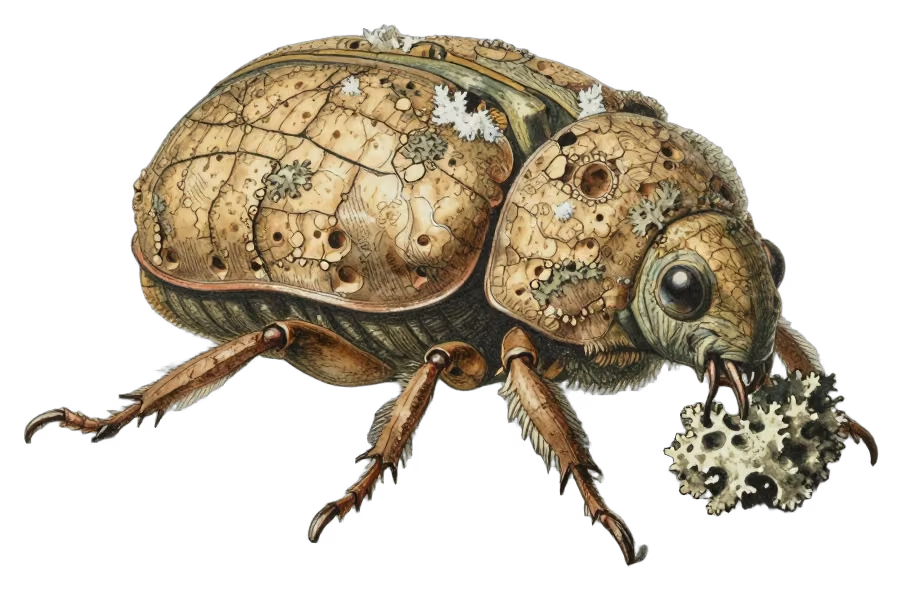
In a world that has no native mammals or birds, one might expect to find no notable life forms in the high mountains and alpine meadows. One would be wrong. To quote two cliches, "nature abhors a vacuum", and "life finds a way." The corkbug is one such example. Related to the more familiar giant insects of the lowlands, it has uniquely adapted to the rarefied air, biting winds, and even the snow of the high western mountains of Dalvashia.
The corkbug is a giant insect (though possibly actually a crustacean), and is covered in a different substance than giant ants or beetles. Instead of standard chitin, it clad in a cork-like substance, thick, but airy and light, that aids in insulation of the creature from the cold. Beneath the cork, there are amounts of oil fat also for insulation.
Early settlers found that the cork makes excellent insulation and is sought after in other parts of Dalvashia, and the oil is ready made for lubrication and for burning. As a result, in many areas corkbugs have been extensively hunted.
In combat, corkbugs only receive half damage from attacks by blunt weapons, owing to their thick insulation. Though not especially fast, their thick hides give them an excellent AC. If forced to, they bite to attack for 1-4 hit points of damage.
Corkbugs are generally harmless, feeding on lichen, moss, dried leaves, and any other plant material it can find. In effect, they fulfill the role of sheep or mountain goats here.