Buata
| Statistic | Value |
|---|---|
| Climate/Terrain | Tropical jungle, islands |
| Frequency | Rare |
| Organization | Solitary |
| Activity Cycle | Any |
| Diet | Omnivore |
| Intelligence | Low (5-7) |
| Treasure | None |
| Alignment | Neutral evil |
| No. Appearing | 1-6 |
| Armor Class | 2 |
| Movement | 10 |
| Hit Dice | 2 |
| THAC0 | 16 |
| No. of Attacks | 3 |
| Damage/Attack | 1-3/1-3/1-6 |
| Special Attacks | None |
| Special Defenses | None |
| Magic Resistance | None |
| Size | M (6' tall) |
| Morale | Unsteady (5-7) |
| XP Value | 300 |
Description
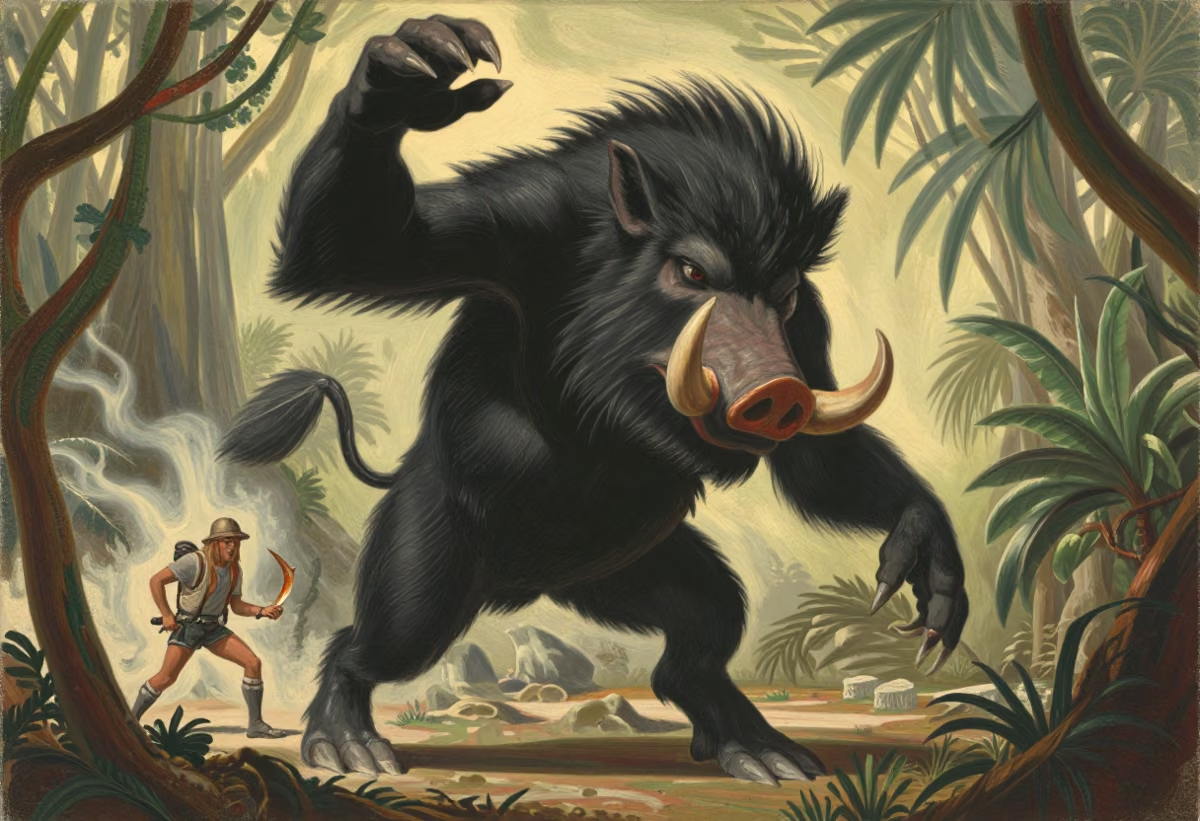
The buata is unique to the jungles of the islands of Polynesia, and is in appearance a jet-blacked, furred, lumbering creature. It resembles some kind of transitional form between an orc and a wild boar, as it is able to move either on all four legs or upon its hind legs. Like a wild boar, it possesses huge tusks, which protrude from the jaw even when the mouth is closed.
There is speculation that the buata represents a primitive from of orc, perhaps some sort of "missing link." Other scholars believe they are some sort of offshoot, related to but not ancestors to modern orcs, much like gorillas are to humans. Buatas are not found in lands that contain orcs, and it is not believed that the two races could coexist.
Combat
Unlike the more intelligent orcs, the buata does not posses any natural ability to fashion its own tools. By and large, the buata relies on a claw-claw-bite routine, though the latter is especially deadly owing to the huge tusks. Some buatas (25% of them) are able to pick and use weapons they may encounter, perhaps dropped by a slain or a fleeing enemy (i.e. prey). Generally, these weapons will be native weapons, such as a club or spear, though it is not impossible for one to be found with a metal sword or the like. They are not known to use shields or any type of armor.
Habitat/Society
The buatas are barely above gorillas in intelligence, so they do not form tribes or nations like orcs are known to do. Instead, they are found in family units or solitarily. Each family unit is ruled over by a dominant male. When young males in the family unit reach five years of age (buata mature fast) they may challenge the dominant male for leadership; the loser, if not killed, becomes a solitary wanderer.
Ecology
The preferred prey of a buata is human flesh, though they are known to eat the meat of just about anything they can catch. They also consume plant material and carrion.