Two 2 HD lesser quasi-elemental
| Statistic | Value |
|---|---|
| Intelligence | semi- (2–4) |
| Alignment | neutral |
| Armour Class | 3 |
| Movement | flight, 18 (A) |
| Hit Dice | 2, 4 or 6 |
| THAC0 | 18, 16 or 15 |
| Number of Attacks | 1 |
| Damage per Attack | 1d6+1 point per Hit Die |
| Special Attacks | see below |
| Special Defence | needs +1 or better weapon to hit |
| Magic Resistance | nil |
| Size | S (1-foot sphere) |
| Moral | élite (14) |
| XP Value | 270, 650 or 1400 |
Description
| Roll | Result |
|---|---|
| — | Two 2 HD lesser quasi-elemental |
| 11–50 | Three 2 HD lesser quasi-elemental |
| 51–80 | Two 4 HD lesser quasi-elemental |
| 81–00 | One 6 HD lesser quasi-elemental |
Lesser Quasi-Elemental
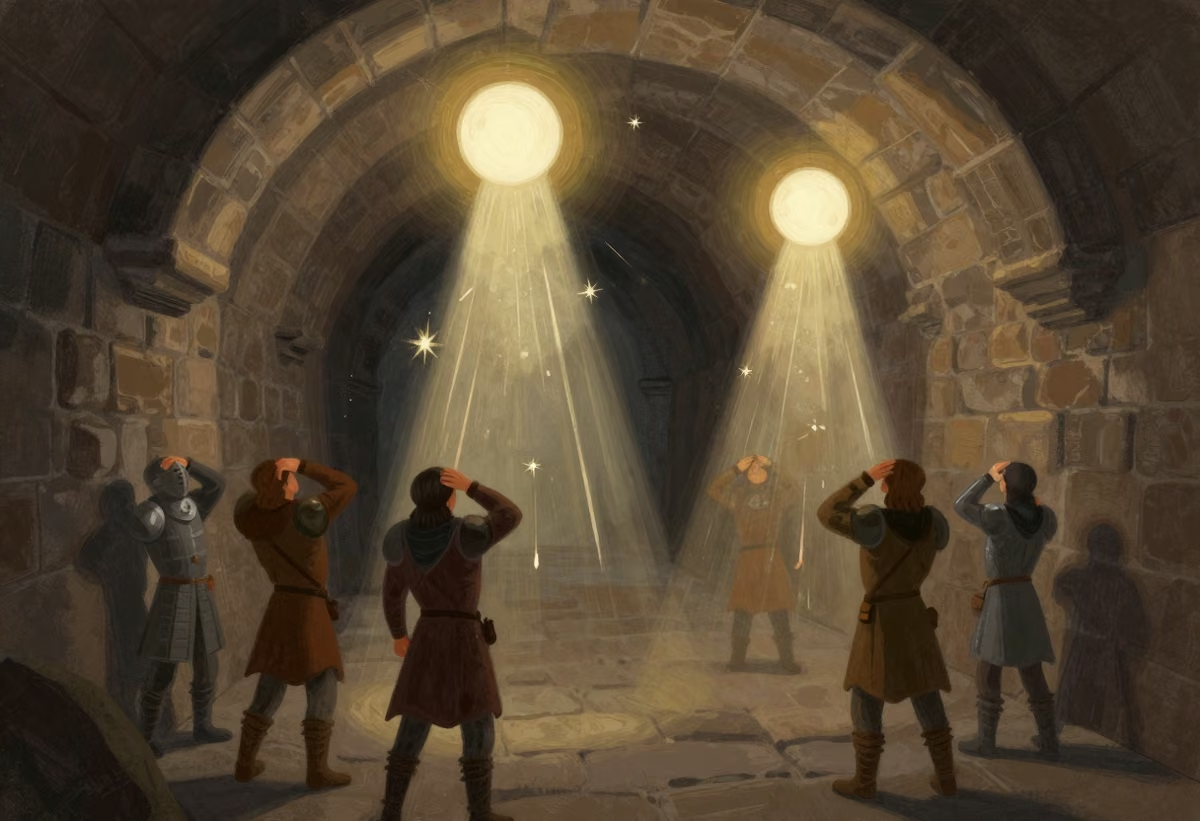
Lesser radiance quasi-elementals inflict 1d6 points of energy damage + 1 point per Hit Die (double damage to creatures directly affected by sunlight), and all within 10 feet must save versus petrification or be −1 to hit from the blinding light. Light and energy attacks do not harm them. Fire and heat do only half normal damage. Cold and water attacks do double damage. Darkness keeps them at bay.
Also in this section of the source
Contain Area of Effect (Alteration, Metamagic)
- Range: 0
- Components: V, S, M
- Duration: Special
- Casting Time: 3 rounds
- Area of Effect: Creature touched
- Saving Throw: None
- Author: Kai Rottenbacher
This spell gives the creature touched one spell level per caster level with which spells may be cast. The freely chosen spells are then changed in their aspects so that stay within a certain area of effect the caster specifies at the casting of these spells. This prevents the spells from expanding in their effect into undesired areas as it so often happens with these unruly fireball spells.
This spell may be layered up to a maximum of 2 spell levels per caster level. As it works by touch it can be given to anyone who casts spells or uses items which duplicate spell effects (or spell-like effects).
These creatures can use up the spell levels at their leisure: This spell lasts until all spell levels have been used up.
The material component is a small silver box encircled with a paper strip inlaid with a strip of hammered platinum which costs no less than 500 gp (the whole arrangement).
Control Normal Fires (Alteration)
- Range: 1 foot per level
- Components: V, S, M
- Duration: 1 round per level
- Casting Time: 2
- Area of Effect: 1 cubic foot per level
- Saving Throw: None
- Author: Brock Neverman
This spell enables the wizard to cause fires as small as a torch or lantern to become as large as a 6-foot diameter bonfire or to cause a bonfire to shrink to the size of a torch or explode into a fire with a diameter of 18 feet. In this process fuel is burned according to the size of the fire. Also heat dissipation can be adjusted which will also affect the amount of fuel used.
The amount of change a wizard can bring about in a fire is determined as follows: take the wizard’s level divided by 2 and round it down. This is the maximum multiplier or divisor for the size (in volume) and effects of the fire.
The material component differs for the two different uses of the spell: if the spell is used to increase a fire, the material component is a tinderbox, which is not consumed in the casting. If the spell is used to shrink a fire, the material component is a drop of water.
Create Bedroom (Conjuration/Summoning)
- Range: 10 feet
- Components: V, S, M
- Duration: 2 hours per level
- Casting Time: 1 turn
- Area of Effect: 30 square feet per level
- Saving Throw: None
- Author: Kai Rottenbacher
This spell creates the interior of a bedroom. It contains one or more beds (5 square feet per level maximum), covered in sheets (rheumatic covers), a thin layer of covers (in summer) or succeedingly thicker for other temperatures (up to and including Arctic temperatures), one pillow per two levels, one night table per 5 levels, one shuttered oil lamp (with oil) per table, a bed warming pan, some bed rugs, a small sparker set (to light the lamps), a small wardrobe with sleeping gowns (male or female), a night cap for men, one beard holder per level (any size), soft night slippers, and a covered bed pot. This spell creates only the interior of the room; it doesn’t normally create the walls, floors, or ceilings.
As with the other room spells, no items can be used to cause harm, help in combat; nor can they be sold. If tried, they vanish in a puff of smoke.
The material components: a small bit of cloth or fur (for the covers, gowns, and slippers), a drop of oil (for the oil lamps), a tiny piece of flint (for the sparker set), and a tiny piece of any kind of metal (for the pot, pan, and lamp).
Create Kitchen (Conjuration/Summoning)
- Range: 10 feet
- Components: V, S, M
- Duration: 1 turn per level
- Casting Time: 1 turn
- Area of Effect: 10 feet per side per level area (any shape)
- Saving Throw: None
- Author: Kai Rottenbacher
This spell creates a complete set of kitchen utensils, including: a small icebox (large enough for approximately 6 to 8 gallons of fluid), 2 large fireplaces including a spit each, a stove with 8 fire places, an oven with three large compartments, 4 pots (large enough to contain enough stew for a very hungry halfling each), 8 small stirring dishes, 4 pans, 5 stirring pots, 3 hot water baths (for the pots), 3 cold water baths (again for the pots), 10 small but very sharp knives, 10 small spoons (for tasting), 5 large forks (for turning meat), 3 small hammers (for softening meat), 5 cutting boards, 2 egg cutters, a salad dryer, 3 large mixing bowls, a large sink, 3 waste baskets, 10 wooden stirring rods, 10 pan scrubbers, 10 wooden turnabouts, 3 corkscrews or one elaborate bottle opening set, and 3 serving dishes per level. This spell creates only the interior of the room; it doesn’t create the walls, floors, or ceilings.
The utensils cannot be used for anything but cooking or the preparation of food (and I mean normal food, not what goblins consider food). Thus, the knives cannot be used to attack someone (or even to defend oneself with), the water in the water baths cannot be drunk or be used for washing or anything else but heating or cooling food still in the creation process, the waste basket cannot be used for anything but storing the remains of cooking the food, etc. If it is tried the appropriate utensil vanishes with a small puff of smoke. The whole set of utensils also vanishes at the end of the duration including anything still in the waste basket or the sink unless it is normally not put into these containers (thus, this spell cannot be used to escape a hopeless situation or to create utensils for an escape or something else). The utensils cannot be sold (if tried they vanish as above). They can only be used to prepare food. They will even vanish if they are used to block someone’s way during combat.
The material component depends on the quality desired: the caster needs a small model of a kitchen knife, a pot, a pan, a tiny stove, a tiny bit of ice (if the icebox is desired), a tiny splinter of wood, and a small spark. These miniatures can be from almost any material (except the wood and the spark as they are necessary for the fire). The utensils will be of the same material as the miniatures were made from. The caster can either use these material components during the actual casting or he can use it during the preparation. If it is used in the actual casting, the casting time is one turn; if it is used during the preparation time, the preparation (memorisation) time increases to one hour (instead of 45 minutes), but the caster can then summon the kitchen utensils at any later time with a snap of his fingers — ready to be used.
Curse Weapon (Enchantment)
- Range: 5 feet per level
- Components: V, S, M
- Duration: 1 round per 2 levels
- Casting Time: 3
- Area of Effect: One weapon
- Saving Throw: Negates
- Author: Unknown
This spell is used to curse the weapon of an opponent. When it is cast, the wizard chooses which weapon to curse. Unless the owner of the weapon makes a successful saving throw versus spell, that weapon will have a penalty applied to all to-hit and damage rolls for the duration of this spell. The penalty is equal to 1 for every four levels of the wizard, to a maximum of −5. This penalty only applies to the chosen weapon, not to other weapons carried by the owner.
This spell will negate magical bonuses (only for the spell’s duration); if a weapon’s magical bonus is reduced, its current value is used for determining which types of creatures may be hit by it (i.e., if a sword, +4 sword is reduced to +1 by this spell, it cannot be used to hit elementals for the duration of the spell).
The material component of this spell is a small replica of the weapon to be cursed; it is consumed with the casting.
Cyril’s Bungee Snap (Evocation, Wild Magic)
- Range: 30 feet per level
- Components: V, S, M
- Duration: Instantaneous
- Casting Time: 3
- Area of Effect: One 10-foot per level long magical cord
- Saving Throw: Special
- Author: Craig Allen Campbell
This unique spell allows the wild mage to pull wisps of raw magical energy directly from the astral plane to create a magical "bungee" cord. The term "bungee" was chosen by Cyril. He had heard the word long ago and didn’t know what it meant, but has always liked the sound. He believes it to be from a long-forgotten language.
Two loops on the ends of the cord are then looped over two items or creatures. After the wizard has looped the cord and released control of the magic, the raw magical energy in the cord collapses in upon itself, pulling the two items or creatures together at a magnificent velocity. Only creatures who are magically anchored or objects that are securely attached to something else are immune, although the DM may allow a "bend bars" roll for a character who reacts quickly to grab onto something.
Note that there must be some way for a magical cord to fasten itself to each item. For example, a tree can be easily looped, but a wall can only be looped if there are protrusions or other fastening points for the cord.
The two items or creatures are drawn together and will hit each other. Items drawn against items must save versus crushing blow or be broken into no less than 50 pieces. An item drawn against a person need not save, but the person will take falling damage in accordance with his previous distance from the object (1d6 per 10 feet with a maximum of 10d6). If the item is particularly small, the DM may impose less damage. Cyril prefers bouncing people off of walls with this spell. If two people are drawn together, each takes falling damage for half their previous distance apart.
In all cases, the DM may call for Strength or Dexterity checks to hold onto items and saving throws versus fall to check for item damage. In the case of a creature drawn to an item, a saving throw is allowed for half damage. No saving throws are allowed for two creatures drawn to each other.
The material component for this spell is a piece of string, looped at both ends.
Dancing Lights II (Evocation)
- Range: Special
- Components: S
- Duration: 1 day
- Casting Time: 1
- Area of Effect: One globe per level
- Saving Throw: None
- Author: Jim Gitzlaff and Jim Sisolak
This spell creates up to one globe of light per level of experience of the caster. Each globe may be controlled separately and individually, and can float, bob, and otherwise behave rather like the lights from the 1st-level wizard spell dancing lights. The globes must either remain in sight of the caster or stay within a 30-foot per level radius lest they instantly vanish. They can move as fast as 200 feet per round.
The globes may be given a variety of simple commands by the caster. These commands may be individual (eg.: "globe 6 stop there in the centre of the intersection") or global (eg.: "all globes spin around the head of that figure"). The globes are not intelligent, hence cannot be given commands that require more discernment than a magic mouth could handle.
The globes are 1 foot in diameter and can be varied in colour (any) and brightness (anywhere from a guttering candle to a light spell for each globe).
This spell has several major uses:
- An improved, more eerie version of the 1st-level spell.
- To provide portable illumination. The lights can brighten things on ledges, in rooms, in pits, etc., without risking any party member’s health. Since each globe can be the equivalent of a light spell, this illumination can be quite significant.
- To try to distract opponents in long range combat. Folks in melee usually dodge, jump, and otherwise dance about too much for this spell to affect them. Archers and spellcasters, on the other hand, need to be still and concentrate in order to be effective. For every three globes spinning or flashing around the eyes of a single archer, missile attacks are made at a −1 penalty to-hit. For example, if Zarg tries to shoot his crossbow while 8 globes whirl and oscillate around his head, he will get a −2 penalty to-hit. Spellcasters must make a Wisdom check at a −5 bonus to the roll in order to keep their concentration & avoid botching the spell. For every globe after the first, the caster gets a +1 penalty to the Wisdom check. For instance, Abulator is trying to disintegrate Malithe while 4 globes spin in front of his eyes. Thus, he must make a Wisdom check at a −2 bonus to the roll or his spell fails.
The globes may be destroyed in two ways. A successful dispel magic cancels every globe in its area of effect. The alternative is to destroy the globes physically. They may be hit by magical, silver, or iron weapons (but not steel or wooden ones), have AC 0, and can take as many points of damage as the caster has levels of experience. Damage from spells will also harm the globes, though they are immune to fire and electrical damage of any sort.
Darklight’s Field of Infeasibility (Enchantment, Illusion)
- Range: 0
- Components: V, S
- Duration: 2 turns per level
- Casting Time: 3
- Area of Effect: Special
- Saving Throw: None
- Author: Keith Taylor
This spell was created by Darklight when he was captain of a spelljamming vessel crewed by a mix of plasmoids, lizardmen, xixchil, and hurwaeti. It was designed in an attempt to keep local populations from being thrown into chaos at every landing. The spell creates a subtle field of illusion and enchantment around 2 HD of creatures per caster level, which lasts for two turns per caster level. This field clings to each being touched, whether they remain in a group or not, and radiates an insidious message to all who encounter or view the affected beings. This message reassures onlookers that there is nothing out of the ordinary about these beings. Thus, the most bizarre of beings may enter crowded groundling cities and not be subject to undue attention or attack. A side effect of this is that all reaction modifiers are nullified, negating Charisma and related bonuses. When an observer is questioned later about a being under the field’s protection, they will remember the event precisely, and may become puzzled retroactively at their lack of reaction beforehand. The magic of the field tends to prevent this realization from becoming traumatic, however. Certain very powerful or extraplanar beings may not be affected by this spell: especially dragons, demons, devils, daemons, etc. generally will not sustain such a subtle camouflage, as their natural aura negates the feeble cloaking of this spell.