Airy Assistant
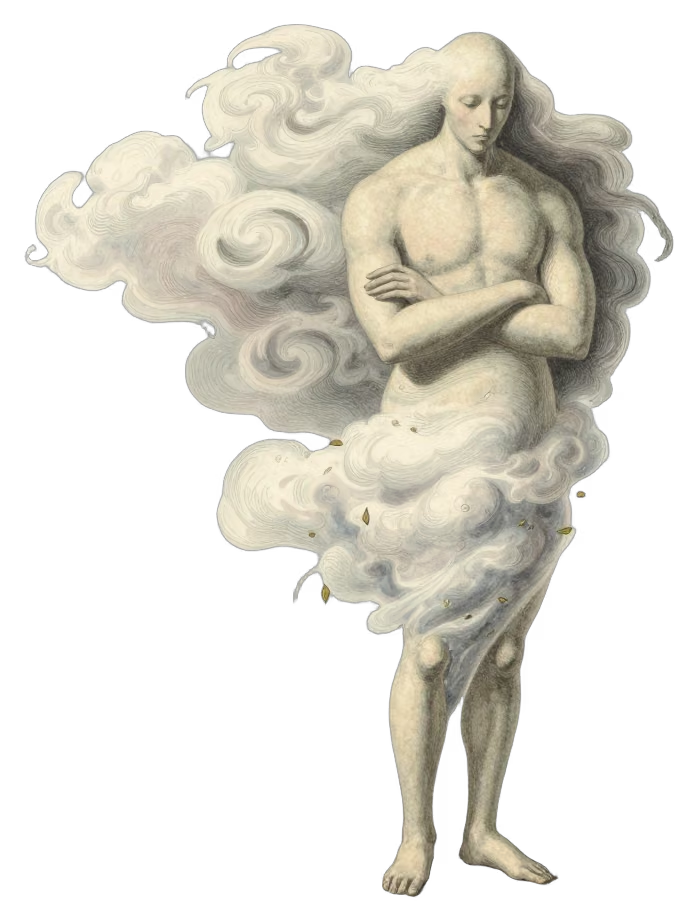
| Statistic | Value |
|---|---|
| Intelligence | Low (2–4). |
| Alignment | Lawful Neutral. |
| Size | L (10 feet high). |
| Morale | 20. |
| XP Value | 1500. |
Description
Its Strength score also determines its weight allowance and its chance to open doors and bend bars.
An airy assistant is not in fact under the control of the priest who summoned it — it will obey the creature that possesses the holy symbol that was used for summoning it. So if the priest’s holy symbol is taken from him by someone, the control over the airy assistance for the rest of the duration passes to that person. If the holy symbol is destroyed, the airy assistant immediately returns to its own plane of existence. An airy assistant can be physically destroyed, and it can also be forced back to its home plane by a successful dispel magic, abjure or banishment. Dismiss air elemental (the reversal of conjure air elemental) also works. A protection from evil or good spell will keep the airy assistant at a distance.
The material component for this spell is the caster’s holy symbol.
Also in this section of the source
Vylja’s Energy Shield (Abjuration)
- Sphere: Protection
- Range: 0
- Components: V, S, M
- Duration: Special
- Casting Time: 8
- Area of Effect: Creature touched
- Saving Throw: None
- Author: Ezra van Everbroeck
When Vylja’s energy shield is cast, the protected creature is surrounded by a glimmering and crackling blue cloak of magic. The energy shield lasts for 5 rounds for each level of the caster, unless it is exhausted earlier.
The energy shield will absorb attacks based on pure magical energy that are directed against the creature it protects. It absorbs one magic missile for each level the caster has attained (a magic missile cast by a 9th-level wizard will take five charges off the energy shield). At the end of each round during which the energy shield has absorbed at least one magic missile, there is a chance of 1% per level of the caster of the magic missile that the energy shield implodes, causing the protected creature to suffer 1d4 points of magical energy damage for each charge it has left.
Vylja’s energy shield also protects against spellfire attacks: it absorbs its caster’s level Hit Dice of damage before becoming exhausted. The chance of the energy shield imploding rises to 2% per level of the spellfire wielder. This 2% is cumulative with the 1% mentioned above.
When a creature protected by Vylja’s energy shield comes into contact with a wall of force, the energy shield automatically implodes. There is however also a 3% chance per level of the caster of the energy shield that the wall of force will also be dispelled.
Because magical attacks based on fire, electricity and cold are partly supported by pure magical energy, a creature protected by an energy shield has a bonus of +2 on its saving throws against such spells. This does not exhaust the energy shield in any way, and such spells cannot cause the energy shield to implode.
In order to cast Vylja’s energy shield, a priest needs his holy symbol and a sapphire worth at least 1000 gp.
Vylja’s Storm Armour (Conjuration)
- Sphere: Elemental (Air), Protection
- Range: 0
- Components: V, S, M
- Duration: 3 turns per level
- Casting Time: 1 round
- Area of Effect: Creature touched
- Saving Throw: None
- Author: Ezra van Everbroeck
Upon casting this spell the creature touched by the priest is covered on all sides by a translucent armour of dense air and wind, approximately 3 inches thick. This air current absorbs the damage inflicted by weapons of all kinds and effectively grants the protected creature an Armour Class of 1. The storm armour can be combined with magical devices like a ring of protection. If the creature touched already has an Armour Class of 2 or better, the storm armour will improve it by two places (from AC −3 to AC −5, for example).
A storm armour also grants full protection against natural and magical gusts of wind, so that the creature protected can walk through hurricane like winds without suffering ill effects (the creature can still be hit by flying debris of course).
Other creatures can deduce the presence of a storm armour, because the protected creature’s hairs and clothing will be moving as if blown upon by a soft breeze. The material component is the priest’s holy symbol with which he has to touch the creature to be affected.
Vylja’s Zephyr (Conjuration/Summoning)
- Sphere: Elemental (Air), Summoning
- Range: 10 yards
- Components: V, S, M
- Duration: 3 turns per level
- Casting Time: 1 round
- Area of Effect: Special
- Saving Throw: None
- Author: Ezra van Everbroeck
This spell enables specialty priests of Ærdrie Fænya (the elven goddess of air, weather, and flying creatures) to summon a special mount from the elemental plane of air: a zephyr. Zephyrs are large flying creatures with a remarkable physical resemblance to giant eagles, but their bodies consist of dense air instead of bones and blood. Their bodies and feathers usually appear a translucent white, but this changes into the colours of the rainbow when shone upon by the sun. A zephyr has these statistics:
Zephyr.
- 4 HD; 30 HP; AC 7.
- MV 3, flight 48 (B); THAC0 15.
- Number of Attacks 3; Damage 1d6/1d6/2d6. If it has dived for more than 50 feet, it gains a bonus of +4 on its attack role, and the claw damage is doubled (but not the beak attack).
- Intelligence: 10 (limited telepathy with the priest).
- Special Defences: Due to its exceptional eyesight, a zephyr cannot be surprised during the day, nor can its rider. Only magical weapons can hit a zephyr.
- Magic Resistance: 15% (also for its rider).
- Alignment: Neutral.
- Size: L (10-foot high, 20-foot span).
- Morale: 20 (absolute loyalty to the priest).
- XP Value: 1000.
As all zephyrs belong to the retinue of Ærdrie Fænya, the goddess has to grant her personal permission to the summons of the priest. The zephyr will stay until the spell expires, but the priest can send it back to its plane of origin whenever he wants to. Only the priest who has summoned it can ride the zephyr, and no special proficiency is needed for him to do so.
A zephyr can only be hit by magical weapons. It is also vulnerable to spells that penetrate its magic resistance. Dispel magic, abjure and banishment will, if successful, send the zephyr back to its plane of origin early. The zephyr can only be cured by the spells of the priest that summoned it. Should a zephyr die, while serving a priest, the priest will be unable to summon another one until he has repented, performing a special service to his goddess. Even if the zephyr is not killed, only one summons for the animal will be granted each week.
The priest needs his holy symbol to cast this spell, and a feather of a giant eagle.
Warp Metal (Alteration)
Reversible
- Sphere: Elemental (Earth)
- Range: 10 yards per 4 levels
- Components: V, S
- Duration: Permanent
- Casting Time: 7
- Area of Effect: Five pounds per level
- Saving Throw: None
- Author: Teh S. Cheng
This spell is similar to the 2nd-level warp wood spell, except as noted above, and that metal substances are affected. For those objects that possess structural strength, this spell does 1 point of structural damage per 3 levels of the priest. Against metal creatures (iron golems, for example) the spell inflicts 1d4 points of damage + 1 per level of the priest (save for half damage).
Wraith’s Form (Necromancy)
- Sphere: Necromantic, Protection
- Range: 0
- Components: V, S, M
- Duration: 2 rounds per level
- Casting Time: 1
- Area of Effect: The caster
- Saving Throw: None
- Author: Jim Vassilakos
The priest and all carried gear become para-ethereal, and an aura of negative energy surrounds the priest. The priest can only be struck by magical weapons or by silver weapons for half-damage and is treated as gaseous for movement purposes. Undead will not recognize the priest as a living being unless they are of higher status and Intelligence in which case they may save versus death magic at -4 in order to recognize the necromancer for what he is. Living creatures suffer 1d6 damage on touch (which is the priests only attack on non-ethereal creatures during the spell duration). The priest may negate the effects of the spell at will, but will appear to non-ethereal creatures as a shadowy, smoky, semi-transparent ghost and will take 1d6 damage per round from sunlight. Note that this spell may be cast only from planes adjacent to the ethereal (those being the primes and the surface of the inner sphere). The priest is not affected by normal winds. The material component for this spell is a bit of cotton wool.
Sixth-Level Spells
Adaptation, 10-foot Radius (Abjuration)
- Sphere: Protection
- Range: 0
- Components: V, S, M
- Duration: 1 turn per level
- Casting Time: 1 round
- Area of Effect: All creatures within 10-foot radius sphere
- Saving Throw: None
- Author: Unknown
All those in the area of effect of this spell are affected as per the 4th-level spell adaptation (q.v.), up to a maximum of 2 persons per level of the priest (excluding the priest, and rounding upwards).
Alter Reality (Alteration)
- Sphere: Time
- Range: Special
- Components: V, S
- Duration: Special
- Casting Time: 3 turns
- Area of Effect: The caster
- Saving Throw: None
- Author: Steve Miller
This spell creates a time divergence ranging a number of rounds equal to of the caster’s level into the past. If this spell is used for a trivial purpose (such as letting a gambling time spirit bet on the winning horse instead of the one that lost), there is a 65% chance Tidligsent will notice and strip the priest of spells. Additionally, there is an 80% chance that use of this spell will attract the attention of time guardians. DMs should make a separate check for each eventuality.
This spell was written for the "time spirit" class. Contact the author for more information on this class.
Ambulatory Trees (Alteration)
- Sphere: Plant
- Range: 10 feet per level
- Components: V, S, M
- Duration: 1 round per level
- Casting Time: 1 per tree
- Area of Effect: One tree per 3 levels
- Saving Throw: None
- Author: Kai Rottenbacher
This spell is similar to the effect of a treant causing trees to walk and do his bidding. With this spell the priest can affect up to one tree per 3 levels that is in range. Affected trees change into a treant with total Hit Dice no more than three times the caster’s level. Their power is equal to a treant of the same Hit Dice with the exception of those trees with more Hit Dice than the largest treant. In that case take the damage done by the largest treant and multiply it with the percentage the tree is larger than the largest treant. The trees stay in the changed state for a maximum of 1 round per level of the caster. If they are "killed" before the duration runs out they topple (beware the falling wood) over and stay that way even after the duration runs out. Otherwise they return to their rooting spot and turn into normal trees again.
The material components are the holy symbol of the priest and a tiny bit of bark from a treant.
Bass’s Elemental Domination (Conjuration)
- Sphere: Elemental (All)
- Range: 80 yards
- Components: V, S, M
- Duration: Special
- Casting Time: 1 round
- Area of Effect: One conjured elemental
- Saving Throw: Special
- Author: Riccardo Facchetti
This spell enables the caster to assume the control of an elemental creature conjured by another spellcaster or magic device. Magic devices are considered spellcasters of twelfth level. The domination is successful on a roll of 11 on a d20 (50%: you must roll an 11 or better), modified as follows:
- if the caster is of higher level than the conjurer, subtract the difference in level from the base throw.
- if the caster is of lower level than the conjurer, add the difference in level from the base throw.
- if the caster is an elementalist, he has an additional modifier: −2 if the elemental is of the same element as the caster; +2 if the elemental is of the opposite element as the caster; +0 in any other case.
- at the DMs option, you can modify the roll with something we may call the willpower: the Wisdom bonus for priests, the Intelligence bonus for wizards, the better of the two for cleric/mages; subtract or add the difference in willpower of the two spellcasters.
If the spell fails, the elemental attacks the spellcaster who cast the domination for at least 4 rounds of fury without control, then the conjurer can restart to control the elemental (i.e., he can choose to let the elemental finish the work or command it to a different target).
The duration of the spell is 1 turn per level but it can never be higher than the remaining time of the original conjuration spell (see the Player’s Handbook, pages 227 and 232). The material component is the caster’s holy symbol.
In the Dark Sun setting this spell will work differently with respect to how powerful the elemental to be dominated is: if you try to dominate a lesser elemental, the duration of the spell is increased by 3 turns (duration: 3 turns + 1 turn per level). If you try to dominate a normal elemental, the spell works as described above. If you try to dominate a greater elemental, the spell works only on an elemental of your school, without any same-school bonus, and the duration of the spell is a quarter of usual (duration: 1 turn per 4 levels).
NB: this spell can be cast only on elementals that are conjured, and works only for elementals that are already controlled by another spellcaster.
Break Curse (Abjuration)
Reversible
- Sphere: Protection
- Range: 10 feet
- Components: V, S, M
- Duration: Permanent
- Casting Time: Special
- Area of Effect: One item, object, or area
- Saving Throw: Special
- Author: Kai Rottenbacher
This spell is a higher powered version of remove curse. Instead of removing the curse (which means to some priests that the curse is just relocated to another area, item or object), this spell breaks and destroys it. It takes a lot more time to break a curse than to remove one. Thus, the casting time is 1 hour or more. For each hour, the caster and the curse (i.e. the creator of the curse) get a saving throw versus spell at their base saving throws (no bonuses except race). These saving throws are modified due to special circumstances. If, for example, the priest is in the holiest of his temple wielding one of the greatest artifacts of his religion against a simple cursed sword, -1, the saving throws would be modified very positively in the direction of the priest and very negatively to the side of the sword (DM’s judgement). Each failed saving throw causes the next saving throw to be made as if the creature or item were one level lower. If both fail their saving throws, both lower their respective levels. This level loss is only in respect to their saving throws against each other — they do not actually lose levels. Once the curse side loses all levels, the curse is broken. This means that the item is now changed into a normal magic item of the kind it tried to depict in the beginning. If the priest loses all levels, he has to save versus death magic once per lost level (this time again against base saving throw). Per failed saving throw versus death magic the priest actually loses one level permanently. They may be restored with restoration. If both reach zero levels at once, then the priest is sucked into the item or area which now seems to be cursed with another curse instead of its original curse. The effects of this are up to the DM.
The material components are the holy symbol of the priest plus one item which carries a significant symbolic opponent to the curse per level of the curse creator. As the opposing level is not known, one should have lots of stuff to ensure that enough items are there. For each item that is lacking during the casting, the caster of this spell has to save versus death magic (at normal saving throws); any failed saving throws indicate that the curse sucked in the priest; any levels the priest had are now added to the level of curses in the item or area. The significant items are destroyed one by one per failed saving throw of the curse creator. These items can be supplied during the casting by helpers.
The reverse, instill curse, creates a very strong curse which can be placed in an item or on an area. If it is placed within an item, the item gains the power to force the wielder to commit suicidal acts, to become a homicidal maniac, or something the like (all subject to a saving throw versus spell each time the item is touched or thrice per round if continuous touch). Such items can resist the effect of break curse as if they used the normal saving throws of the curse caster at the time the caster cast this spell.
The reversed spell requires the priest’s holy symbol, a significant amount of solidified hatred (about a teaspoon full), a huge amount of disgust (a wineskin full), and a large sack of desire to harm.
Conjure Air Elemental [1] (Conjuration/Summoning)
Reversible
- Sphere: Elemental (Air)
- Range: 60 yards
- Components: V, S
- Duration: 1 turn per level
- Casting Time: 6 rounds
- Area of Effect: Special
- Saving Throw: None
- Author: Charles Anthony Leone
This spell is in all aspects the same as the spell conjure fire elemental in the Player’s Handbook (q.v.), except that it opens a gate to the plane of air, and that either an air elemental or 2d4 invisible stalkers are summoned. 87% of the time, an air elemental will appear. The stalkers will appear when the roll would indicate salamanders or an efreeti.
Conjure Air Elemental [2] (Conjuration/Summoning)
- Sphere: Elemental (Air)
- Range: 10 feet per level
- Components: V, S, M
- Duration: 1 turn per level
- Casting Time: 1 turn
- Area of Effect: Special
- Saving Throw: None
- Author: Kai Rottenbacher
With this spell (akin to conjure fire elemental and earth elemental) a priest can conjure an air elemental or a related creature from the elemental plane of air. The elemental has no aggressive feelings toward the priest as the priest is normally in good standing with the elemental planes. The priest just has to give a general set of instructions and the elemental creature will try to fulfill them. Instead of a normal 16 HD air elemental there are chances for other air elemental creatures: 75% for a 16 HD air elemental, 15% for an aerial servant, 8% for a djinn, 2% for a 21–24 HD air elemental (fire elemental duke).
The material components are an open stretch of air no less than 100 feet square plus the holy symbol of the priest.
Deathwalk (Enchantment/Charm)
- Sphere: Charm
- Range: 0
- Components: V, S, M
- Duration: Permanent
- Casting Time: 3 rounds
- Area of Effect: Creature touched
- Saving Throw: None
- Author: The Avangion of Delphi
A very potent and deadly spell, deathwalk should be used only when a long-term damaging effect is desired. The creature affected is, quite simply, no longer able to fall into a normal unconscious sleep. If sleep is cast upon the affected creature or the creature is otherwise affected in such a way that unconsciousness would result, the creature falls into a restless unconscious gaining no benefits from it. For every 3 consecutive days the creature is unable to sleep, all abilities temporarily drop by 1 point and 1d4 HP are temporarily lost, however no abilities can drop below 2 and hit points cannot be reduced to 0. The incoherentness and sluggishness eventually gets to the point where the creature is must keep bed, and can barely move. In this way, deathwalk releases its true powers because if the creature cannot eat or perform other necessary bodily functions especially that of proper health care, death ensues. After eight consecutive days without sleep, the creature must make a successful saving throw versus paralysation each day or fall into a restless coma. The material components for this spell are a black shroud, which burns while the spell is in effect, and a small crystal sphere that essentially traps the spirit and essence of the affected creature within it.