Dragon, Elemental Fire
| Statistic | Value |
|---|---|
| Climate/Terrain | Elemental Plane of Fire, volcanoes |
| Frequency | Very rare |
| Organization | Solitary |
| Activity Cycle | Any |
| Diet | Special |
| Intelligence | Genius (17-18) |
| Treasure | Special |
| Alignment | Varies |
| No. Appearing | 1 (2-5) |
| Armor Class | -6 (base) |
| Movement | 12, Fl 35 (C), Jp 3 |
| Hit Dice | 18 (base) |
| THAC0 | 3 (at 18 HD) |
| No. of Attacks | 3 + special |
| Damage/Attack | 2d10 / 2d10 / 5d12 |
| Special Attacks | Special |
| Special Defenses | Variable |
| Magic Resistance | Special |
| Size | G (65' base) |
| Morale | Fanatic (17-18) |
| XP Value | Variable |
Copyright 1998 by John Kastronis and Jon Winter
Description
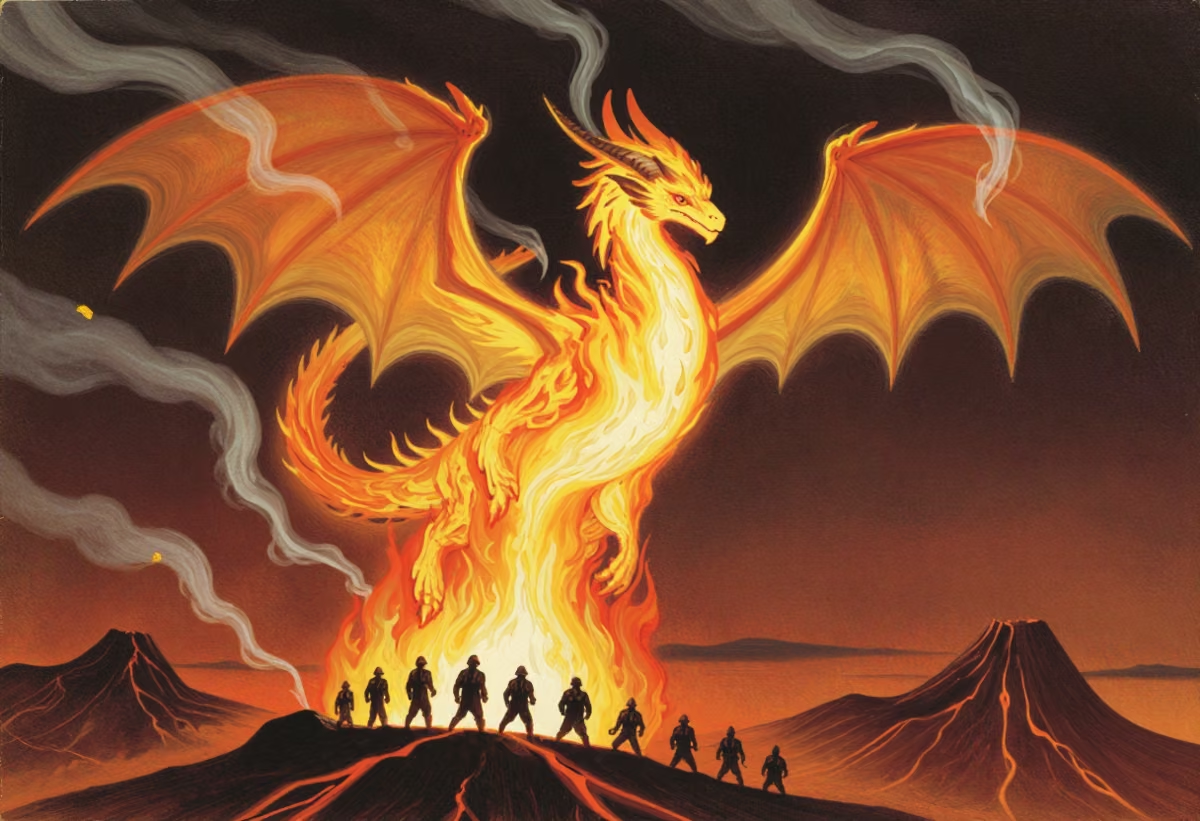
Fire dragons are deadly creatures, born of elemental flame and all-consuming in nature. They're mesmerising beasts to watch; their bodies flicker and dance in an almost hypnotic pattern. Physically, they appear similar in shape to red dragons, suggesting some ancient link between the two races, but rather than being made of solid flesh, their scales are pure flame. Fire dragons are also fiery-tempered. They are quick to take action, whether it be a friendly gesture or a deadly attack.
Fire dragons speak their own language, the language of fire elementals, and a language common to all elemental dragons. When born, there is a 13% chance that the dragon can communicate with all sentient creatures. This chance increases by 4% per age category.
Combat
Fire dragons fight efficiently and mercilessly. They know they are powerful, and they use that power to their advantage. Fire dragons often like to attack with their breath weapon before moving into physical combat. When fighting creatures that seem useful or who could possess useful information, they prefer to use their fire charm ability to soften them up first.
Breath Weapon/Special Abilities
A fire dragon's breath weapon is a cone of elemental fire, 90' long, 5' wide at the dragon's mouth and 30' at the base.
Fire dragons are born immune to energy draining and electricity. They take double damage from cold or water attacks (easier said than done on the Plane of Fire, however). When attacked with fire, they actually gain a number of hit points equal to the number of hit dice the attack would have inflicted. For example, a 12th-level mage casts a fireball, which would normally do 12d8 damage. The fire dragon gains 12 hit points instead of taking damage.
Any being that comes into physical contact with a fire dragon takes Xd8 points of damage, where X is equal to the dragon's age category. A successful save vs. breath weapon can halve this damage, and immunity and resistance to fire can also reduce this damage. When a being not immune to fire or heat comes within 30' of the dragon, they take 1d4 points of damage per age category of the dragon. Once within 30', anything combustible must make a successful saving throw or catch fire.
A fire dragon cast spells and uses its magical abilities at 16th-level plus its combat modifier.
As they age, they gain the following additional abilities:
- Very Young: fire charm at will.
- Young: burning hands three times per day.
- Juvenile: fireball three times per day.
- Adult: flame strike three times per day.
- Mature Adult: delayed blast fireball three times per day.
- Old: meteor swarm three times per day.
- Very Old: summon fire elemental three times per day.
Habitat/Society
Fire dragons very rarely leave their home on the Elemental Plane of Fire. Those that do normally make their homes in active volcanoes and lava flows. They are solitary creatures, only coming together to mate.
Most (50%) of fire dragons are neutral. The rest are evenly split between good and evil (25% chance of either). Of these dragons, roughly 40% are neutral, and the rest lawful or chaotic (30% chance of either).
Ecology
Fire dragons sustain themselves on flames and heat, very rarely actually eating something. Even when they do this, sages speculate, they don't gain any benefit from it. They hate water and ice dragons and will attack them on sight (although the species rarely encounter each other).
Fire dragons can be extremely damaging to the life surrounding their lair (unless they're on the Plane of Fire, of course!). When they leave the lair, their extreme body temperature can ignite dry wood as far as 30' away. They can easily start forest or brush fires, destroying an ecology within a matter of hours. Fire dragons love doing this, although permanent forest fires in one area tend to be a bit of a giveaway that something odd is going on...
Chant goes that the efreet have a platoon of fire dragons guarding their City of Brass. Considering that the efreet hate fire dragons as much as they do any other creature, and that the feeling's entirely mutual, it's likely that these dragons are enslaved somehow. Djinn legends also tell of fire dragons with efreet riders; a lethal combination of malevolent force. Fortunately nobody seems to have seen anything like this for hundreds of years, but those rumors always have a habit or resurfacing.
| Age | Body (') | Tail (') | AC | Breath Weapon | Wizard/Priest | MR | Treasure | XP Value |
|---|---|---|---|---|---|---|---|---|
| 1 | 15-27 | 14-25 | -3 | 4d12+1 | Nil | Nil | Nil | 18,000 |
| 2 | 27-39 | 25-36 | -4 | 6d12+2 | Nil | Nil | Nil | 19,000 |
| 3 | 39-51 | 36-46 | -5 | 8d12+3 | Nil | 35% | E, S, T | 20,000 |
| 4 | 51-58 | 46-58 | -6 | 10d12+4 | 1 | 40% | H, S, T | 22,000 |
| 5 | 58-75 | 58-68 | -7 | 12d12+5 | 2 | 45% | H, S, T | 23,000 |
| 6 | 75-88 | 68-78 | -8 | 14d12+6 | 2 2 | 50% | H, S, Tx2 | 24,000 |
| 7 | 88-101 | 78-92 | -9 | 16d12+7 | 2 2 2 | 55% | H, S, Tx2 | 25,000 |
| 8 | 101-114 | 92-103 | -10 | 18d12+8 | 2 2 2 2 / 1 | 60% | H, S, Tx2 | 27,000 |
| 9 | 114-128 | 103-116 | -11 | 20d12+9 | 2 2 2 2 2 / 2 | 65% | H, S, Tx3 | 28,000 |
| 10 | 128-142 | 116-128 | -12 | 22d12+10 | 2 2 2 2 2 2 / 2 2 | 70% | H, S, Tx3 | 29,000 |
| 11 | 142-156 | 128-141 | -13 | 24d12+11 | 2 2 2 2 2 2 2 / 2 2 2 | 80% | H, S, Tx3 | 31,000 |
| 12 | 156-170 | 141-154 | -14 | 26d12+12 | 2 2 2 2 2 2 2 1 / 2 2 2 2 | 85% | H, S, Tx4 | 33,000 |
Also in this section of the source
Dragon, Elemental Water
Copyright 1998 by John Kastronis
| Statistic | Value |
|---|---|
| Climate/Terrain | Elemental Plane of Water, deep seas |
| Frequency | Very rare |
| Organization | Solitary |
| Activity Cycle | Any |
| Diet | Special |
| Intelligence | Genius (17-18) |
| Treasure | Special |
| Alignment | Varies |
| No. Appearing | 1 (2-5) |
| Armor Class | -3 (base) |
| Movement | 4, Sw 35 |
| Hit Dice | 18 (base) |
| THAC0 | 3 (at 18 HD) |
| No. of Attacks | 3 + special |
| Damage/Attack | 1d12 / 1d12 / 4d10 |
| Special Attacks | Special |
| Special Defenses | Variable |
| Magic Resistance | Special |
| Size | G (40' base) |
| Morale | Fanatic (17-18) |
| XP Value | Variable |
Water dragons are extremely fluid creatures, in form and personality. They are quick to change from one emotion to another, forming an opinion of someone at first glance, then quickly changing it as the situation warrants. They are quick to anger and quick to forgive.
Water dragons look like cloud dragons made of pure water. They always blend in perfectly with the water they are in, whether it is the clear water of the Elemental Plane of Water, the murky depths of an ocean, or the crystal blue waters of a flowing river. While in water they are effectively invisible. When on land, water dragons take on a slight blue hue, but they are clear overall.
Water dragons speak their own tongue, as well as the tongues of water elementals and that common to all elemental dragons. At birth, 16% of earth dragons can speak with any intelligent creature. This chance goes up by 5% per age category.
Combat
Water dragons are effective fighters both in the water and on land. While in water, they prefer to sneak up on potential opponents, gauging their actions and seeing if they act in a hostile manner. When they are on land, they have the disadvantage of being seeable, but their watery nature makes up for this.
Breath Weapon/Special Abilities
A water dragon's breath weapon is a stream of water that is 5' wide and extends 60' in a straight direction. Creatures hit by the stream must save vs. breath weapon stunned for 1d6 rounds from the force, as well as taking the listed damage. Creatures who make their save are still knocked to the ground for 1 round and take half damage.
A water dragon casts spells and uses its magical abilities at 15th level plus its combat modifier.
Water dragons are born immune to water, water-affecting spells (such as transmute water to dust), acid, and energy-draining. They take half damage from electricity and double damage from fire. Spells which induce cold (such as cone of cold), inflict normal damage, but act as a slow spell cast upon the dragon.
While in any sufficiently large body of water (at least large enough to cover their bodies), water dragons are invisible. If kept out of water for more than a day, they begin to evaporate, losing 1d4 hit points per hour out of the water. If they return to a sufficiently large body of water (such as a lake or river), they immediately regain the lost hit points. Normal weapons don't affect water dragons, they pass through their bodies harmlessly. Magical weapons of less than +2 enchantment only inflict half damage.
As they age, they gain the following abilities:
- Very Young: create water at will.
- Young Adult: transmute dust to water three times per day.
- Mature Adult: airy water three times per day.
- Very Old: part water three times per day.
- Wyrm: summon water elemental three times per day.
- Great Wyrm: tsunami three times per day.
Habitat/Society
Water dragons, like all other elemental dragons, very rarely leave their home plane. When they are encountered on other planes, they are usually found living in deep oceans or other large bodies of water.
Most (60%) of water dragons are neutral. There is an equal (20%) chance that they are either evil or good. Half (50%) of all water dragons are chaotic, some (40%) are neutral, and only a few (10%) are lawful.
Ecology
Water dragons have little need for sustenance. They survive by contact with water. They loathe to venture out of water for more than a few hours, and they'll never go near any dry, hot, or extremely cold place.
| Age | Body (') | Tail (') | AC | Breath Weapon | Wizard/Priest | MR | Treasure | XP Value |
|---|---|---|---|---|---|---|---|---|
| 1 | 3-12 | 1-8 | 0 | 4d10+1 | Nil | Nil | Nil | 19,000 |
| 2 | 12-21 | 8-17 | -1 | 6d10+2 | Nil | Nil | Nil | 20,000 |
| 3 | 21-30 | 26-35 | -3 | 8d10+3 | 1 | 35% | 1/2 D | 22,000 |
| 4 | 30-40 | 26-35 | -3 | 10d10+4 | 1 | 35% | 1/2 D | 23,000 |
| 5 | 40-50 | 35-42 | -4 | 12d10+5 | 2 | 40% | D | 24,000 |
| 6 | 50-61 | 42-50 | -5 | 14d10+6 | 2 2 | 45% | D, A | 25,000 |
| 7 | 61-72 | 50-58 | -6 | 16d10+7 | 2 2 2 | 50% | D, A, B | 27,000 |
| 8 | 72-83 | 58-68 | -7 | 18d10+8 | 2 2 2 / 1 | 55% | D, A, Bx2 | 28,000 |
| 9 | 83-94 | 68-78 | -8 | 20d10+9 | 2 2 2 2 / 2 | 60% | D, A, Bx3 | 29,000 |
| 10 | 94-106 | 78-88 | -9 | 22d10+10 | 2 2 2 2 2 / 2 2 | 65% | D, A, Bx3 | 31,000 |
| 11 | 106-118 | 88-98 | -10 | 24d10+11 | 2 2 2 2 2 2 / 2 2 2 | 70% | D, A, Bx4 | 32,000 |
| 12 | 118-132 | 98-108 | -11 | 26d10+12 | 2 2 2 2 2 2 2 / 2 2 2 2 | 75% | D, A, Bx4 | 33,000 |
Dragon, Quasi-Elemental Lightning
Copyright 1998 by John Kastronis
| Statistic | Value |
|---|---|
| Climate/Terrain | Quasi-Elemental Plane of Lightning, thunder storms, thunder clouds |
| Frequency | Very rare |
| Organization | Solitary |
| Activity Cycle | Any |
| Diet | Special |
| Intelligence | Genius (17-18) |
| Treasure | Special |
| Alignment | Varies (primarily Neutral) |
| No. Appearing | 1 (2-5) |
| Armor Class | -5 (base) |
| Movement | 12, Fl 35 (C), Jp 3 |
| Hit Dice | 17 (base) |
| THAC0 | 4 (at 17 HD) |
| No. of Attacks | 3 + special |
| Damage/Attack | 2d10 / 2d10 / 5d12 |
| Special Attacks | Special |
| Special Defenses | Variable |
| Magic Resistance | Special |
| Size | G (50' base) |
| Morale | Fanatic (17-18) |
| XP Value | Variable |
Stormy and with tempers as quick as greased lightning (pardon the pun), lightning dragons are one of the more dangerous elemental dragons to those caught unprepared. They are often seen flitting (if something of their size can flit) among the brilliant flashes of lightning that occupy the Quasi-elemental Plane of Lightning.
Appearing as blue dragons with crackling lightning dancing from their scales, they prove to be an intimidating sight. They are surrounded by a soft light which grows in intensity as they become angry. An extremely mad dragon may get bright enough to blind a person. They emit a barely audible rumble that increases in volume proportionally to the brightness of the light. The sound, however, never posses a serious threat to damaging ears.
Lightning dragons speak their own tongue and one common to all elemental dragons. When they are born, they have a 13% chance to speak the language of any sentient creature. This chance increases by 4% per age category.
Combat
Lightning dragons like to take an offensive approach to combat, employing whatever means they have to eradicate opponents. They rarely flee from combat, even if they are gravely injured. Their penchant for destruction has been described by at least on invoker as "charming"
Breath Weapon/Special Abilities
A lightning dragon's breath weapon is a 5' wide stroke of lightning that streaks 100' in a straight line. This bolt inflicts double damage to creatures wearing metal armour or carrying more than 30 lbs. of metallic materials.
Lightning dragons cast spells and use their magical abilities at 14th-level plus their combat modifiers.
Any AC bonus gained from metal armour is negated when fighting a lightning dragon. If a metal shield is used, the AC bonus from that is negated as well. If a lightning dragon is struck by a metal weapon, the wielder is shocked as if she had just been attacked by the lightning dragon's innate shocking grasp ability.
When reduced to less than 1/4 of their maximum hit points, lightning dragons will become so angry and glow so brightly, that all who look at them must save vs. spell or be blinded for 1d10 rounds. Those who pass the save may look at the dragon as they please.
Lightning dragons are born immune to energy draining, blindness, and electricity. They are born with the innate ability to use shocking grasp at will.
As they age, they gain the following additional abilities:
- Young: lightning bolt three times per day.
- Juvenile: thunder staff three times per day.
- Adult: chain lightning three times per day.
- Mature Adult: wall of lightning (similar to wall of fire but with lightning instead of fire) three times per day.
- Very Old: summon the storm (a version of control weather which always produces an intense lightning storm) three times per day.
Habitat/Society
Lightning dragons prefer to remain on their home plane, but occasionally make jaunts onto other planes. Storm giants seem to have a particular liking of the creatures, as do many invokers.
Lightning dragons have the greatest chance of all elemental dragons to have a moral bend, with an equal (45%) chance of being good or evil. The rest (10%) are morally neutral. This tendency is offset by a low ethical deviation, with only a small number being lawful or chaotic (5% chance of either). The others (90%) are ethically neutral.
Ecology
Lightning dragons sustain themselves on electricity. They seem to be able to gain small amounts of "natural electricity" from anywhere they are, so it's near impossible to starve them outside of a vacuum. They draw electricity towards themselves, often leaving a "tunnel" behind them when travelling on the Quasi-Elemental Plane of Lightning. Canny adventurers have followed lightning dragons through the plane to escape being hit with a nasty bolt of lightning.
Because they have a tendency to cause storms, they can be devastating to an ecology, especially a coastal one. They tend to do this infrequently, however.
| Age | Body (') | Tail (') | AC | Breath Weapon | Wizard/Priest | MR | Treasure | XP Value |
|---|---|---|---|---|---|---|---|---|
| 1 | 9-15 | 7-12 | -2 | 4d8+2 | Nil | Nil | Nil | 15,000 |
| 2 | 15-27 | 12-24 | -3 | 6d8+3 | Nil | Nil | Nil | 18,000 |
| 3 | 27-39 | 24-34 | -4 | 8d8+4 | 1 | 40% | 1/2H, S | 19,000 |
| 4 | 39-51 | 34-46 | -5 | 10d8+5 | 2 | 45% | H, S | 20,000 |
| 5 | 51-63 | 46-56 | -6 | 12d8+6 | 2 2 | 50% | H, S | 22,000 |
| 6 | 63-76 | 56-66 | -7 | 14d8+6 | 2 2 2 | 55% | H, S | 23,000 |
| 7 | 76-89 | 66-80 | -8 | 16d8+7 | 2 2 2 2 / 1 | 60% | H, Sx2 | 24,000 |
| 8 | 89-102 | 80-91 | -9 | 18d8+8 | 2 2 2 2 2 / 2 | 65% | H, Sx2 | 25,000 |
| 9 | 102-116 | 91-104 | -10 | 20d8+9 | 2 2 2 2 2 2 / 2 2 | 70% | H, Sx2 | 27,000 |
| 10 | 116-130 | 104-116 | -11 | 22d8+10 | 2 2 2 2 2 2 2 / 2 2 2 | 75% | H, Sx3 | 28,000 |
| 11 | 130-144 | 116-129 | -12 | 24d8+11 | 2 2 2 2 2 2 2 1 / 2 2 2 2 | 80% | H, Sx3 | 29,000 |
| 12 | 144-158 | 129-142 | -13 | 25d8+12 | 2 2 2 2 2 2 2 2 / 2 2 2 2 | 85% | H, Sx4 | 31,000 |
Dragon, Quasi-Elemental Radiant
Copyright 1998 by John Kastronis
| Statistic | Value |
|---|---|
| Climate/Terrain | Quasi-Elemental Plane of Radiance, rainbows |
| Frequency | Very rare |
| Organization | Solitary |
| Activity Cycle | Any |
| Diet | Special |
| Intelligence | Supra-Genius (19-20) |
| Treasure | Special |
| Alignment | Varies (primarily Neutral) |
| No. Appearing | 1 (2-5) |
| Armor Class | -5 (base) |
| Movement | 12, Fl 35 (C), Jp 3 |
| Hit Dice | 17 (base) |
| THAC0 | 4 (at 17 HD) |
| No. of Attacks | 3 + special |
| Damage/Attack | 2d8 / 2d8 / 5d12 |
| Special Attacks | Special |
| Special Defenses | Variable |
| Magic Resistance | Special |
| Size | G (60' base) |
| Morale | Fanatic (17-18) |
| XP Value | Variable |
Radiant dragons are majestic creatures. They are similar in appearance to amethyst dragons, but much larger. Their skin is a shimmering mass of silky material, which constantly changes color.
Radiant dragons speak their own tongue and a tongue common to all elemental dragons. Also, 20% of hatchling radiant dragons can speak with any intelligent creature. The chance to posses this ability increases 6% per age category.
Combat
Radiant dragons are honorable and respectful of their opponents. They are not foolish, however. They will take advantage of any weakness and attack their opponent without mercy.
Breath Weapon/Special Abilities
A radiant dragon's breath weapon is a stream of brilliant radiance, 50' long, 20' high, and 10' wide. This instantly kills any creature of less than 6 HD that doesn't save vs. dragon breath, a successful save still induces blindness for 2d20 rounds and the creature takes the damage listed below. A creature of more than 12 HD that makes its save takes half the damage and isn't blinded, otherwise they take full damage and are blinded for the same length of time.
Radiant dragons cast spells and use their magical abilities at 15th-level plus their combat modifiers.
Radiant dragons are born immune to energy draining, blindness, and electricity. They are born with the following abilities: chromatic orb at will, color spray at will, dancing lights at will, and continual light three times per day.
As they age, they gain the following additional abilities:
- Young: hypnotism three times per day.
- Juvenile: rainbow pattern three times per day.
- Adult: prismatic spray three times per day.
- Mature Adult: prismatic wall/ three times per day.
- Very Old: prismatic sphere three times per day.
Habitat/Society
Radiant dragons are very reclusive creatures. Very few live on the Prime Material Plane, most dwell on the Plane of Radiance. Radiant dragons prefer to layer in areas of brilliant light displays, such as in crystal chambers where colorful light is reflected.
Some 50% of radiant dragons are neutral in alignment, of the rest, half are good and half evil. On the law-chaos axis, 40% of radiant dragons are lawful, 40% neutral, and only 20% chaotic.
Ecology
Radiant dragons eat little, if anything at all. They usually only eat right before going into a long sleep, usually consuming a few large animals. When they are awake, light seems to sustain them.
| Age | Body (') | Tail (') | AC | Breath Weapon | Wizard/Priest | MR | Treasure | XP Value |
|---|---|---|---|---|---|---|---|---|
| 1 | 13-25 | 12-22 | -2 | 2d12+2 | Nil | Nil | Nil | 15,000 |
| 2 | 25-37 | 22-34 | -3 | 4d12+3 | Nil | Nil | Nil | 18,000 |
| 3 | 37-49 | 34-44 | -4 | 6d12+4 | 1 | 45% | E, S, T | 19,000 |
| 4 | 49-61 | 44-56 | -5 | 8d12+5 | 2 | 50% | H, S, T | 20,000 |
| 5 | 56-73 | 56-66 | -6 | 10d12+5 | 2 2 | 55% | H, S, T | 22,000 |
| 6 | 73-86 | 66-76 | -7 | 12d12+6 | 2 2 2 | 60% | H, S, Tx2 | 23,000 |
| 7 | 86-99 | 76-90 | -8 | 14d12+7 | 2 2 2 2 / 1 | 65% | H, S, Tx2 | 24,000 |
| 8 | 99-112 | 90-101 | -9 | 16d12+8 | 2 2 2 2 2 / 2 | 70% | H, S, Tx2 | 25,000 |
| 9 | 112-126 | 101-114 | -10 | 18d12+9 | 2 2 2 2 2 2 / 2 2 | 75% | H, S, Tx3 | 27,000 |
| 10 | 126-140 | 114-126 | -11 | 20d12+10 | 2 2 2 2 2 2 2 / 2 2 2 | 80% | H, S, Tx3 | 28,000 |
| 11 | 140-154 | 126-139 | -12 | 22d12+11 | 2 2 2 2 2 2 2 1 / 2 2 2 2 | 85% | H, S, Tx3 | 29,000 |
| 12 | 154-168 | 139-152 | -13 | 24d12+12 | 2 2 2 2 2 2 2 2 / 2 2 2 2 | 90% | H, S, Tx4 | 31,000 |
Dragon, Quasi-Elemental Steam
Copyright 1998 by John Kastronis
| Statistic | Value |
|---|---|
| Climate/Terrain | Quasi-Elemental Plane of Steam, hot springs, fog banks, jungles |
| Frequency | Very rare |
| Organization | Solitary |
| Activity Cycle | Any |
| Diet | Special |
| Intelligence | Genius (17-18) |
| Treasure | Special |
| Alignment | Varies (primarily Neutral) |
| No. Appearing | 1 (2-5) |
| Armor Class | -6 (base) |
| Movement | 12, Fl 35 (C), Jp 3 |
| Hit Dice | 17 (base) |
| THAC0 | 4 (at 17 HD) |
| No. of Attacks | 3 + special |
| Damage/Attack | 2d10 / 2d10 / 5d10 |
| Special Attacks | Special |
| Special Defenses | Variable |
| Magic Resistance | Special |
| Size | G (55' base) |
| Morale | Fanatic (17-18) |
| XP Value | Variable |
Steam dragons are wispy creatures. The are quite aloof and distant, never remaining in contact with other beings for long. They prefer solitude to the companionship most other creatures crave. They see the company of other beings as an excuse for idle chat and flights of fancy, things that they do not normally endorse.
When in solid form, steam dragons appear to be misty cloud dragons. A slight vapor always seems to be rising from the surface of their bodies, although, in truth, it is just part of their bodies similar to hair on a human. They tend to be gray in color, although the gray runs the gamut of light to dark.
Steam dragons speak their own language and that common to all elemental dragons. At birth, they have a 16% chance to speak the language of any sentient creature. This chance increases by 5% per age category.
Combat
Steam dragons prefer to avoid combat, if possible, as it is generally a waste of time. When engaged in combat, however, they seek to end it as quickly as possible, often attempting to take out what seems to be a leader then engaging the remaining attackers. They very rarely chase those who flee from them.
Breath Weapon/Special Abilities
A steam dragon's breath weapon is a cloud of scalding steam, 90' long, 30' wide, and 30' high. Creatures caught in the cloud can roll saving throws vs. breath weapon for half damage. In still air, the cloud remains for 1d4+4 rounds. On the second round and third rounds, it inflicts half normal damage, on the fourth and subsequent rounds, it condenses into a clammy fog that blinds creatures for 1d4 rounds and inflicts 3d4 points of drowning damage per round for as long as the creature remains in the cloud (a successful save vs. breath weapon negates both effects).
Steam dragons cast spells and use their magical abilities at 14th-level plus their combat modifiers.
Steam dragons are born immune to energy draining, water attacks, and heat (but not fire).
Steam dragons are born with the ability to assume (or leave) a cohesive mist-like form at will, once per round. In this form, they are 75% unlikely to be distinguished from normal mist. Their armor class improves by -3 while in mist form and their magic resistance increases by 15%. They can employ spells and innate abilities while in mist form, but they cannot attack physically or use their breath weapons. They can fly at a rate of 9 (MC: A) while in mist form.
As they age, they gain the following additional powers.
- Very Young: fog cloud three times per day.
- Young: wall of fog three times per day.
- Juvenile: stinking cloud three times per day.
- Adult: solid fog three times per day.
- Mature Adult: cloudkill three times per day.
- Old: death fog twice per day.
- Very Old: neutralise gas three times per day. Ancient: airy water three times per day.
Habitat/Society
When encountered outside their home plane, steam dragons often times lair with or close to mist dragons. The two species seem to have a friendly relationship. They also like to lair in hot, steamy jungles, near natural hot springs, and in areas of dense fog.
The majorities (80%) of steam dragons are neutral. Otherwise, there is an equal (10%) chance of them being good or evil. A surprising majority (90%) of steam dragons is lawful. The rest (10%) are neutral. No chaotic steam dragon has ever been encountered.
Ecology
Steam dragons sustain themselves on vapors and water particles in the air. They shy away from deserts and arctic climates because of the lack of moisture in the air. They tend to be non-damaging to the environments they prefer to live in.
| Age | Body (') | Tail (') | AC | Breath Weapon | Wizard/Priest | MR | Treasure | XP Value |
|---|---|---|---|---|---|---|---|---|
| 1 | 13-25 | 12-22 | -2 | 3d6+2 | Nil | Nil | Nil | 15,000 |
| 2 | 25-37 | 22-34 | -3 | 5d6+3 | Nil | Nil | Nil | 18,000 |
| 3 | 37-49 | 34-44 | -4 | 7d6+4 | 1 | 45% | Y, Z | 19,000 |
| 4 | 49-61 | 44-56 | -5 | 9d6+5 | 2 | 50% | X, Y, Z | 20,000 |
| 5 | 56-73 | 56-66 | -6 | 11d6+5 | 2 2 | 55% | X, Y, Z | 22,000 |
| 6 | 73-86 | 66-76 | -7 | 13d6+6 | 2 2 2 | 60% | X, Y, Zx2 | 23,000 |
| 7 | 86-99 | 76-90 | -8 | 15d6+7 | 2 2 2 2 / 1 | 65% | X, Y, Zx2 | 24,000 |
| 8 | 99-112 | 90-101 | -9 | 17d6+8 | 2 2 2 2 2 / 2 | 70% | X, Y, Zx2 | 25,000 |
| 9 | 112-126 | 101-114 | -10 | 19d6+9 | 2 2 2 2 2 2 / 2 2 | 75% | X, Y, Zx3 | 27,000 |
| 10 | 126-140 | 114-126 | -11 | 21d6+10 | 2 2 2 2 2 2 2 / 2 2 2 | 80% | X, Y, Zx3 | 28,000 |
| 11 | 140-154 | 126-139 | -12 | 23d6+11 | 2 2 2 2 2 2 2 1 / 2 2 2 2 | 85% | X, Y, Zx3 | 29,000 |
| 12 | 154-168 | 139-152 | -13 | 25d6+12 | 2 2 2 2 2 2 2 2 / 2 2 2 2 | 90% | X, Y, Zx4 | 31,000 |
Elemental Beast
| Statistic | Value |
|---|---|
| Climate/Terrain | The inner planes |
| Frequency | Very rare |
| Organization | Solitary |
| Activity Cycle | Any |
| Diet | None |
| Intelligence | High (13-14) |
| Treasure | Nil |
| Alignment | Any Neutral (LN, TN, or CN) |
| No. Appearing | 1 |
| Armor Class | 0 |
| Movement | 12 |
| Hit Dice | 10 |
| THAC0 | 11 |
| No. of Attacks | 4 |
| Damage/Attack | 1d10/1d10/1d10/1d0 |
| Special Attacks | Spells |
| Special Defenses | Elemental immunity |
| Magic Resistance | Nil |
| Size | L (10' tall) |
| Morale | Champion (15-16) |
| XP Value | 9,000 |
These hulking creatures have been compared by many to be the Hordlings of the inner planes. Although all have the same statistics and size, their shapes differ, and no two beasts look alike, not even when two beasts hail from the same element.
All of them sport 4 appendages that they use to attack, and their entire body is composed from their respective element. It makes sages think that these beasts are a manifestation of their element but other facts seems to contradict this.
Combat
When encountering a creature who is not a native of their home plane they will immediately attack it in an attempt to remove the "contamination", as they refer to this. They lash will their 4 appendages and can attack multiple opponents.
Their most fearsome mode of attack is the fact that they duplicate any spell of their element of up to 4th level. It is suspected that every time a new spell is researched they immediately know of it, and can duplicate it. You are forewarned that they are dangerous combatants. The "good" side of it is that they use some of their power to give the spells shape and suffer 1 point of damage for every spell level they "cast".
An elemental beast is immune to its element and will suffer only half damage from 2 other elements that are related to it.
Habitat/Society
As written before, they are solitary, and cannot reproduce. The only time someone witnessed two beasts meet it was when they both attacked him. And he was very lucky to have made it alive, at least he made it enough to tell about it, but then he died from his wounds.
Ecology
Elemental beasts are the cleaners of the elemental planes, their job is to rid them of creatures that are not natives.
Mages have found a spell that allows them to summon these creatures, and give them control on them. But extensive research has raised a question. Not matter how many times they summoned them, they have never seen a case when an elemental beast on the elemental planes disappeared. It seem that when the spell is cast the beast is created and sent to the wizard's location.
Furthermore, they discovered that some of the elemental beasts that are summoned become real, meaning that upon their destruction, or the spell's duration has expired they appear in their respective plane. It made some sages think that these creatures have actually came into existence because of the mages who found the means for the spell that summons these beasts.