Dead Man's Dream
| Statistic | Value |
|---|---|
| Climate/Terrain | Oases |
| Frequency | Uncommon |
| Organization | Stand |
| Activity Cycle | Any |
| Diet | Photosynthesis |
| Intelligence | Non (0) |
| Treasure | Incidental |
| Alignment | nil |
| No. Appearing | 1d10 |
| Armor Class | 3 |
| Movement | 0 |
| Hit Dice | 1 HD/2 feet |
| THAC0 | nil |
| No. of Attacks | see below |
| Damage/Attack | nil |
| Special Attacks | Poison |
| Special Defenses | see below |
| Magic Resistance | nil |
| Size | H (20' tall) at maturity |
| Morale | nil |
| XP Value | 65-2,000 |
| Psionics | nil |
Description
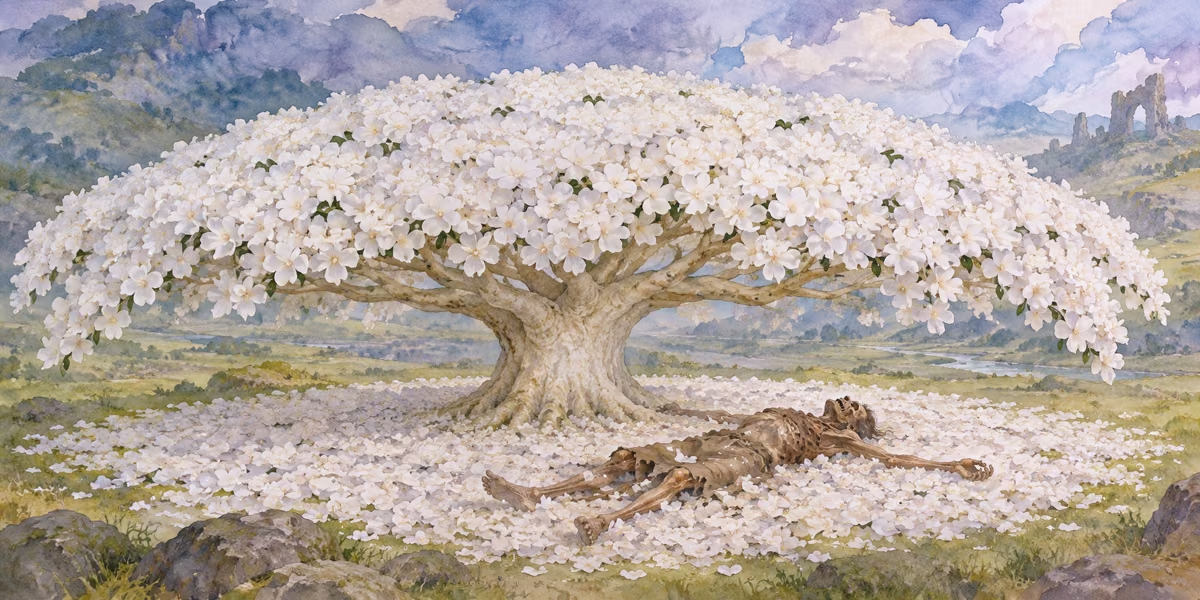
Dead man's dreams are profusely flowering trees that can be found near many oases. These umbrella-shaped trees grow up to 20 feet in height and 30 feet wide. Their numerous, thin branches bear many white, heart-shaped flowers year round. Indeed there are often more flowers per branch than there are dark green, oval, waxy leaves. These trees get their name from the mildly hallucinogenic nature of their pollen.
Combat
A dead man's dream does not engage in combat. Rather, it continuously produces extraordinarily large numbers of flowers. These flowers blanket the ground beneath the tree in a rough circle equal in diameter to the width of the tree, and they give off a sweet aroma when stepped on. This aroma causes the imbiber reflexively to inhale deeply. In game terms, any player stepping on the flowers must specifically state that his character is attempting not to breath the fragrance and must make a successful Constitution check with a -2 penalty. Success indicates that he is able to prevent taking a breath (and the DM should refer to the rules on holding one's breath when one is unable to get a good gulp of air in the PHB); failure means that he has taken a breath and is subject to the following effects. If the player does not state that his character is attempting to hold his breath, he automatically takes a deep breath and imbibes some of the tree's pollen.
Under normal circumstances, the pollen of a dead man's dream is not lethal. Any character smelling the pollen must save versus poison with a -4 penalty. Failure indicates that the slightly hallucinogenic properties of the poison take effect the next round. While under the effects of the hallucinogen, the affected character only wants to remain near the tree to smell the "pretty flowers." The hallucinogenic effects merely keep the victim nearby while the true nature of the poison takes effect. The poison actually constitutes a paralytic poison of type O with an onset of 2-24 minutes and duration of 2d6 hours. A character is allowed only the initial saving throw; if he fails the first throw and suffers the hallucinogenic effects, it is too late. He will suffer from the paralysis, it's just a matter of time. He continues to hallucinate while paralyzed.
If the tree has been under stress, its pollen can be lethal. Any character smelling the pollen must save versus poison with a -4 penalty. Failure indicates that the hallucinogenic properties of the poison take effect the next round, and the character suffers from paralysis exactly as above. However, at the end of the paralysis duration, the character falls into convulsions for 1-4 minutes and must make a second saving through versus poison (type J, in this case), this time with a +4 to the roll. Success means that the character suffers 20 points of damage and comes out the paralysis (assuming that he had more than 20 HPs; if not, he dies). Failure means that the character dies.
A successful use of the herbalism proficiency permits the character to determine whether a tree is under stress from a safe distance by observing the flowers (thicker than usual), the bark (which, normally white, turns a very light green), seed pods (significantly less), and the leaves (slightly curled at the edges). The exact nature of the stress can be due to any of a various causes, and is ultimately up to the DM. Some suggestions as to possible stresses include high population density (a large number of dead man's dreams in a small area), diminishing water source, insect infestation, and physical damage (such as loosing a large number of branches or a cracked trunk). It takes several days after the introduction of a stress before the lethal effects of the pollen become prevalent; and, conversely, it takes several days after the removal of a stress before the lethal effects of the pollen dissipate.
Habitat/Society
Dead man's dreams are never found far from a body of water. Usually, they are found in stands of only a few trees.
Ecology
The dual nature of the poison of the dead man's dream serves the tree well. In the case of few trees, the debilitating nature of the poison causes the victim to fall unconscious onto the flowers. Upon waking, the victim moves off, covered with pollen and small, prickly seed pods, spreading the tree's pollen and propagating the species. When the tree is stressed, the deadly nature of its poison causes the victim to fall at the foot of the tree. The natural decomposition of the body provides needed nutrients which the tree absorbs through the soil.
Since the wood from a dead man's dream is soft, it makes poor quality weapons. Any weapon made from this wood incurs an additional -1 to hit and damage; furthermore, it breaks on a roll of 3 or less when maximum damage is inflicted. However, the fine, straight grain of this blonde wood is accented by numerous small, dark knots producing an aesthetically pleasing effect. Thus, it is a prized by jewelers, sculptures, and furniture makers. In addition, the pollen of non-stressed trees can often be purchased in the warrens and bardic districts of the cities-states and is mainly used as a recreational drug. The pollen of stressed trees is much rarer due to the hazardous nature of obtaining and working with this more potent pollen. While the trees do not collect treasure, valuable items are sometimes found beneath them along with the owner's remains.