Horse, Clydesdale
| Statistic | Value |
|---|---|
| Climate/Terrain | Any non- |
| Frequency | Common |
| Organization | Herd |
| Activity Cycle | Day |
| Diet | Herbivore |
| Intelligence | Animal (1) |
| Treasure | Nil |
| Alignment | Neutral |
| No. Appearing | 1 |
| Armor Class | 7 |
| Movement | 14 |
| Hit Dice | 3+3 |
| THAC0 | 17 |
| No. of Attacks | 1 |
| Damage/Attack | 1-4 |
| Special Attacks | Nil |
| Special Defenses | Nil |
| Magic Resistance | Nil |
| Size | L (16 to 17 hands OR 5 feet to 6 feet) |
| Morale | Unsteady (5-7) |
| XP Value | 75 |
Description
The best draft horse in most lands is the Clydesdale horse. Known for its magnificent beauty and equally magnificent strength, Clydesdale horses are loved by those few merchants and travelers who can afford this majestic beast. Clydesdale horses can be trained as war horses but few warriors, especially paladins, will belittle themselves by riding a draft horse; no matter how grand, it is still a draft horse.
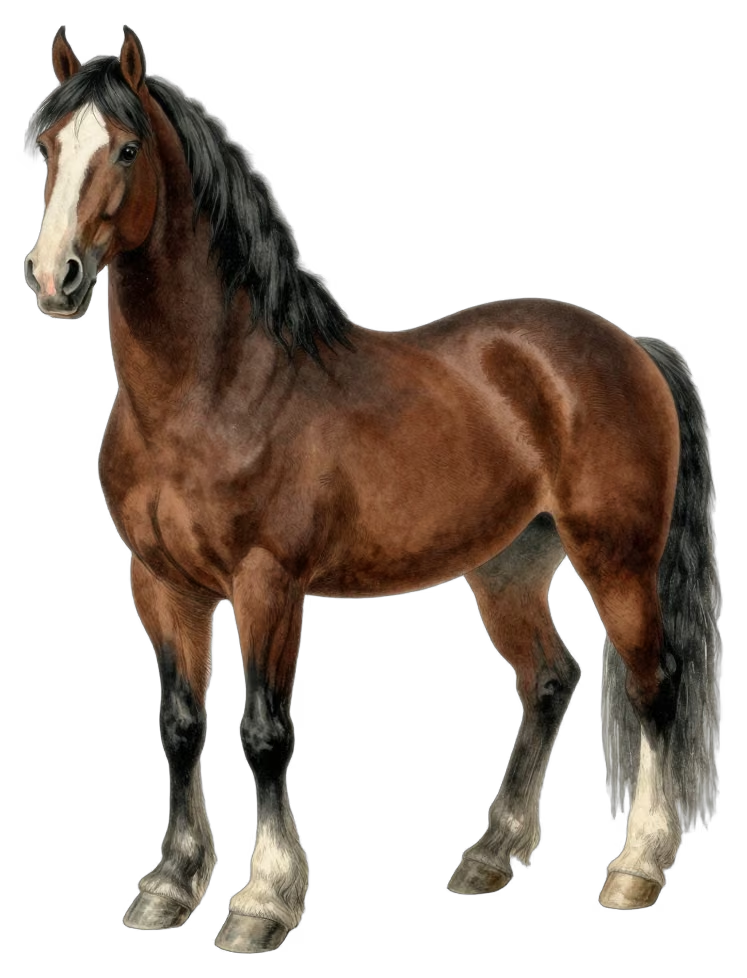
Clydesdale horses are strong, sturdy draft horses (see Horse, MC1). They are faster than the typical draft horse and can haul more weight than the typical draft horse. A Clydesdale weighs 1500 to 2000 pounds. Clydesdales' colors are bay, brown, black, chestnut, roan, or gray (becomes lighter colored with age and may finally turn white). They have white straps on the face, and white legs to knees and hocks.
Combat
Clydesdales fight only when cornered. They attack with a bite that does 1d4 points of damage.
A Clydesdale can be trained as a war horse. A Clydesdale war horse has 3 attacks (bite/hoof/hoof) for 1d8 points of damage each. For more information on war horses see MC1 under the heading HORSE.
A Clydesdale can charge causing the victim to make a save vs. petrifaction or become petrified by the sight of such a large horse charging. If the save is successful, the victim must make a moral check at -1 or flee.
Habit/Society
Mares give birth to a single foal which will mature in two years. During this period the foal will stay as close to the mother at all times.
In the wild a herd of Clydesdales will consist mostly of females and immature male horses. There will usually be only one dominate male horse. Herds are usually lead by a mature female or matriarch. This dominance will often continue into domestication, with female horses being a team leader.
Clydesdales can carry great weights for long periods of time. A Clydesdale's normal carrying capacity is 270. A Clydesdale's encumbered, half-speed load is 400. A Clydesdale's fully encumbered, 1/3 movement load is 530.
Ecology
Clydesdales feed on food typical of all horses. Their favorite food is grain with a touch of honey.