Kulmander
| Statistic | Value |
|---|---|
| Size/Type | Tiny Aberration |
| Hit Dice | 1d8 (4 hp) |
| Initiative | +3 |
| Speed | 20 ft. (4 squares) |
| Armor Class | 15 (+2 size, +3 Dex), touch 15, flat-footed 12 |
| Base Attack/Grapple | +0/-12 |
| Attack | Sting +5 (1d2-4 plus poison) |
| Full Attack | Sting +5 (1d2-4 plus poison) |
| Space/Reach | 2-½ ft./0 ft. |
| Special Attacks | Poison |
| Special Qualities | Darkvision 60 ft., animation |
| Saves | Fort +0, Ref +3, Will +3 |
| Abilities | Str 3, Dex 16, Con 10, Int 13, Wis 12, Cha 11 |
| Skills | Hide +13, Knowledge (any one) +3, Listen +4, Move Silently +5, Spot +4 |
| Feats | Alertness, Weapon FinesseB |
| Environment | Underground |
| Organization | Solitary or pack (3–8) |
| Challenge Rating | 1 |
| Treasure | Standard |
| Alignment | Usually chaotic neutral |
| Advancement | By character class |
| Level Adjustment | +2 |
Description
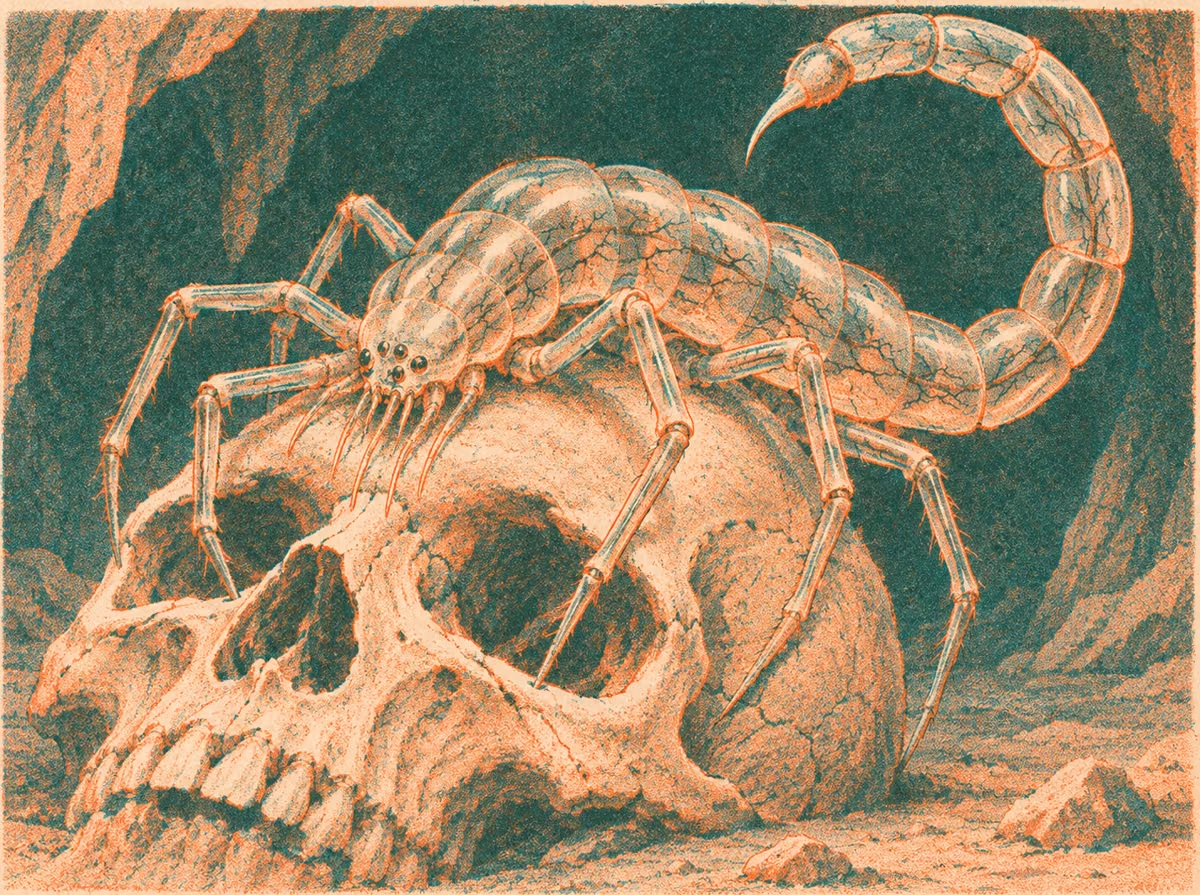
This oversized insect has eight legs, a segmented body and a long tail with a barb at the end. The shell is a pale gray hue that is semi-transparent. Many dark vessels can be seen pulsing just under the surface.
This tiny creature resembles a monstrous scorpion with no front claws and a lengthened tail. Despite its appearance, the kulmander is much more intelligent than a mere insect and is capable of magically manipulating its surroundings. Its shell is more fragile than a comparable insect. So, like a hermit crab, it frequently occupies a hollow object for protection. Typically this will be the skull of a skeletal corpse, which the kulmander then magically animates to do its bidding.
The segmented body of the kulmander lacks pigmentation, and the shell is a light translucent gray hue through which can be seen the vessels that pulse with the surges of ichor. What is perhaps surprising about the kulmander is how much of the body is occupied by neural tissue. Over half the creature is composed of the brain stem, and each segment contains a pair of exquisitely sensitive tendrils that are used to feel its surroundings.
The kulmander are underground dwellers that have a strong fear of wide open places. Thus they will almost never be found above the surface unless they have somehow become trapped and need to locate a new passage into the subterranean world. They only travel across the surface at night, and will find a secure shelter during the daylight hours.
Combat
Normally a kulmander will employ the combat capabilities of the body that it has animated. If the body is destroyed, the stinging tail deliver a potent paralytic dose that can disable even a large man for several minutes. While its foe is so disabled, the kulmander will seek a place to hide or a new corpse to occupy.
Spell-like Abilities: At will―mage hand; 1/day―animate rope. Caster level equal's the kulmander's class level.
Animation (Sp): As a free action a kulmander can animate and control any inanimate object of size Medium or smaller with which it maintains physical contact. Once contact is lost, the object immediately becomes inert and ceases to animate. An animated object gains the game statistics in the core rulebook III for animated objects. If the kulmander controls the object from within a cavity, it gains concealment and a damage reduction equal to the hardness of the object animated.
Poison (Ex): Injury, Fortitude DC 12, initial and secondary damage 1d3 Dex and paralysis for 1d4 minutes. The save DC is Constitution-based and includes a +2 racial bonus.
Kulmander Culture
Typically a kulmander is a solitary creature, although it will socialize with beings it finds beneficial. Occasionally kulmander swarms will form for some express purpose, typically for a mass migration to richer lands. Once this migration is completed, however, the individual kulmander will normally go their own way. Societies of kulmanders can occur in locations that are rich in life, such as wetlands or jungles.
Kulmander culture usually expresses itself through an intermediary form, by manipulating the creatures and objects that they animate. They perform elaborate dances and rituals with their animated figures, and will often seek to decorate them in elegant markings and attire.
Few kulmanders are religious in nature and clerics are particularly rare. They favor a career as a bard or rogue, employing their skills in stealth and entertainment to blend into their surroundings and prey on other life forms. Most dislike the risks of combat, so kulmander fighters and warriors are infrequent.
==============================