Tordori
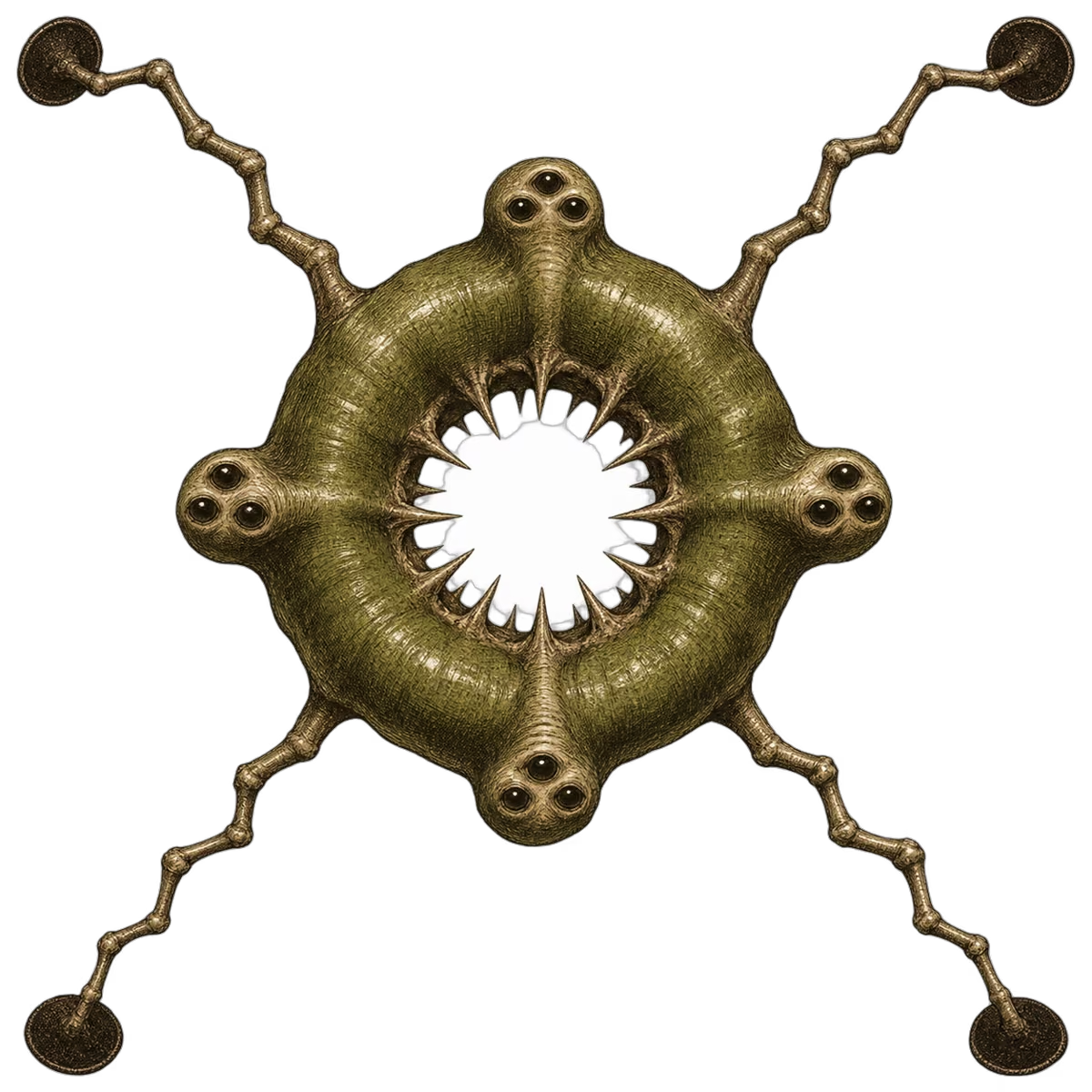
| Statistic | Value |
|---|---|
| Size/Type | Medium Aberration |
| Hit Dice | 5d8+10 (33 hp) |
| Initiative | +5 |
| Speed | 50 ft. (10 squares), climb 50 ft. |
| Armor Class | 16 (+5 Dex, +1 natural), touch 15, flat-footed 11 |
| Base Attack/Grapple | +3/+3 |
| Attack | Slam +8 melee (1d4) or glob +8 ranged (acid) |
| Full Attack | Slam +8 melee (1d4) or 4 globs +8 ranged (acid) |
| Space/Reach | 5 ft./5 ft. |
| Special Attacks | Acid |
| Special Qualities | Darkvision 60 ft., all-around vision, resistance to acid 15, immunities |
| Saves | Fort +2, Ref +6, Will +5 |
| Abilities | Str 10, Dex 20, Con 13, Int 9, Wis 12, Cha 10 |
| Skills | Climb +6, Hide +10, Jump +5, Listen +2, Search +1, Spot +3 |
| Feats | Lightning Reflexes, Weapon Finesse |
| Environment | Any |
| Organization | Solitary, pair, brood (2–5), or pack (6–10) |
| Challenge Rating | 4 |
| Treasure | None |
| Alignment | Always neutral evil |
| Advancement | 6–7 HD (Medium), 8–10 HD (Large) |
| Level Adjustment | ― |
Description
This odd-looking creature has a squat, rounded, body resting on four flexible legs. There is a vertical hole through the mid-part of its body, giving it the appearance of a thick wheel. It has a rubbery green flesh and knob-like protrusions between each pair of legs, each with three eye-like organs.
The thick, round body of this strange creature is shaped like a torus, with a spiny, vertical hole in the center. It has four identical legs around the exterior, each with six flexible joints. On the end of each leg is a dark, sticky pad that allows it to cling readily to any surface.
The flesh of a tordori is rubbery and smooth, with a drab olive hue that merges with a speckled pattern of pale green and black along the top. Placed on the outer rim between each of the legs is a short, knobby protrusion with three small, dark eyes arranged around the top of the rim.
The tordori can move with remarkable speed and it has lightning-quick reflexes. It moves equally fast whether it is running across a floor or up a wall, and it is also a proficient leaper. Surprisingly it is a clumsy swimmer, although it can float effortlessly.
The tordori reproduces by budding off a small copy of itself, shaped as a small, four-legged oval. This bud must then seek a tordori bud of the opposite sex to merge with before it can grow to adulthood. Each bud can live for up to eight days and will not stop to eat, sleep, or drink during that time. Some mature tordori are more social in nature, and they may pair up with a suitable mate in order to ensure that the bud copies successfully join.
Combat
The primary modes of attack of the tordori are the four protruding knobs distributed between the legs. Each of these can fire a sticky glob of acid at any single target within a ninety-degree arc. The acid clings to the target and continues to burn for several rounds. Once a prey has been slain or subdued, the tordori squats with its inner rim over the target and injects potent digestive juices that turn the body into a soft pile of mush. The tordori then absorbs the remains through a series of small pores on the interior of the central opening.
A crafty creature, its mind is capable of devising clever tactics to overcome a foe. However it lacks any sense of self-awareness and exists primarily to hunt down and slay living creatures, then consume them for nutrients. It can be relentless in this task, but will be a patient and wily hunter until a suitable opportunity to strike arises.
Acid (Ex): Each of the four side knobs can hurl an acid blob once every 1d3 rounds that functions like an acid arrow spell (caster level 9th.) During a single round, a tordori can only aim one knob at a target in any one 90-degree arc (forward, left, backward, right) so no two ports can aim at the same target unless the foe is directly above or below. A tordori can turn its body each round to change which knob it brings to bear in any given arc.
All-Around Vision (Ex): Their many eyes give them a +2 racial bonus to Spot and Search checks, and they can't be flanked.
Immunities (Ex): Due to their particular alien physiology, tordori are immune to mind-influencing effects, poison, sleep, disease, and any form of mind reading.
Skills: A tordori has a +4 racial bonus to Climb and Jump checks.
Also in this section of the source
Trig
Author: Robert J. Hall.
Trig Militant 1st-Level Warrior
| Statistic | Value |
|---|---|
| Size/Type | Medium Humanoid |
| Hit Dice | 1d8+1 (5 hp) |
| Initiative | +2 |
| Speed | 40 ft. (8 squares) |
| Armor Class | 17 (+2 Dex, +4 natural, +1 light shield), touch 12, flat-footed 15 |
| Base Attack/Grapple | +1/+2 |
| Attack | Shortspear +2 melee (1d6+1) |
| Full Attack | Shortspear +2 melee (1d6+1) |
| Space/Reach | 5 ft./5 ft. |
| Special Attacks | ― |
| Special Qualities | Low-light vision, fast healing 2 |
| Saves | Fort +3, Ref +2, Will -1 |
| Abilities | Str 13, Dex 15, Con 12, Int 10, Wis 9, Cha 8. |
| Skills | Climb +3, Jump +3, Listen +4, Spot +2 |
| Feats | Alertness |
| Environment | Temperate plains |
| Organization | Solitary, pair, company (2–5), squad (11–20, plus 2 3rd-level sergeants), or company (30–100, plus 1 3rd-level sergeant per 10 members, plus 5 5th-level lieutenant, 1 7th-level leader) |
| Challenge Rating | 1 |
| Treasure | Standard |
| Alignment | Usually lawful neutral |
| Advancement | By character class |
| Level Adjustment | +1 |
This humanoid creature is slender and lean, with a scaled hide that has only a few patches of fur. Its hirsute face has a wide, fanged snout, keen eyes arranged one above the other, and large, bat-like ear lobes.
The trig, or au'giar trigomn, resemble a thin, wiry human in overall form, with facial features that resemble a cross between a salamander and a bat. Their colorful body hide is tough and finely scaled, with patches of scented fur providing distinctive age and leadership markings. Large ears are shaped somewhat like a bats', providing the trig with good hearing―albeit only to the fore.
Due to their carnivorous nature, the face of a trig has a prominent, fanged snout. On the female of the species, a colorful beard runs down both sides of the face from the cheeks. These beards hide scent glands that distinctly identify every trig. Their eyes are the same color as their flesh, with cat-like pupils and a cool, unblinking stare. A prominent ringed protuberance runs down from their chin to the belly, forming a long, neck-like tube that can distend to swallow large portions of fresh meat.
Most of the settled and civilized members of the trig race are female. These reside in cities, or in breeding settlements known as styches. The males prefer to live solitary lives in the wilds, wandering between remote styches of trigs where they can mate. The trig females reproduce by laying one or two translucent, leathery eggs in a shallow pool, which are carefully protected in moist, warm caves.
Five categories of trig are born from these eggs: the mules, militants, magi, males, and the rare mutants. For every twenty eggs hatched, there are born roughly the following: ten mules, five males, three militants, and a single magi. Less than one in a thousand mules is born a mutant.
- The mules are short and tough beings, with mediocre intelligence and somewhat clumsy reflexes.
- The militant trig are taller, with broad, muscular bodies and lightning-fast reflexes. Their hide is especially tough, and they have a better ability to heal from wounds than their kin.
- The magi tower over their other kin, and are blessed with good intelligence, a remarkable verbal memory, and excellent organizational skills.
- The males are the shortest of the trig, with stooped, muscular bodies and keen senses. They spend much of their lives wandering the wilderness during the night time. Males are almost as intelligent as a human, although their aggressive and independent nature makes them unsuited for a settled lifestyle.
- The rare mutants are almost indistinguishable from normal mules, but have the innate power to channel psionic energy for the magi.
Trig Society
Work within the trig community is divided among the five trig categories according to type, and it is very rare for a trig to perform the duties of a different type.
- Mules perform all the hard, back-breaking labor that is required by the trig society. Mules willingly endure great hardships in order to complete their assigned tasks, making them a favored target for non-trig slave raiders. On occasion a bright mule will appear, and these are allowed to focus their energies on more creative works.
- The militants are the warriors of the trig, and they perform most of the fighting. With their tough hide, militant trig have little need for additional armor. Instead they carry heavy packs of supplies and equipment to allow for rapid maneuvers over long distances. Units of trig militants are tough, steady, and relentless in action, and they can run down even a non-trig cavalry unit after a lengthy chase. Although militants make good infantry troops, they are very poor riders.
- The magi are responsible for maintaining the oral records and traditions of the trig, aided only by pictograms on clay tablets that are used to prompt the recall of memories. While intelligent and skilled, the magi have only a minor, inate ability to use psionics. Instead they rely on the rare mutant trig to serve as catalysts and generate the needed psionic energies. Hence, all magi psions are accompanied by a mutant assistant when casting spells and rituals. Most magi favor long, flowing robes for their attire, with sandals and a variety of precious metal adornments.
- The sole purpose of the males is to mate with the females. When one of the female trig enters heat, they enter a styche in order to mate with the healthiest surviving males.
- Since the time of the earliest appearance of psions among the non-trig people, the mutants have been carefully bred by the magi in order to strengthen the Catalytic abilities of their line. As a result, the Mutants have become somewhat inbred and have begun to develop some peculiar physical characteristics.
The basic organizational unit of the trig females is called a cretch. These are formed when a group of hatchlings is born and raised in a warm, damp cavern, forming a tight family bond between the female hatchlings that will last for a lifetime. The cretch eggs are laid by a closely allied grouping of adult females known as a Kith. By tradition, the Kith must consist of at least one mule, one militant, and one magi, so that each young hatchling will have an adult example on which to model their behavior. The trig females instinctively fear the presence of adult males within a cretch, as the males will slay any infant offspring that is not their own. So the Kith are constantly on guard to protect their hatchlings against such intrusions.
With the exception of the males, the members of a cretch will usually cohabitate in close proximity to each other for most of their lives. Each member of a cretch becomes responsible for the livelihood of all the others. Should a mutant be born to a cretch, most likely that female will serve as a assistant to a magi within the same cretch. When a member of a cretch dies, all of the other members will mourn the loss.
The faces of the trig have little ability to form emotional expressions, so they display their mood by altering the color of their prominent ears. Indeed, the trig magi often wear large cowls to more clearly present their ears against a lighter background. The magi also prominently display their neck ridges, leaving their garb open down to the belly in order to demonstrate their appetite.
Most trig females have an innate dislike of sea travel. Hence they never build ports and prefer to leave the task of shipping goods overseas to other races. They also instinctively distrust animals that have been domesticated by other races, so they will not, for example, ride a horse. Instead, the trig have domesticated several breeds of animals to serve their special requirements.
Politically, the trig are organized and ruled by the magi. However, each type of trig is expected to select masters from among their kind who will serve as their voice in the government. These masters are usually the eldest of their kind, and are often members of the same cretch. As the eldest trig, they will have lost their ability to lay eggs, so they can fully dedicate their lives to their political duties.
The magi, and indeed all female trig, do not seem to comprehend the right of rule by heredity. Instead, the prerequisite for serving in the government is to become a member of a Kith. Often a close political alliance is usually formed by the members who served together in the same Kith. Females who have belonged to a number of Kith will be highly respected and have a greater voice in the ruling of the trig people.
The verbal knowledge of the magi, and the untiring labor of their dedicated mules, allow the trig to build tremendous fortress cities that are huge hives of activity. The thick walls of these old cities tower over the lesser structures of other beings on this world and serve as the foundation of trig military strategy. Within these enclosed cities are formed many artificial caverns that serve to protect their cretch from male trig and other invaders.
When at war with another group or race, the trig militants prefer to engage in combat by maneuver. Their light, mobile battle units can strike deep into enemy territory, often catching their foe off guard. When called upon to do battle, however, the militants form a phalanx in the style of a roman maniple. That is, each battle group forms a block of troops, with each block offset from its neighbor to allow room for maneuver. When the maniples close with the enemy, they form up into a single line.
The militant battle groups form a most unusual phalanx. While the first two or three rows are equipped with the standard overlapping shield and pike, the next two rows carry a weapon known as a pole-bow. This is a small crossbow that has been mounted at the end of a pole, allowing the weapon to be projected forward and fired into the midst of the enemy. The two rows armed with the pole-bow take turns arming their weapon and firing, trading their positions with each release. The bolts released by these small crossbows, while not very accurate at range, are devastating in close quarters.
The ancient religious traditions of the trig center around the Allwoh, a belief that the many gods are really one god and the Allwoh chooses to speak with different voices. The ageless temples of Allwon are built to exacting specifications, according to trig tradition. In the center is the Pillar of the Allwoh, a great stone totem with the many faces of their goddess peering in all directions. The totem is at the bottom of a circular, stepped court that is surrounded by a double ring of heavy stone pillars. On the side facing the center of the temple, each of the outer pillars bears the face of a different revered cretch mother spirit, an agent of the Allwoh who serves her purposes upon the mortal plane. The temple is covered by a dome that is supported by the outer pillars. At the center of the dome is an opening so that the Pillar of Allwoh may view the sky.
Due to the tremendous age of trig civilization, the magi carry the verbal knowledge of untold generations of their people. Through these verbal traditions, they are now masters of many arts.
The trig economy is based on a currency system that uses kiln-fired, thimble-sized clay spheres. Each sphere bears the stamp of its denomination and a prayer to the Allwoh. For larger debts, the trig instead use musk sticks: hollow lengths of a special grassy-wood known as Mollack. The type of debt is carefully painted on the outside of the tube by a trig scribe, then the hollow interior is sprayed with the unique musk of the trig who is accepting the debt. Due to the sensitive olfactory sense of the trig, the individual who marked the interior can be readily identified. Even loans to the non-trig races can be made in this manner, although the amounts of such debts is usually limited.
There are two types of unique unlawful behavior that are perpetrated by the trig criminal underground. The first is the keeping of male breeders, known as Barrons, against their will inside of the cities. These fertile males are usually taken fresh from the cretch and held in secret chambers for their entire adult lives. Such males are often broken and incapable of life in the wilds. Their offspring are usually inferior, as these males never undergo the hazardous selection trials that occurs in the wilds between the styches. However, some trig females who have a strong fear of travel outside the city walls often prefer to breed with a Barron.
The other criminal activity, and one that is considered a heinous act by all trig, is the replacement of an egg in a cretch by that of another female. Such acts usually occur when a female is banned from joining a Kith due to inappropriate behavior. As the magi control the formation of each Kith, they can forbid entry to any females who have practiced improper codes of behavior, such as capitol crimes or breeding with a Barron. The replaced egg is usually destroyed by the perpetrator of this crime, an act that is akin to murder in trig society.
There are several distinct races of trig, each evolved to thrive in a different climate and terrain. The au'chikar are desert people, with a brown and tan hide that blends into the natural terrain. They favor the targree, a giant, worm-like mount that is slow but can travel great distances in the heat without tiring. Among the temperate plains of the north are the cha'grid, a pale-fleshed people who favor warm garb to cover their pale yellow flesh. These ride the six-legged ern, a large, herbavorous reptile that is surprisingly fast. Finally, the dark-blue fleshed ermok-nok dwell among the forested hills and mountains. These ride the lumar beasts, a giant, flightless bird with a huge, predatory beak.
The trig are not only tolerant of non-trig races, but actually encourage such people to settle among their lands and trade in their cities. The magi of the trig have noted that such races often breed a higher proportion of beings who can serve as catalysts. These special members of the race are accorded great honor among the trig, and are well rewarded for their services to the magi. Due to their cultural heritage, however, the trig are more suspicious about male members of such races, and even mutant males are rarely accepted into the trusted circles of the trig.
Trig as Characters
Trig leaders tend to be magi psions.
Trig mule characters possess the following racial traits.
- Str +2, Dex -2, Con +2, Int -2.
- A trig mules base land speed is 30 feet.
- +2 natural armor bonus.
- Low-light vision.
- +2 racial bonus on Listen checks.
- Automatic Languages: Common, Trig.
- Favored Class: Rogue.
- Level adjustment +0.
Trig militants possess the following racial traits.
- Str +2, Dex +2, Cha -2.
- A trig mules base land speed is 40 feet.
- A trig militant is automatically proficient with simple weapons and shields.
- +4 natural armor bonus.
- Low-light vision.
- Fast Healing 2.
- +2 racial bonus on Listen checks.
- Automatic Languages: Common, Trig.
- Favored Class: Fighter.
- Level adjustment +2.
Trig magi possess the following racial traits.
- Str -2, Int +2, Cha +2.
- A trig mules base land speed is 30 feet.
- +1 natural armor bonus.
- Low-light vision.
- +2 racial bonus on Listen checks.
- Automatic Languages: Common, Trig.
- Psionics (Sp): 3/day―lesser confusion, mage hand, message. Effective caster level equals the trig magi's class levels. The save DCs are Charisma-based.
- Spell Resistance (Ex): A trig magi has spell resistance equal to class levels +5.
- Psionics Limitation (Ex): Must be within 30 feet of a mutant in order to use psionic powers.
- Favored Class: Psion.
- Level adjustment +2.
Trig males possess the following racial traits.
- Str +2, Wis +2, Cha -2.
- A trig mules base land speed is 30 feet.
- +2 natural armor bonus.
- Low-light vision.
- +4 racial bonus on Listen checks.
- +2 racial bonus on Spot checks.
- Automatic Languages: Common, Trig.
- Favored Class: Ranger.
- Level adjustment +1.