Terror Crane
| Statistic | Value |
|---|---|
| Size/Type | Large Animal |
| Hit Dice | 4d8+8 (26 hp) |
| Initiative | +2 |
| Speed | 40 ft. (8 squares) |
| Armor Class | 13 (-1 size, +2 Dex, +2 natural), touch 11, flat-footed 11 |
| Base Attack/Grapple | +3/+11 |
| Attack | Claw +6 melee (1d6+4) |
| Full Attack | 2 claws +6 melee (1d6+4) and bite +4 melee (1d8+2) |
| Space/Reach | 10 ft./10 ft. |
| Special Attacks | ― |
| Special Qualities | ― |
| Saves | Fort +6, Ref +6, Will +2 |
| Abilities | Str 19, Dex 14, Con 15, Int 2, Wis 12, Cha 6 |
| Skills | Jump +11, Listen +5, Spot +5 |
| Feats | Alertness, Multiattack |
| Environment | Temperate plains |
| Organization | Solitary or brood (2–5) |
| Challenge Rating | 2 |
| Advancement | 8–10 HD (Large) |
| Level Adjustment | ― |
Description
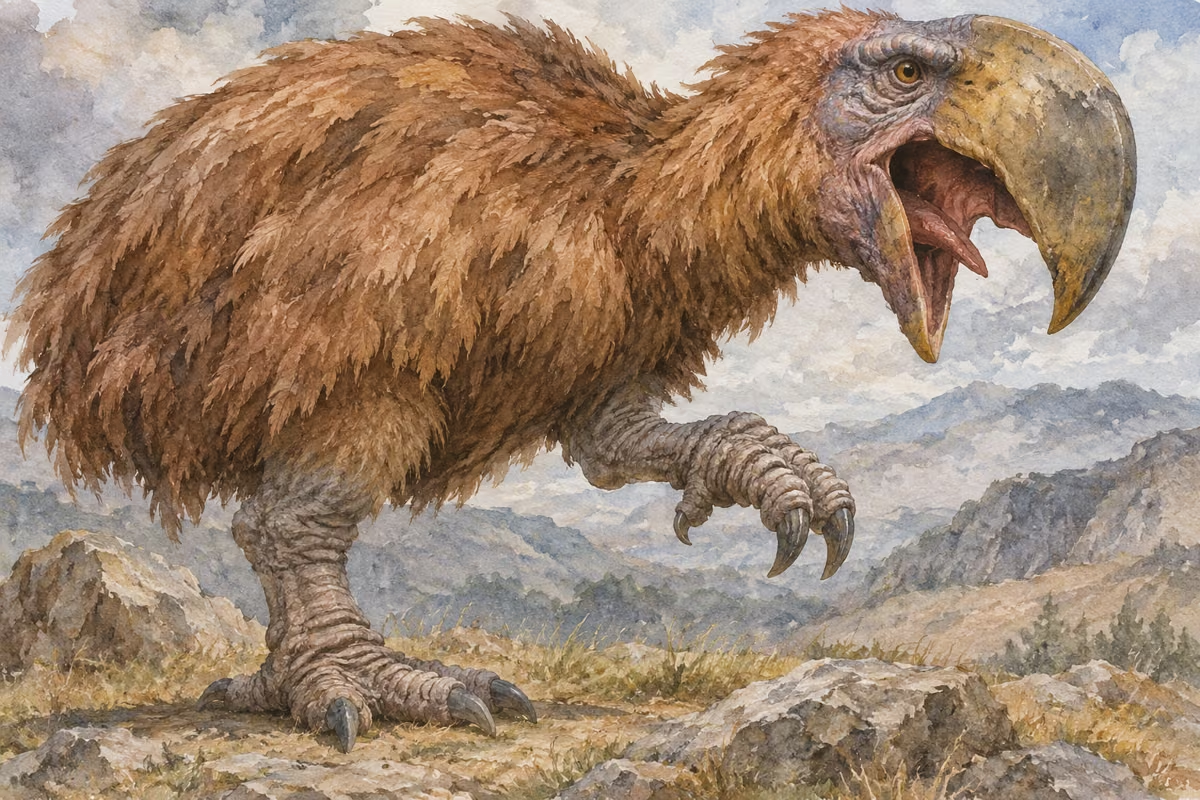
This large bird creature walks upright on its powerful lower legs. Its beak is unusually large and is hooked downward at the tip like a raptor. The head, neck, and body is wrapped in a heavy coat of downy feathers, but the legs are covered by a wrinkled hide.
This giant, heavy, flightless bird stood over 6 ft. in height, with huge clawed feet and a giant, parrot-shaped beak. While a predatory bird, the diatryma steini, or terror crane, is an omnivorous creature that consumed vegetation and used its heavy jaw to crack nuts. It resembled an oversized ostrich, but was somewhat slower as it had no enemies from which it needed to escape. The coat of feathers probably provided some protection to the bird, much like a thick hide. The terror crane lived on the North American continent some 50 million years ago.
Combat
Terror crane attacks by leaping on its prey with its taloned feet, then crushing bones and ripping out flesh with its beak.
Skills: Terror cranes have a +4 racial bonus on Jump checks.
Also in this section of the source
Woolly Mammoth
Author: Robert J. Hall.
| Statistic | Value |
|---|---|
| Size/Type | Huge Animal |
| Hit Dice | 12d8+72 (144 hp) |
| Initiative | +0 |
| Speed | 40 ft. (8 squares) |
| Armor Class | 16 (-2 size, +8 natural), touch 8, flat-footed 16 |
| Base Attack/Grapple | +9/+28 |
| Attack | Gore +20 melee (2d6+16) |
| Full Attack | Slam +20 melee (1d8+11) and 2 stamps +15 melee (1d8+5); or Gore +20 melee (2d6+16) |
| Space/Reach | 15 ft./10 ft. |
| Special Attacks | Trample 1d8+16 |
| Special Qualities | Low-light vision, scent |
| Saves | Fort +14, Ref +3, Will +4 |
| Abilities | Str 32, Dex 10, Con 23, Int 2, Wis 13, Cha 5 |
| Skills | Listen +10, Spot +9 |
| Feats | Alertness, Endurance, Great Fortitude |
| Environment | Cold plains |
| Organization | Solitary or herd (6–30) |
| Challenge Rating | 8 |
| Advancement | 11–21 HD (Huge) |
| Level Adjustment | ― |
These relatives of the elephant had long, dark brown hairs on top of a dense coat of woolly fur. There was a 3–4 in. layer of fat beneath the coat to further protect the body from the cold. The heavy body of the mammuthus primigenius had a humped, sloping back, a prominent domed head, straight legs, and a relatively short tail. It had two curved tusks attached to the bottom of the head, pointing upward. The woolly mammoth stood 9–10 ft. in high at the shoulder, and the biggest specimens were greater in size than the modern elephant. Like the elephant, the mammoth also had a flexible trunk that could be used for grazing.
This species ranged north of the arctic circle during the last ice age, and the great bulk and thick coat were evolved for this bitterly cold climate. This was easily the largest and most conspicuous animal of the tundra region. It existed on the grass and plants of the tundra during the summer, and switched to shrubs during the bitterly cold winter.
Combat
Wooly mammoths typically charge threatening creatures, advancing with horns ready.
Trample (Ex): Reflex half DC 27. The save DC is Strength-based.