Shaggy Stalker
| Statistic | Value |
|---|---|
| Size/Type | Large Aberration |
| Hit Dice | 10d8 (45 hp) |
| Initiative | +1 |
| Speed | 30 ft. (6 squares), climb 30 ft. |
| Armor Class | 22 (-1 size, +1 Dex, +12 natural), touch 10, flat-footed 21 |
| Base Attack/Grapple | +7/+14 |
| Attack | Eye rays +7 ranged touch and tentacle +4 melee (1d4+3) |
| Full Attack | Eye rays +7 ranged touch and 4 tentacles +4 melee (1d4+3) |
| Space/Reach | 10 ft./10 ft. |
| Special Attacks | Eye rays, improved grab, beak bite 2d6+3 |
| Special Qualities | All-around vision, anti-psionic cone, darkvision 60 ft., psi-like abilities, power resistance 25, favored enemy |
| Saves | Fort +3, Ref +4, Will +12 |
| Abilities | Str 17, Dex 12, Con 11, Int 16, Wis 16, Cha 18 |
| Skills | Balance +11, Climb +20, Concentration +6, Hide +8, Listen +15, Psicraft +11, Search +8, Spot +15, Survival +5 |
| Feats | Alertness, Blind-Fight, Improved Initiative, Iron Will |
| Environment | Underground |
| Organization | Solitary |
| Challenge Rating | 12 |
| Treasure | Standard |
| Alignment | Usually chaotic good |
| Advancement | 11–15 HD (Large); 16–32 HD (Huge) |
| Level Adjustment | ― |
Description
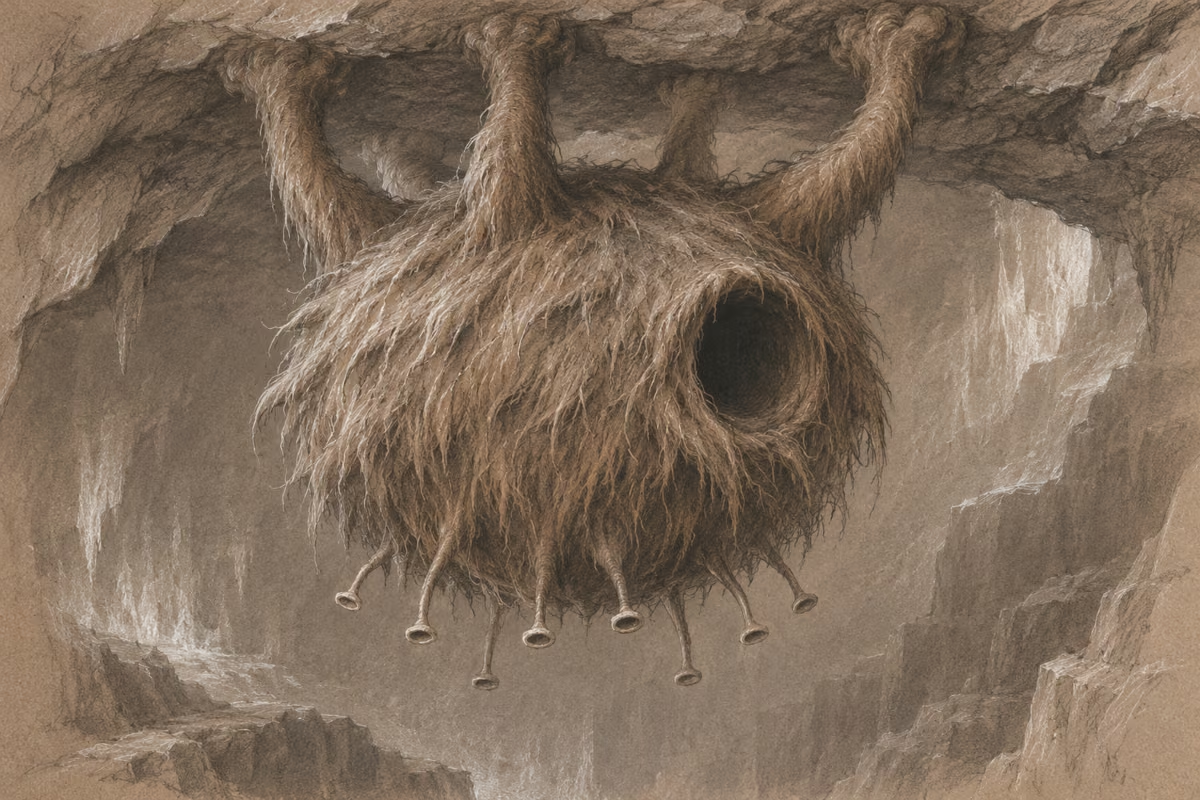
A great shaggy creature hangs from the ceiling, its brown body suspended by a bundle of tentacles on the underside. On the side opposite the tentacles are several curious stalks with hollow openings at the end. There is a large, pit-like opening in the center of its body.
This bizarre species was created long ago by an unknown race for the purpose of combating an evil breed of psionic predators. The mindset and powers of this potent creature were greatly modified from the original species, and as a result the shaggy stalker is an altogether different creature than its predecessor. As of yet it is still a relatively rare being in the world, and can only be found underground in selected locations. The effect of this creature on the population of its racial enemy has been quite dramatic, however.
A shaggy stalker is a 6-foot-wide orb covered in a long, thick coat of multi-hued brown hair. Rather than an eye, the shaggy stalker has a vision pit through which it is able to discern its surroundings with good clarity. Eight smaller vision pits on the ends of stalks peer out from the shorter mat of hair on the top of the orb. The long, hanging coat of shaggy hair disguises a mass of powerful furry tentacles attached to the underside. A formidable beaked mouth sits at the bottom in the midst of these tentacles.
To move about underground, the shaggy stalker uses the gripping pads on the ends of its tentacles to cling to walls and ceilings.
Combat
Shaggy stalkers rarely attack without provocation, and normally only hunt for food or for their species enemy. They will put themselves at considerable risk in order to aid those who are attacked or enslaved by their enemy race, and will on occasion even ally themselves with enemies of this foe.
When faced with multiple opponents their favorite tactic is to lower themselves into the midst of their enemies from above, then employ their rays to best effect. Against a single foe a shaggy stalker will attempt to attack from ambush, using up to four of its tentacles to tightly grasp the foe and then bite with its beak.
Eye Rays (Su): Each of the eight small vision pit rays resembles a psionic power (manifester level 13th). Each ray has a range of 150 feet and a save DC of 17. The save DCs are Charisma-based. The eight rays include:
Brain Lock: The target must succeed on a Will save or be affected as though by the psionic power. Shaggy stalkers typically use this ray against psionically enslaved defenders of their enemy race in order to safely neutralize them during the battle.
Psionic Charm: The target must succeed on a Will save or by affected as though by the psionic power. The shaggy stalker uses this ray to target weak-willed members of the enemy.
Psionic Disintegrate: The target is affected as though by the psionic power, taking 22d6 points of damage (5d6 on a Fortitude save). The shaggy stalkers enjoy using this ray against the leaders of their enemy, who are susceptible to its destructive power.
Psionic Dominate: This works like the psionic power, except the subject can be of any size and can affect an aberration, animal, dragon, elemental, fey, giant, magical beast, monstrous humanoid, or outsider. The shaggy stalker uses this ray to create confusion in the ranks of an enemy, particularly among those guarding any of their enemy race.
Attraction: The target must succeed on a Willpower save or be affected as though by the psionic power. This ray is often targeted against fleeing opponents, or those it thinks will survive the fight.
Empathic Feedback: The target is dealt the amount of damage it deals you, or 13 points, whichever is less. The shaggy stalker will use this ray against physically threatening targets it wants to destroy early in the fight, or to finish off wounded foes.
Mind Trap: This works like the psionic power, but will only drain targets within a cone-shaped region. If the eye is shifted to another area, the power will no longer function against the previous targets. This ray is typically aimed at racial foes among the enemy, particularly at the individual whom the creature perceives as being the most dangerous.
Recall Agony: This works just like the psionic power, causing 6d6 points of damage. (Will half).
Improved Grab (Ex): To use this ability, the shaggy stalker must hit with a tentacle attack. It can then attempt to start a grapple as a free action without provoking an attack of opportunity. If it wins the grapple check, it establishes a hold and can beak bite.
Beak Bite (Ex): Attack bonus +4, damage 1d8+3.
Negate Psionics Cone (Su): A shaggy stalker's central vision pit continually radiates a 100-foot cone of null psionics field as the psionic power (manifester level 12th). All psionic powers and effects within the cone are suppressed―even the shaggy stalker's own eye rays. Once a round, during its turn, the shaggy stalker decides whether the negate psionics cone is active or not (the shaggy stalker deactivates the cone by squeezing closed its central eye pit.)
Psi-Like Abilities: At will―conceal thoughts, empathic transfer, missive, escape detection, forced share pain (DC 17); 3/day―brain lock, body adjustment (2d12*). Manifester level 10th. Save DC is Charisma-based.
*Includes augmentation for the necrotic brain's manifester level.
Favored Enemy: This power works like the ranger's favored enemy feature, except the chosen foe must have psionics or a psi-like ability.
Skills: Shaggy stalkers receive a +4 racial bonus to Balance and Climb checks. A shaggy stalker can always choose to take 10 on Climb checks, even if rushed or threatened.
Shaggy Stalker Society
The shaggy stalker is normally a solitary creature that dwells exclusively beneath the earth. It is rarely to be found at a particular location for very long, relying on mobility to confuse its enemies. Rather than building an extensive base, it uses its disintegration power to create a series of well-camouflaged ambush ports at suitable locations in tunnel ceilings. From these holes the creature waits for an opportune moment to strike at its prey passing beneath. It is a cunning, patient, and unpredictable creature that may allow weeks or months to pass between each attack.
Once the fear of its bizarre form is overcome, the shaggy stalker can prove to be a trustworthy ally and pleasant companion, especially to those whom it has rescued from slavery to its racial foe. The creature will rarely have long-lasting friendships, however, as such may impair its ability to stalk its hereditary foe. The rare exception is the occasional closely allied metallic dragon, particularly those of the brass or copper variety, with whom they can form life-long bonds.
Advanced Benefits
In addition to the standard changes due to Hit Dice advancement, shaggy stalkers also gain the following special benefits.
- The manifester level of the psi-like abilities is equal to the creature's HD.
- The save DC of the eye rays is equal to 10 + ½ HD + Charisma modifier.
- Power resistance is equal to the creature's HD + 15 (maximum 35).
- 12–17 HD ― The body adjustment heals 3d12 points of damage.
- 13+ HD ― Add At will―read thoughts to the psi-like abilities.
- 15+ HD ― Add 3/day―dimensional slide to the psi-like abilities.
- 16+ HD ― Add At will―mass missive to psi-like abilities.
- 17–24 HD ― The favored enemy bonus increases to +4.
- 18+ HD ― The body adjustment heals 4d12 points of damage.
- 19+ HD ― The brain lock power can also affect animal, fey, giant, magical beast, or monstrous humanoid.
- 21+ HD ― Add 3/day―psionic dimensional anchor to the psi-like abilities.
- 23+ HD ― Add 3/day―detect psionics to the psi-like abilities.
- 24+ HD ― The brain lock power can also affect abberation, dragon, elemental, or outsider.
- 25+ HD ― The favored enemy bonus increases to +6.
- 27+ HD ― Add 3/day―ultrablast to the psi-like abilities.
- 29+ HD ― Add 3/day―energy conversion to the psi-like abilities.
- 31+ HD ― Add 3/day―greater psionic teleport to the psi-like abilities.
Also in this section of the source
Swarm
Swarms are dense masses of Fine, Diminutive, or Tiny creatures that would not be particularly dangerous in small groups, but can be terrible foes when gathered in sufficient numbers. For game purposes a swarm is defined as a single creature with a space of 10 feet―gigantic hordes are actually composed of dozens of swarms in close proximity. A swarm has a single pool of Hit Dice and hit points, a single initiative modifier, a single speed, and a single Armor Class. It makes saving throws as a single creature.
Many different creatures can mass as swarms. The swarm’s type varies with the nature of the component creature (most are animals or vermin), but all swarms have the swarm subtype.
A swarm of Tiny creatures consists of 300 non-flying creatures or 1,000 flying creatures. A swarm of Diminutive creatures consists of 1,500 non-flying creatures or 5,000 flying creatures. A swarm of Fine creatures consists of 10,000 creatures, whether they are flying or not. Swarms of non-flying creatures include many more creatures than could normally fit in a 10-foot square based on their normal space, because creatures in a swarm are packed tightly together and generally crawl over each other and their prey when moving or attacking. Larger swarms are represented by multiples of single swarms. A large swarm is completely shapeable, though it usually remains contiguous.
Combat
In order to attack, a single swarm moves into opponents’ spaces, which provokes an attack of opportunity. It can occupy the same space as a creature of any size, since it crawls all over its prey, but remains a creature with a 10-foot space. Swarms never make attacks of opportunity, but they can provoke attacks of opportunity.
Unlike other creatures with a 10-foot space, a swarm is shapeable. It can occupy any four contiguous squares, and it can squeeze through any space large enough to contain one of its component creatures.
Vulnerabilities of Swarms
Swarms are extremely difficult to fight with physical attacks. However, they have a few special vulnerabilities, as follows:
- A lit torch swung as an improvised weapon deals 1d3 points of fire damage per hit.
- A weapon with a special ability such as flaming or frost deals its full energy damage with each hit, even if the weapon’s normal damage can’t affect the swarm.
- A lit lantern can be used as a thrown weapon, dealing 1d4 points of fire damage to all creatures in squares adjacent to where it breaks.