Golden Spitting Scarab
| Statistic | Value |
|---|---|
| Size/Type | Large Vermin |
| Hit Dice | 6d8+6 (33 hp) |
| Initiative | +1 |
| Speed | 30 ft. (6 squares), burrow 10 ft. |
| Armor Class | 17 (-1 size, +1 Dex, +7 natural), touch 10, flat-footed 16 |
| Base Attack/Grapple | +4/+9 |
| Attack | Bite +5 melee (1d8+1) or sting +5 melee (1 plus implant) or spit +5 ranged (entangle) |
| Full Attack | Bite +4 melee (1d8+1), or sting +4 melee (1 plus implant) or spit +5 ranged (entangle) |
| Space/Reach | 10 ft./5 ft. |
| Special Attacks | Spit, implant |
| Special Qualities | Darkvision 60 ft., simple anatomy, tremorsense 60 ft., vermin traits |
| Saves | Fort +6, Ref +3, Will +3 |
| Abilities | Str 12, Dex 13, Con 15, Int ―, Wis 12, Cha 10 |
| Skills | Spot +5 |
| Feats | ― |
| Environment | Underground |
| Organization | Solitary or pair |
| Challenge Rating | 4 |
| Treasure | None |
| Advancement | 7–8 HD (Large), 9–10 HD (Huge) |
| Level Adjustment | ― |
Description
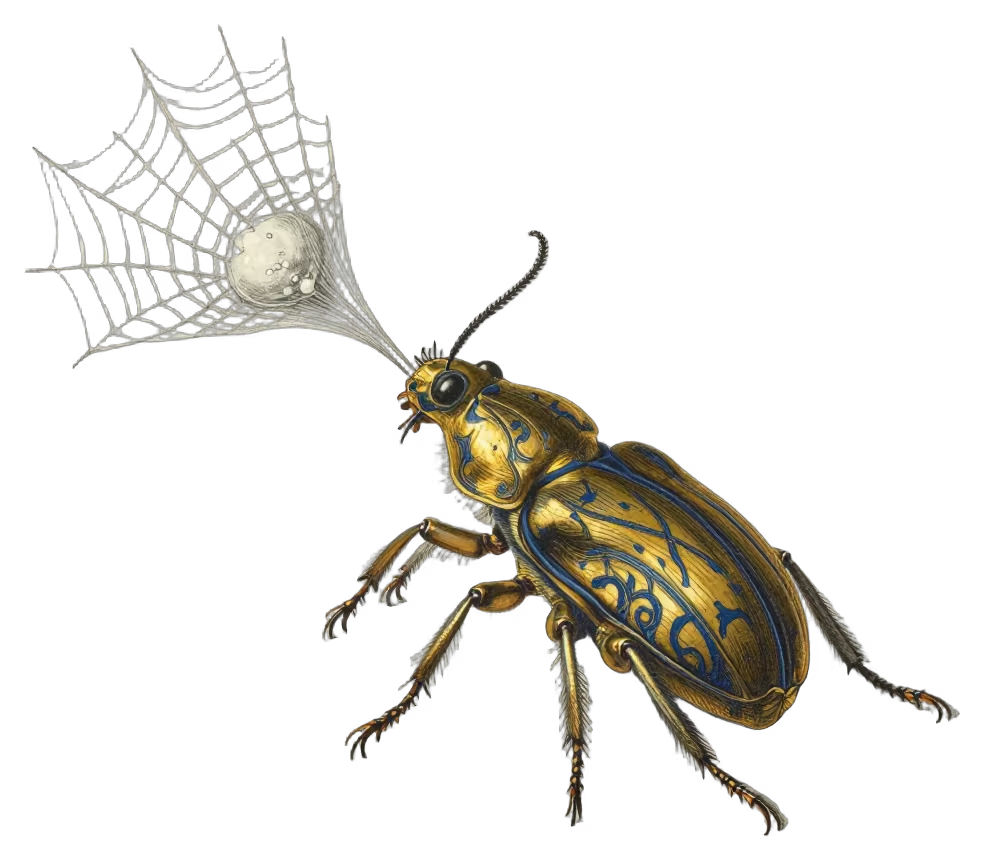
This giant, stout-bodied beetle has an dark golden-hued shell that is covered in an intricate pattern of deep azure lines. Their antennae are unusually long and curl back over the body almost like feathers. These insects dwell in tunnels and passages beneath the earth, consuming fungus and lichen gnawed from the wall surfaces.
When they need to reproduce the golden spitting scarab turns predatory and begins hunting warm-bodied prey to serve as hosts for their eggs. The larvae from these eggs slowly consume the host, and eventually emerge to depart into the wilds.
Combat
A golden spitting scarab can spit a large glob of viscous fluid that readily sticks to almost any surface. Once this glob adheres, it will shoot outward in a lattice of fine, resilient strands that entangle themselves about the target to form a net. The scarab seeks to capture as many warm-bodied hosts as possible, then inject the eggs into the body.
Spit (Ex): As a standard action each round, a golden spitting scarab fires a sticky glob at one opponent within 30 feet. The scarab makes a ranged touch attack. If it hits, the glob adheres. On the following round the target must succeed on a DC 15 Reflex save or become entangled in a net of silken strands. The save DC is Constitution-based.
An entangled creature can escape with a successful DC 15 Escape Artist check or burst it with a DC 19 Strength check as a standard action. The check DC are Constitution-based, and the Strength check DC includes a +4 racial bonus.
Implant (Ex): A golden spiting scarab that hits with its stinger can inject several eggs into the opponent's body. The affected creature must succeed on a DC 15 Fortitude save to avoid a successful implantation. The save DC is Constitution-based. Often the golden spiting scarab injects an entangled or otherwise helpless creature, which gets no saving throw.
The eggs gestate for 3–6 days before hatching into larvae that eat their way out, killing the host. Twenty-four hours before the eggs hatch, the victim falls deeply ill (-4 to all ability scores, to a minimum of 1). A remove disease spell rids the victim of the eggs, as does a DC 25 Heal check. If the check fails the healer can try again, but each attempt (successful or not) deals 1d3 points of Constitution damage to the patient.
Simple Anatomy (Ex): Due to the simple, redundant anatomy of a golden spitting scarab, there is a 50% chance to ignore any additional damage from a critical hit or sneak attack.
Skills: Golden spitting scarabs have a +4 racial bonus on Spot checks.
Also in this section of the source
Heart-eater
By Ashley H
| Statistic | Value |
|---|---|
| Size/Type | Fine Vermin |
| Hit Dice | 1d4+2 (4 hp) |
| Initiative | +3 |
| Speed | 20 ft. (4 squares) |
| Armor Class | 17 (+4 size, +3 Dex), touch 17, flat-footed 14 |
| Base Attack/Grapple | +0/-16 |
| Attack | Bite +3 melee (1d3-5 plus bug fever) |
| Full Attack | Bite +3 melee (1d3-5 plus bug fever ) |
| Size/Reach | ½ ft./0 ft. |
| Special Attacks | Flying bite |
| Special Qualities | Darkvision 30 ft., bug fever, spawn young, infestation, mind control, hive mind |
| Saves | Fort +4, Ref +3, Will +0 |
| Abilities | Str 1, Dex 16, Con 14, Int 10, Wis 10, Cha 1 |
| Skills | Hide +21, Intimidate +4, Listen +2, Move Silently +5, Spot +2 |
| Feats | Flyby Attack |
| Environment | Temperate and warm desert, forest, hills, plains, and underground |
| Organization | Hive (20–200) |
| Challenge Rating | 1 |
| Treasure | None |
| Alignment | Always chaotic evil |
| Advancement | Fine (2–3 HD), Diminutive (4–5 HD) |
| Level Adjustment | ― |
Heart-eaters are the spawn of a diseased and foul land, cultivated and supported by an evil god. They look much like winged roaches, growing from coin-sized to hand-sized in the course of a few months. After mating, the heart-eaters lay their eggs in the fecal matter or food of their victims, which must be always meat-eating mammals. The eggs then hatch inside in a matter of weeks.
The newly hatched heart-eaters begin eating their way through the bodies of their victims, devouring each other, until one finds itself in the heart, brain, or spinal column. There it grows to full size on the muscle of its hosts, gradually taking over the body and mind, until the host, believing himself to be perfectly fine, is doing the bidding of the heart-eater. By the time the heart-eater reaches full adulthood after about four weeks, the host has become nothing more than a puppet to the heart-eater's whims, a vegetable with working limbs.
The heart-eater does not usually leave the body of the host until the host is killed or dies of natural causes, at which point, an adult heart-eater may try to acquire a new victim by sneaking down his throat as he sleeps and chewing through the wall of the stomach. A younger heart-eater (less than 4 weeks old) will not survive long outside the host's body. The heart-eater usually vacates the body of the dead or dying host immediately through the mouth or other convenient wound, though a few of the older ones have been known to stay inside until the host begins to decay.
A rare few incidents describe adult heart-eaters leaving the bodies of their hosts willingly, either to overtake new hosts, or because they are forced out by excessive toxins in the host's body. In the former case, the bug will have its host kiss its victim and hold the jaw open, while it forces its way into the mouth and down into the stomach.
Assuming the victim can break the hold, a successful DC 15 Fortitude save will retch the creature up. This save attempt can only be made within the first five rounds of combat, as after that, the bug will be busy eating its way up to the victim's heart to take over. The previous host, if the heart-eater was adult, will fall over dead, unable to survive without the vermin. Once the heart-eater entrenches itself in its victim's tissues, after 1d6+2 rounds, it will attempt to make the victim into its host. Heart-eaters can live to be about 10 years old, and it is the older set, usually over 6, that show the intelligence to use tactics and strategy even in their insectoid forms or when cut off from the hive. Younger adult insects have been known to develop similar intelligence under stress, such as prolonged separation from the hive.
Killing the heart-eater does free the host from its slavery, so long as the killing takes place before the heart-eater is at full maturity. At that point, the heart-eater has eaten the last few scraps of the victim's vital tissues, and is magically keeping the victim alive. The victim will not be able to survive without it.
Heart-eaters are known to dislike fire, probably from an instinctual aversion to light. They tend to keep their hosts away from it, wherever possible, though as they get older, their self-control becomes a little stronger.
Combat
Heart-eaters will avoid combat wherever possible when outside the bodies of their hosts. If combat takes place, the heart-eater will do its absolute best to run, hide, and disappear. They are not brave creatures by nature, nor are they cowardly; they simply have strong survival instincts. Host-less combat usually begins when the heart-eater has advanced on a sleeping or grappled victim and attempted to go down his throat, or when a heart-eater has just been deprived of its host.
If the heart-eater's host has just been killed, it loses contact with the hive for 1d6 rounds (+2 if the death is truly traumatic, such as a sword blow that barely missed the heart), and is reduced to insect intelligence. It spends one round struggling free of the body, and in the round which follows can do nothing but run at its top speed for the nearest shelter. In that round, the heart-eater is a slave to its deepest instincts: get away from fire, get away from light, and get somewhere safe.
When inside the body of the host, the heart-eater gains full control of the host's physical abilities and partial control of the host's mind. The heart-eaters also gain full control of the host's magic, since all magic originates from the evil god who created them. The heart-eater will give its host the conviction that the host must attack, and let the host figure it out from there.
If the host has no idea how, the heart-eater will likely have the host bite those it is attacking, since that's how the bug itself would do it, were it host-less.
If the host is somehow knocked insensate but the heart-eater finds himself still in control of the body, the heart-eater will do his best to continue doing as the host did. Even so, all expression typically fades from the face, and motions become jerky and rapidly mechanical, as the heart-eater devotes all its attention to whatever was taking place. The heart-eater will need to roll a Bluff check at DC 10, if he's trying to convince onlookers that he truly is the host.
Flying Bite (Ex): A host-less heart-eater can use its ability to fly as a scare tactic in order to escape combat. The bug flies up at the face of its nearest attacker, immediately rolling an Intimidate check. Should it defeat the victim's modified level check, the victim will reflexively duck out of the way and the heart-eater will fly over his shoulder and run for shelter without provoking an Attack of Opportunity. Should it fail, the attack continues as a standard bite attack.
Bug Fever (Ex): Disease―bite, Fortitude DC 12, incubation period 1d3+1 days, damage 1d6 Str. The save DC is Constitution-based.
The bite typically leaves a nasty little welt, which fades over time from a violent red to a fainter purplish color. The victim might believe he's healing... at least, until the fainting spells set in as the victim's strength is sapped away. The victim's skin becomes red and bloated, and the victim runs a constant fever. Should he attempt any strenuous activity, he must succeed at a DC 15 Strength check or faint for a full round. In this condition he is helpless.
Spawn Young (Ex): The heart-eater lays its eggs either in the food of potential hosts, or in the digestive tract of its current host. In the latter case, the host is compelled to absentmindedly transfer the eggs, once they've been expelled with the host's waste, into the food of other potential hosts. Potential hosts, by the way, include any living creature which eats meat, not just humanoids. The host will attempt to cover up this disgusting habit by subtle means, utilizing any cooking skill and wisdom he may possess. The potential victims of this nefarious deed may either eat the food without suspicion, in which case they get no rolls, or check the food over before eating it, in which case they may roll against the heart-eater's host's skill check to see if they spot the alterations. Detect Poison will not reveal the eggs, as they are not poisonous.
Upon eating the food, potential victims become incubators. Incubation lasts 1d6+3 days, during which the eggs grow from the size of a grain of sand to the size of a coin in the victim's gut, muscle-lining, and stomach. The incubator must make a DC10 Fortitude save to see if his body staves off the parasitic infection. This check must be made once for every tainted meal eaten. Should the victim fail, the young will hatch at the end of the incubation period. The young will kill one another off within a day, until only one remains. At this point, that one will attempt to take over the host's body mentally.
Infestation (Ex): Hosts are unaware of the infestation in most cases, but may feel a sense of kinship with other infected people, or even heart-eaters and roaches crawling around on the floor. It is extremely difficult to tell an infected victim from a normal person―they have all the memories, attitudes, and dreams of a normal being, and no obvious wounds or external markings.
Where there is concern of an infestation, certain medicines (closer to pesticides) are forced down the throats of potential victims, forcing them to cough and retch up any bugs or eggs they've been raising. This does not work, however, on the entrenched adult. Magic is about the only method of detection in fantasy societies.
The heart-eater is difficult to remove from a host without also harming the victim. If a victim gets the cure within the first three weeks, have him roll a DC 10 Fortitude save to avoid retching it up immediately. Once he has successfully downed it, the young heart-eaters will be vomited up in about half an hour. If the victim takes the cure after week three, but before the heart-eater has gained complete dominance of him, he must take extra medicine to have any chance of affecting the heart-eater. His DC is 16; the heart-eater's is 18. If both succeed, the medicine has no effect. If the victim fails, the medicine is vomited up and the heart-eater has another chance to dominate the victim to prevent him from swallowing it. If the victim succeeds and the heart-eater fails, the heart-eater is immediately forced from its perch and vomited up, and is blocked from the hive for 1d6+2 rounds. If the victim succeeds and the heart-eater succeeds, the medicine makes the victim extremely ill, but the heart-eater is not vomited up, and will probably have another chance to dominate the victim.
Mind Control (Su): The young heart-eater will worm its way into a spot in the victim's heart. There, it will exert magical mental control over the host at will. The host may roll to resist this each time. Within the first week, the DC is 13, and the host cannot be forced to do anything contrary to his alignment. Within the second week, the DC is 15, and the host may be forced to do something one step off from his alignment. By the third week, the DC is 17; the host may be forced to do anything the heart-eater desires. By the fourth week, however, the heart-eater is an adult. At this point, the human becomes, effectively, a slave, with the heart-eater animating his limbs and controlling his mind. The DC to resist this is 18, and goes up by 1 with every failed attempt at resistance. When the heart-eater is in control after the fourth week, the host's alignment changes to Chaotic Evil. The heart-eater is able, prior to gaining full control of the host, to remove any memories made in its presence which it doesn't want the host to have. The heart-eater will also do its utter best to prevent the host from finding out that it is infected, and will attempt to imbue the host with a sense of happy contentment - all is right with the world.
Hive Mind (Su): The heart-eaters, from their third week of life on, are in constant mental contact with each other at a range of ten miles. What one knows, they all know. This makes fighting them en masse extremely difficult. A hive will likely consist of perhaps 50% adult heart-eaters living in their hosts, 25% young adults in the bodies of humans, and 25% adults looking for new hosts. Any also has, at any given point, about 100 times its members in eggs waiting to be hatched, or already hatched and fighting for supremacy of their pet human. Hives range in size from 10 to 10,000 individuals. Hives can communicate between one another, but only if two adult heart-eaters come close enough for direct physical contact. When that takes place, they communicate with short-range mental conversation, to a distance of ten feet. There are no clear leaders of hives; they are typically ruled by the group, and it is not normally possible for heart-eaters to disagree with one another, because without the hive intelligence, they are merely semi-intelligent insects, barely capable of communication.
Skills: Heart-eaters have a +4 racial bonus to Move Silently checks and a +8 racial bonus to Bluff checks. Adult heart-eaters have a +8 racial bonus to any Bluff skill checks while they dominate a host.
Heart-Eater Society
Heart-eaters are almost entirely alien by appearance and behavior. Their very survival involves the death of another being; they are inherently dangerous, and are instinctively destructive to things which don't suit their interests. They are parasites who believe themselves better than the host.
They have little interest as a species in humanity's accomplishments, laws, or thoughts; they wish only to live and procreate and please their dark god. If procreation means the subjugation or destruction of an inferior (if sentient) race, well then, so be it! It'll be nice to get those filthy two-legged things under control. And then there's their dark god - they are utterly desperate, in an almost childlike sense, to please him. Since he is chaotic, so are they. (Ordinarily, they might be a little more Lawful.)
Heart-eaters think little of mankind; they see meat-eating mammals as walking incubators just waiting to be captured. Even so, as they get older, they do get a little more clever. The adults have been known to develop rudimentary personalities when away from the hive, and can communicate via their hosts. They tend to find the idea of communicating with other races laughable, however. It'd be like a king taking time to talk to his throne.
As a hive, they can be clever and disguise the signs of their presence; they may obey laws simply to do so. They do not make decisions independently when attached to the hive, nor do they think of themselves as "we" - it is always "I". As such, unless a threat is presented to the whole hive, or a host is particularly important to preserve, individual heart-eaters, when inside the bodies of their hosts, show little sense of self-preservation.
The lone heart-eater is still "I", but he might be unsettled by the lack of backup, the fewer available bodies and spawn, and the severe curtailing of his senses. Thus he will show a sense of preservation -at least, until he gets back to the hive, at which point his knowledge will be passed to it and he will once more have that comforting sense of multiple bodies and extended senses. Should a female heart-eater be prevented from getting back to her hive, she will start her own by laying as many eggs as possible.
When a single heart-eater is removed from the hive, the hive will investigate his disappearance or death if they don't already know what caused it. The hive shows little concern for the lives or deaths of individuals; the hive is the true individual, and it will expend every effort to protect itself. Hives can have personalities, but they're quite race-oriented, bigoted, and survivalist. Even so, the hive's personality may be expressed in the behavior of its individuals in subtle ways: they prefer the color red; they destroy all cats; they are intensely obsessed with dealing with a single person.
They do not generally care about the gender, appearance, mental state, or abilities of the host they overtake, though the hive will occasionally choose particular humanoids it knows to be powerful or useful in some way. The female heart-eaters are especially aggressive in their choice of victims, however, making sure to take out the most dominant individual they can find, so as to spread their eggs faster. They are more likely to change hosts for an advantage among their victims than males, and will try to participate in food preparation.