Canis Dirus
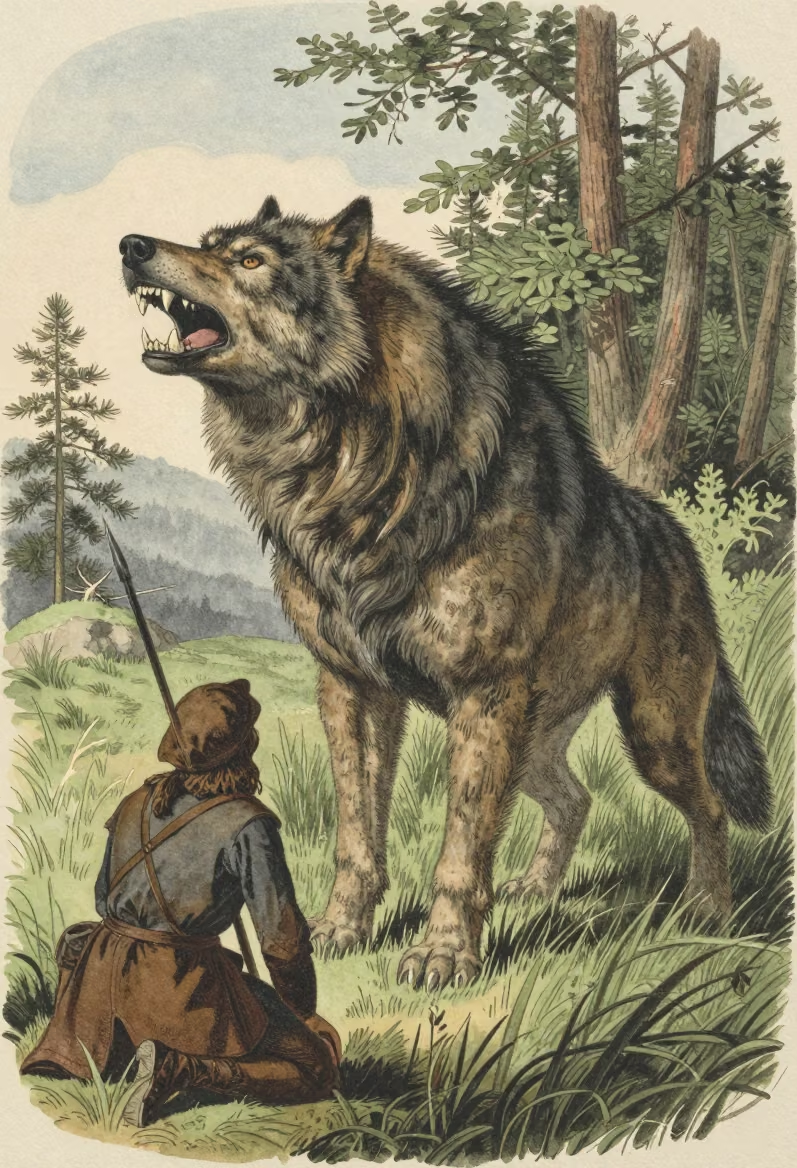
| Statistic | Value |
|---|---|
| Size/Type | Medium Animal |
| Hit Dice | 3d8+9 (23 hp) |
| Initiative | +2 |
| Speed | 40 ft. (8 squares) |
| Armor Class | 15 (+2 Dex, +3 natural), touch 12, flat-footed 13 |
| Base Attack/Grapple | +2/+5 |
| Attack | Bite +6 melee (1d8+3) |
| Full Attack | Bite +6 melee (1d8+3) |
| Space/Reach | 5 ft./5 ft. |
| Special Attacks | ― |
| Special Qualities | Low-light vision, scent |
| Saves | Fort +6, Ref +5, Will +2 |
| Abilities | Str 16, Dex 14, Con 17, Int 2, Wis 12, Cha 6 |
| Skills | 6 Hide +3, Listen +2, Move Silently +3, Spot +2, Survival +2* |
| Feats | Improved Overrun, TrackB, Weapon Focus (bite) |
| Environment | Temperate plains |
| Organization | Solitary, pair, or pack (7–16) |
| Challenge Rating | 2 |
| Advancement | 4–8 HD (Large) |
| Level Adjustment | ― |
Description
An unusually large, heavy-set wolf-like creature peers alertly through the growth. Its muscular, fanged jaw is slightly agape as its nose twitches to catch the scent in the air.
This predator was a larger version of the common wolf, with a length of 5 feet and a weight of 110 lbs. The canis dirus is the largest member of its species known to have existed. It had a heavier build than a common wolf, with shorter but sturdier legs and a larger head. It was quite capable of crushing bones with their large, powerful teeth. However, it had a smaller brain and was not as intelligent as its lesser cousins. Neither could it run as fast due to its shorter legs.
Canis dirus were widespread, and existed both as hunters and carrion feeders. They went extinct when their preferred prey vanished due to climate changes.
Combat
The canis dirus is not as canny a predator as the wolf, relying more on pure brute strength to bring down a foe. Nevertheless it is a capable hunter that that can attack alone or as a pack. Canis dirus will chase or ambush a prey, then knock it down and inflict crippling bites with its powerful jaw.
Skills: *Canis dirus have a +4 racial bonus to Survival checks when tracking by scent.
Also in this section of the source
Carcharodon Megalodon
By Robert J. Hall
| Statistic | Value |
|---|---|
| Size/Type | Colossal Animal (Aquatic) |
| Hit Dice | 15d8+135 (203 hp) |
| Initiative | +1 |
| Speed | Swim 50 ft. (10 squares) |
| Armor Class | 12 (-8 size, +1 Dex, +9 natural), touch 3, flat-footed 11 |
| Base Attack/Grapple | +11/+35 |
| Attack | Bite +20 melee (4d6+24/19–20 and bleeding) |
| Full Attack | Bite +20 melee (4d6+24/19–20 and bleeding) |
| Space/Reach | 30 ft./20 ft. |
| Special Attacks | Bleeding, improved grab, swallow whole |
| Special Qualities | Low-light vision, scent |
| Saves | Fort +20, Ref +10, Will +7 |
| Abilities | Str 42, Dex 12, Con 28, Int 2, Wis 14, Cha 6 |
| Skills | Listen +11, Spot +11, Survival +9* |
| Feats | Alertness, Great Fortitude, Improved Critical (bite), Skill Focus (survival), Weapon Focus (bite) |
| Environment | Warm aquatic |
| Organization | Solitary |
| Challenge Rating | 9 |
| Advancement | 16–24 HD (Colossal) |
| Level Adjustment | ― |
An immense shark with a huge, fang-lined maw surges powerfully and inexorably through the water. It has slick, pale gray flesh, large fins, and a powerful tail.
This giant shark was the largest meat-eating fish ever known to have lived. Reaching an enormous 100–110 ft. in length, megatooth dominated both warm and perhaps even cool water oceans from 24 to 2 million years ago. The serrated, blade-like fangs of this monster grew to a remarkable length of 6-in., large enough to cover a hand. They were arranged in multiple rows of up to 300 teeth, and new ones would grow in as old teeth broke off. When open, the jaws are large enough to accommodate a fully grow man standing upright, and could probably have crushed a small vehicle. Food was not chewed, but was gulped down whole in huge chunks.
At its peak, the "Big Tooth" feasted on the diverse whale populations that peaked during the Miocene period, especially on the calves and old or sick specimens. Later, as the ice ages closed in around the poles and the whales began migrating north to colder waters, the giant shark lost its primary food source and is now believed to have become extinct. Today, the closest living relative of this giant creature is the much smaller great white shark.
Combat
Despite its immense size, this creature relies on surprise for its success. It strikes with a burst of speed, then bites off a chunk and leaves a bleeding hole. It then circles around waiting for the victim to weaken due to blood loss, before closing to finish off whatever is left. For smaller meals it will crush its prey in its fanged maw, then swallow it whole.
Improved Grab (Ex): To use this ability, the carcharodon must hit with its bite attack. It can then attempt to start a grapple as a free action without provoking an attack of opportunity. If it wins the grapple it establishes a hold and can swallow the foe the following round.
Swallow Whole (Ex): A carcharodon can try to swallow a grabbed opponent up to two size categories smaller than itself by making a successful grapple attempt. Once inside, the swallowed creature takes 2d8+16 points of bludgeoning damage and 8 points of acid damage per round from the carcharodon's gizzard.
A swallowed creature can cut its way out by using a light slashing weapon or piercing weapon to do 30 points of damage to the gizzard (AC 14.) Once the creature exits, muscular action closes the hole; another swallowed opponent must cut its own way out.
Bleeding (Ex): The many serrated teeth of the carcharodon will produce a severely bleeding wound. On a successful bite attack, an opponent must succeed on a DC 26 Fortitude check or be dealt 1d8 Constitution damage. Creatures that are not subject to critical hits are not affected by this ability. The save DC is Constitution-based.
Skills: *A carcharodon has a +4 bonus on survival checks when tracking by scent.
Cave Lion
By Robert J. Hall
| Statistic | Value |
|---|---|
| Size/Type | Large Animal |
| Hit Dice | 7d8+21 (52 hp) |
| Initiative | +3 |
| Speed | 40 ft. (8 squares) |
| Armor Class | 17 (-1 size, +3 Dex, +5 natural), touch 12, flat-footed 14 |
| Base Attack/Grapple | +5/+16 |
| Attack | Claw +11 melee (1d6+7) |
| Full Attack | 2 claws +11 melee (1d6+7) and, bite +6 melee (1d8+3) |
| Space/Reach | 10 ft./5 ft. |
| Special Attacks | Pounce, improved grab, rake 1d6+3 |
| Special Qualities | Low-light vision, scent |
| Saves | Fort +8, Ref +8, Will +3 |
| Abilities | Str 24, Dex 16, Con 17, Int 2, Wis 12, Cha 7 |
| Skills | Hide +8*, Jump +8, Listen +6, Move Silently +9*, Spot +6 |
| Feats | Alertness, Endurance, Run |
| Environment | Cold plains |
| Organization | Solitary, pair, or pride (6–10) |
| Challenge Rating | 5 |
| Advancement | 8–11 HD (Large) |
| Level Adjustment | ― |
This massive feline is powerfully built, with a great fanged jaw, and keen eyes burning with hunger. It has the straw-hued fur and mane of a lion, but is larger even than its deadly cousin.
This extinct member of the cat family was a third larger in overall dimensions than the modern lion, and weighed perhaps half again as much. They also hunted in prides, much like the modern lion. Felis leo spelaea is known to have dwelled in parts of Europe and northern Asia during the last glacial age. Cave lions were well-adapted to cold climates, with a warm coat and larger body mass to preserve heat.
Combat
The cave lion relies on stealth and sudden rapid charges to catch its prey. It grasps the opponent with its claws, then bites with a powerful jaw.
Pounce (Ex): If a cave lion charges a foe, it can make a full attack, including two rake attacks.
Improved Grab (Ex): To use this ability, a cave lion must hit with its bite attack. It can then start a grapple as a free action without provoking an attack of opportunity. If it wins the grapple check, it establishes a hold and can rake.
Rake (Ex): Attack bonus +11, damage 1d6+3.
Skills: Cave lions receive a +4 racial bonus to Hide and Move Silently checks. In areas of tall grass or heavy undergrowth, the Hide bonus improves to +12.