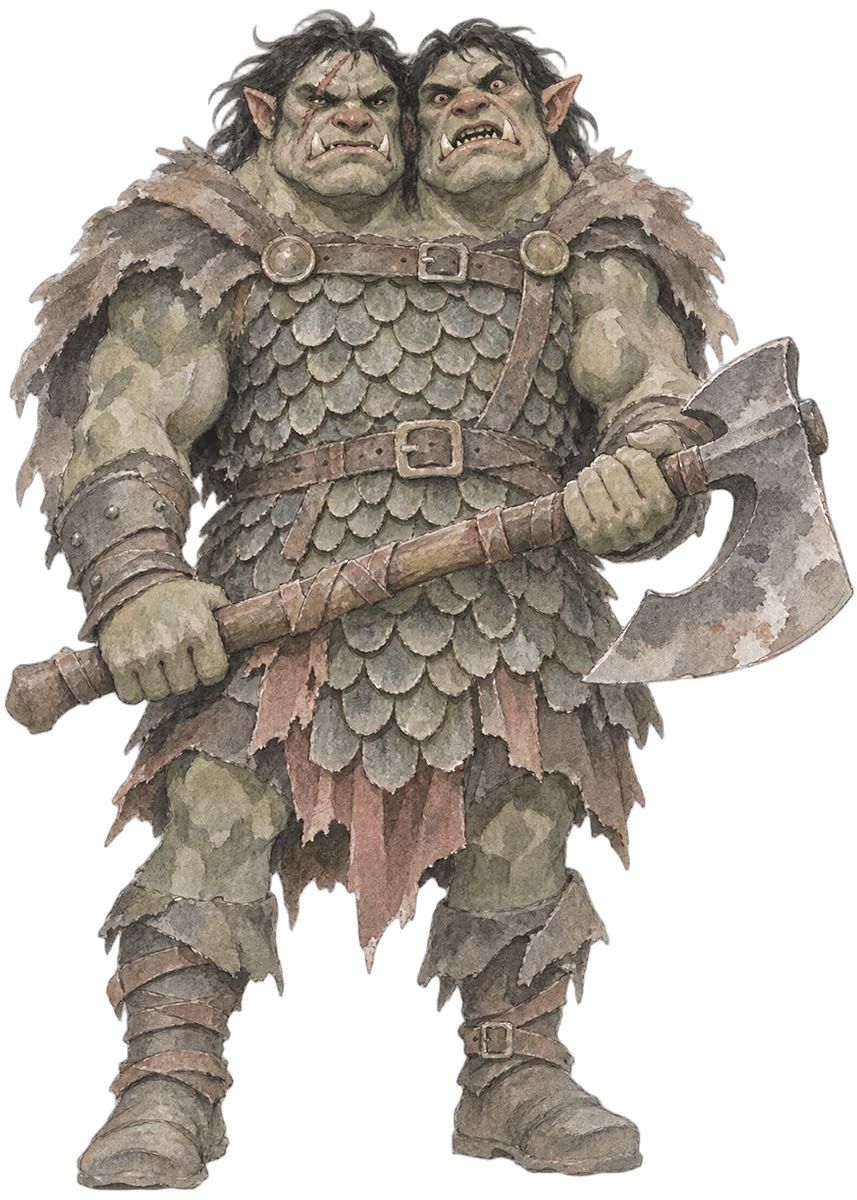
Two-Headed Orc
| Statistic | Value |
|---|---|
| Size/Type | Medium Humanoid |
| Hit Dice | 1d8+1 (5 hp) |
| Initiative | +0 |
| Speed | 30 ft. (6 squares) |
| Armor Class | 14 (+3 studded leather, +1 natural), touch 10, flat-footed 14 |
| Base Attack/Grapple | +1/+4 |
| Attack | Battleaxe +4 melee (1d8+3/x3); or javelin +1 ranged (1d6+3) |
| Full Attack | 2 battleaxes +4 melee (1d8+3/x3); or 2 javelins +1 ranged (1d6+3) |
| Space/Reach | 5 ft./5 ft. |
| Special Attacks | ― |
| Special Qualities | Darkvision 60 ft., light sensitivity, dual mind, dual reflexes |
| Saves | Fort +3, Ref +0, Will -2 |
| Abilities | Str 17, Dex 11, Con 12, Int 8, Wis 7, Cha 6 |
| Skills | Listen +3, Spot +3 |
| Feats | Alertness |
| Environment | Temperate hills |
| Organization | Solitary |
| Challenge Rating | 1 |
| Treasure | Standard |
| Alignment | Usually chaotic evil |
| Advancement | By character class |
| Level Adjustment | +1 |
Description
It is rare for a two-headed orc to survive to adulthood, and those who do so are relentlessly hunted down and slain by their own kind. However they occasionally find acceptance among those of mixed blood, where they can become highly capable warriors or dangerous barbarians. In rare occasions two-headed orcs find others of their kind, but their offspring almost always prove to be normal orcs.
Creating a Two-Headed Mutant
"Two-headed mutant" is a template that can be added to any creature with a discernible anatomy and an obvious head or head-like part of its body (referred to hereafter as the base creature).
For example, elementals and most plants cannot become two-headed mutants, nor can phasms (which lack a true head in their natural form). Creatures that are little more than a head with small limbs (such as a vargouille) cannot use this template.
A two-headed mutant uses all of the base creature's statistics and abilities except as noted here.
Size and Type: If the base creature is a humanoid, the creature's type changes to monstrous humanoid. If the base creature is an animal its type changes to magical beast. Otherwise same as the base creature. Size is unchanged. Do not recalculate saves.
Hit Dice: If the type changes to monstrous humanoid from humanoid, increase the base creature's racial HD to d10. If the type changes to magical beast from animal, increase the base creature's racial HD to d10. Otherwise same as the base creature.
Armor Class: Natural armor improves by +1.
Base Attack/Grapple: If the type changes to monstrous humanoid from humanoid, the portion of the base attack bonus due to racial HD is equal to its racial HD. If the type changes to magical beast from animal, the portion of the base attack bonus due to racial HD is equal to its racial HD. Otherwise same as the base creature.
Attacks: Same as the base creature. If the creature has a bite attack or an attack that originates from the creature's head, such as a stirge's touch attack, it gains an extra attack of this type at the same attack bonus for that attack.
Note that many of the monsters presented in the Core Rulebook III and other sources use weapons that are one size category larger than their own size and wield them two-handed; if you give them two weapons with this template, remember to give them weapons appropriate to their size and do not give them the x1.5 Str bonus since they won't be using them two-handed.
Special Attacks: Same as the base creature. If the base creature has a special attack based on some part of its head or neck (such as a poisonous bite, or a gaze attack), each head can use that ability each round. Spells and spell-like abilities are not duplicated in this manner (a base creature that can cast a spell as a spell-like ability once per day could not cast it twice per day if it were a two-headed mutant), nor are any abilities that originate from elsewhere within the body and are deployed through its head, such as breath weapons (which usually are depicted as originating in the lungs and invoked by an inhalation).
Special Qualities: A two-headed mutant retains all of the special qualities of the base creature and also gains the following:
Dual Mind (Ex): The mutant has two brains, so for all mind-affecting attacks the mutant counts as two separate creatures. If a spell or effect can only affect one of the creature's heads (such as a charm monster spell, which affects a single target), the unaffected head takes control of the entire body. In these situations, the affected head becomes inert for combat purposes (losing its extra bite attack, if any), and the creature temporarily loses its Dual Reflexes ability. Even if one head is charmed or dominated, the creature does not attack itself or split its attacks between its normal opponents and those chosen by its controller.
In effect, mind-affecting attacks must affect both heads in order to achieve the normal result (casting two successful charm monster spells on a two-headed mutant brings it fully under the control of the caster and allows it to use all of its abilities).
Dual Reflexes (Ex): The creature's two heads each control half of its limbs. This means that the creature acts as two creatures for the purposes of making attacks and attacks of opportunity. This has three effects.
- If the base creature has two hands and uses weapons, it gains Superior Two-Weapon Fighting. This means that it may attack with a weapon in each hand, and does not suffer an attack or damage penalty for doing so. In effect, the left and right hands each attack at the creature's normal base attack bonus without any penalties for fighting with two weapons. If the creature's base attack bonus would allow it iterative attacks with its first limb, the second limb does as well.
- The creature may make one more attack of opportunity per round than normal, but this extra attack must be with a different limb than any previous attacks of opportunity. For example, a two-headed mutant ogre could make an attack of opportunity with its left club, and if another attack of opportunity was provoked later that round, the ogre could use the weapon in its right hand to make another attack of opportunity. If the creature has the Combat Reflexes feat, the additional attacks of opportunity from that feat may be taken with either limb in any combination, and the creature still gains its extra attack of opportunity from this ability. So a creature with a 16 Dexterity could make up to 5 attacks of opportunity per round: 1 normally; 1 from this ability, and 3 from the Combat Reflexes feat.
- If the creature has the ability to cast spells or use spell-like abilities, it may use one head and one arm (for somatic components) to cast spells and still make a single attack with its other arm, coordinated by the other head, in the same round. The creature must make a Concentration check, at DC 10 + spell level, to successfully use the spell or spell-like ability.
Skills: Same as the base creature, but the creature's two heads give the creature a +2 racial bonus to Listen, Spot, and Search checks.
Organization: Solitary, or same as base creature.
Challenge Rating: Same as the base creature +1.
Alignment: Often same as the base creature.
Level Adjustment: Same as the base creature +1.
Also in this section of the source
Umbra
By Robert J. Hall
| Statistic | Value |
|---|---|
| Size/Type | Small Undead |
| Hit Dice | 1d12 (6 hp) |
| Initiative | +1 |
| Speed | Fly 20 ft. (perfect) (4 squares) |
| Armor Class | 13 (+1 size, +1 Dex, +1 deflection), touch 13, flat-footed 12 |
| Base Attack/Grapple | +0/― |
| Attack | Chill touch +1 melee (1d3 cold plus umbral mal) |
| Full Attack | Chill touch +1 melee (1d3 cold plus umbral mal) |
| Space/Reach | 5 ft./5 ft. |
| Special Attacks | Umbral mal |
| Special Qualities | Darkvision 60 ft., gloom, immunity to cold and fire, undead traits |
| Saves | Fort +0, Ref +1, Will +2 |
| Abilities | Str ―, Dex 12, Con ―, Int 5, Wis 10, Cha 13 |
| Skills | Listen +2, Spot +2 |
| Feats | Flyby Attack |
| Environment | Underground |
| Organization | Solitary, gang (2–5), or swarm (6–11) |
| Challenge Rating | 1 |
| Treasure | None |
| Alignment | Always chaotic evil |
| Advancement | 2–4 HD (Medium) |
| Level Adjustment | ― |
A chilling body of deep gloom hovers quietly in the air, like a nebulous shadow that has sprung to life. The dark form has an indistinct shape like a cloud of soot.
These horrific shades appear as a vaguely humanoid region of nebulous gloom. The area around the umbra is equally dim as the negative energy aspect of their form absorbs light. While they appear incorporeal they actually have a physical form composed of a cloud of ashes. Because their form has some structure they are not able to pass intact through small openings.
The umbra is a vengeful spirit that exists as the ashes of a cremated body. To create an umbra, a living being must be affected by a geas or a lesser geas. The target must then be slain in a truly horrid manner. Finally the body is burned to ashes and magically animated by means of an animate dead spell. The umbra remains close to the location of its demise and will attack any who intrude upon their ground. Once slain, the gloom vanishes, leaving only a cloud of ashes that slowly fall to the floor.
Combat
The umbra attacks by means of a chilling touch, which can invoke a chaotic negative energy state known as the umbral mal. When present in numbers, they will typically swarm an opponent, using their darkness ability to hinder their foe.
Gloom (Sp): Whenever three or more umbras are within 20 feet of each other, they can work together to create a region of darkness as the spell (caster level 4th). This effect has a radius of 15 feet, centered on an object that can be touched by one of the contributing members. Umbra can always see clearly through their own darkness.
Umbral Mal (Su): Living creatures hit by an umbra's chill touch attack must succeed on a DC 11 Fortitude save or suffer the effect of an umbral mal. The save DC is Charisma-based.
Roll 1d10 on the following table to determine the effect of the umbral mal on the creature.
| 1d10 | Suffers | Effect |
|---|---|---|
| 1–2 | Dread | Shaken for 1d3 rounds. |
| 3–4 | Wither | Fatigued. |
| 5 | Blight | Exhausted. |
| 6 | Terror | Panicked for 1d4 rounds. |
| 7 | Abyss | 2 points of Dexterity damage. |
| 8–9 | Wrath | Sickened for 1d6 rounds. |
| 0 | Folly | Stunned for 1 round. |