Stone Groll
| Statistic | Value |
|---|---|
| Size/Type | Small Magical Beast (Earth) |
| Hit Dice | 1d10+3 (8 hp) |
| Initiative | +1 |
| Speed | 50 ft. (10 squares), climb 20 ft. |
| Armor Class | 16 (+1 size, +1 Dex, +4 natural), touch 12, flat-footed 15 |
| Base Attack/Grapple | +1/-1 |
| Attack | Bite +3 melee (1d4+3) |
| Full Attack | Bite +3 melee (1d4+3) |
| Space/Reach | 5 ft./5 ft. |
| Special Attacks | ― |
| Special Qualities | Darkvision 60 ft., freeze, water vulnerability |
| Saves | Fort +2, Ref +3, Will +1 |
| Abilities | Str 14, Dex 13, Con 11, Int 3, Wis 13, Cha 6 |
| Skills | Climb +5*, Hide +9, Listen +2, Spot +2 |
| Feats | Toughness |
| Environment | Underground |
| Organization | Bunch (2–5) or pack (5–20) |
| Challenge Rating | 1/3 |
| Treasure | None |
| Alignment | Always neutral |
| Advancement | 2–3 HD (Small) |
| Level Adjustment | ― |
Description
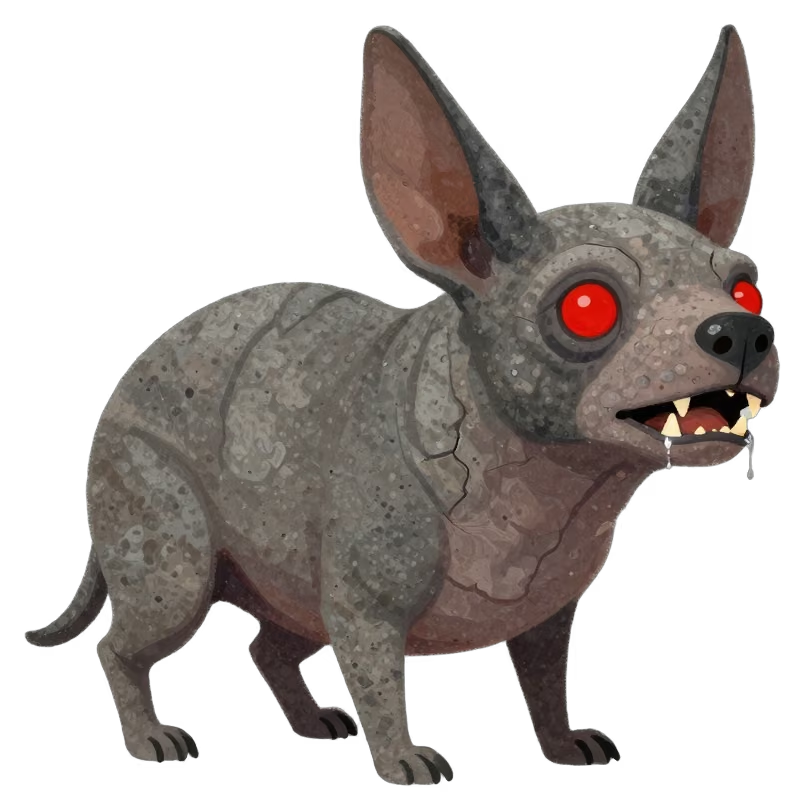
This creature looks like a grotesque, misshapen dog with no body hair and an irregular hide that appears as if made of granite. It has little beady red eyes, and a drooling, fang-lined jaw.
These hairless, dark creatures have an egg-shaped torso, small, slender limbs; large ears; beady red eyes; and a wide, drooling mouth filled with sharp, pointy teeth. They growl when approached and dart about nervously. If they scent fear in their foes, or if an opponent attempts to flee, they are driven to a hunting frenzy. They will only eat fresh meat, and any carcass more than two days old will be ignored after a brief smell.
Stone grolls form small packs in which a pecking order is quickly established. The leaders are usually the strongest and most intelligent members of the pack, and determine whether to attack a particular foe. They utilize scouts to investigate areas ahead of the roving pack, and the yelps from these scouts will draw the immediate response from any grolls in the area. Grolls typically dwell in caverns with large flat areas that are devoid of water.
Stone grolls can be tamed with some patience, although they are likely to revert to their wild ways given sufficient provocation. These creatures are all but inedible except to creatures that consume rock.
Combat
Stone grolls attack with a bite of their powerful jaws. They like to overwhelm smaller prey with their numbers by biting and dragging the victim to the ground. They will also climb up stone walls, surprising their prey by dropping on them from the ceiling. They rarely attack creatures larger than themselves unless present in overwhelming numbers.
Freeze (Ex): As a standard action a stone groll can curl up in a motionless ball, and hold itself so still that it looks like a natural rock. An observer must succeed on a DC 20 Spot check to notice the stone groll is really alive.
Water Vulnerability (Ex): Grolls are dealt 1d4 points of damage each round that they are drenched or immersed in water. They are unable to swim and immediately sink to the bottom of a body of water.
Skills: Stone groll receive a +4 racial bonus on Climb and Hide checks. *The Climb bonus increases to +8 when a stone groll is climbing a rock surface. A stone groll can always choose to take 10 on a Climb check of a rock surface, even if rushed or threatened.
Advanced Benefits
In addition to the standard changes due to Hit Dice advancement, stone groll also gain the following special benefits.
- 2+ HD ― Natural armor bonus improves to +5.
- 3+ HD ― Gain resistance to electricity 5.
Also in this section of the source
Swarm
Swarms are dense masses of Fine, Diminutive, or Tiny creatures that would not be particularly dangerous in small groups, but can be terrible foes when gathered in sufficient numbers. For game purposes a swarm is defined as a single creature with a space of 10 feet―gigantic hordes are actually composed of dozens of swarms in close proximity. A swarm has a single pool of Hit Dice and hit points, a single initiative modifier, a single speed, and a single Armor Class. It makes saving throws as a single creature.
Many different creatures can mass as swarms. The swarm’s type varies with the nature of the component creature (most are animals or vermin), but all swarms have the swarm subtype.
A swarm of Tiny creatures consists of 300 non-flying creatures or 1,000 flying creatures. A swarm of Diminutive creatures consists of 1,500 non-flying creatures or 5,000 flying creatures. A swarm of Fine creatures consists of 10,000 creatures, whether they are flying or not. Swarms of non-flying creatures include many more creatures than could normally fit in a 10-foot square based on their normal space, because creatures in a swarm are packed tightly together and generally crawl over each other and their prey when moving or attacking. Larger swarms are represented by multiples of single swarms. A large swarm is completely shapeable, though it usually remains contiguous.
Combat
In order to attack, a single swarm moves into opponents’ spaces, which provokes an attack of opportunity. It can occupy the same space as a creature of any size, since it crawls all over its prey, but remains a creature with a 10-foot space. Swarms never make attacks of opportunity, but they can provoke attacks of opportunity.
Unlike other creatures with a 10-foot space, a swarm is shapeable. It can occupy any four contiguous squares, and it can squeeze through any space large enough to contain one of its component creatures.
Vulnerabilities of Swarms
Swarms are extremely difficult to fight with physical attacks. However, they have a few special vulnerabilities, as follows:
- A lit torch swung as an improvised weapon deals 1d3 points of fire damage per hit.
- A weapon with a special ability such as flaming or frost deals its full energy damage with each hit, even if the weapon’s normal damage can’t affect the swarm.
- A lit lantern can be used as a thrown weapon, dealing 1d4 points of fire damage to all creatures in squares adjacent to where it breaks.