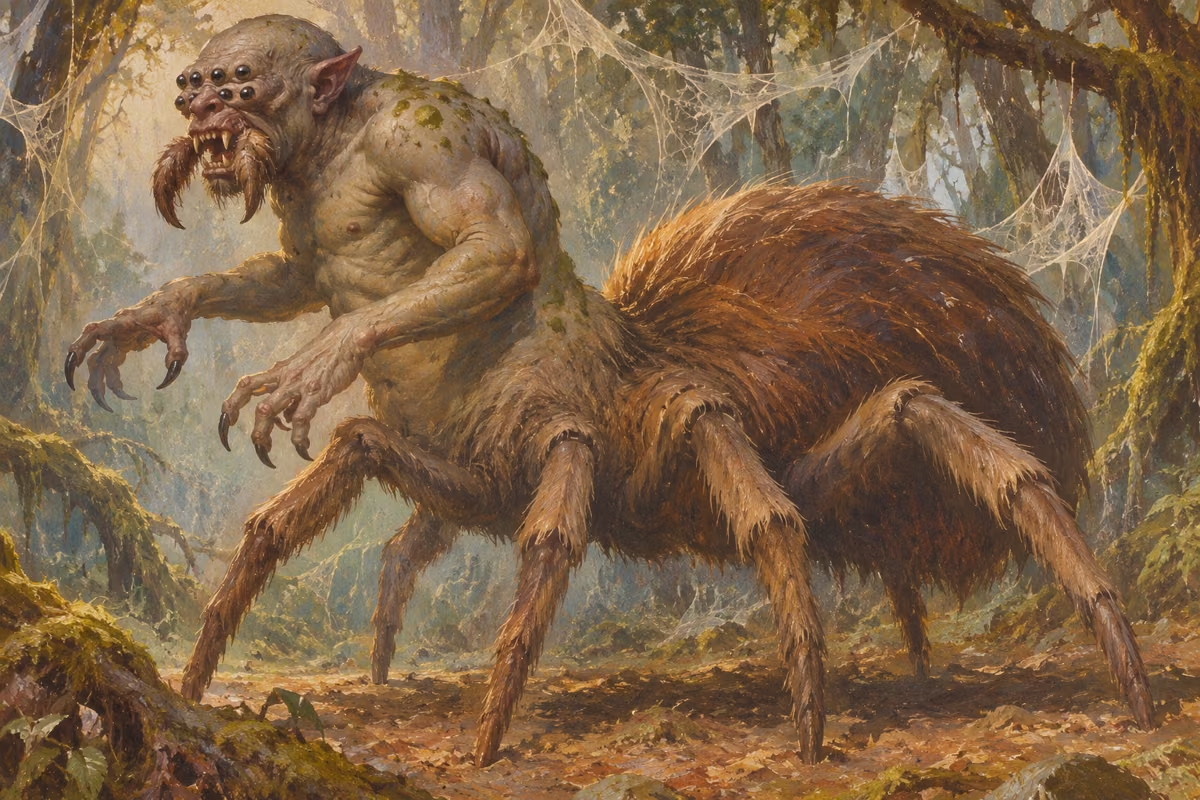
Ollorog, Half-Arachnid Troll
| Statistic | Value |
|---|---|
| Size/Type | Large Monstrous Humanoid |
| Hit Dice | 6d8+30 (57 hp) |
| Initiative | +3 |
| Speed | 30 ft. (6 squares), climb 20 ft. |
| Armor Class | 17 (-1 size, +3 Dex, +5 natural), touch 12, flat-footed 16 |
| Base Attack/Grapple | +6/+16 |
| Attack | Claw +11 melee (1d6+6) |
| Full Attack | 2 claws +11 melee (1d6+6); bite +6 melee (1d8+3 and paralysis) |
| Space/Reach | 10 ft./10 ft. |
| Special Attacks | Rend 2d6+6, cocoon |
| Special Qualities | Darkvision 90 ft., low-light vision, regeneration 5, scent |
| Saves | Fort +7, Ref +8, Will +7 |
| Abilities | Str 23, Dex 16, Con 21, Int 6, Wis 11, Cha 4 |
| Skills | Climb +12, Listen +5, Spot +8 |
| Feats | Alertness, Iron Will, Track |
| Environment | Cold mountains |
| Organization | Solitary, gang (2–4), or mob (6–11) |
| Challenge Rating | 6 |
| Treasure | Standard |
| Alignment | Usually chaotic evil |
| Advancement | By character class |
| Level Adjustment | +6 |
Description
These ugly creatures are an unnatural blend of a large, monstrous spider and a troll. They normally reside in remote, mountainous areas, but during their mating season they will often rove about as packs in the lowlands.
Ollorogs have the head, arms, and upper torso of a troll, and the body and six legs of a giant spider. On their face are the eight dark eyes of a spider, and they have a fanged mouth surrounded by twitching, hairy mandibles. Their flesh is a mottled light gray hue with a splash of darker green spots down their back and across the abdomen. Ollorogs are slightly shorter than normal trolls, but occupy a 10 ft. diameter area due to their six legs.
All ollorog have a ravenous appetite and are constantly on the hunt for food during the night hours. Because of their limited intellect, they can be easily distracted by some food left behind by fleeing prey.
Combat
Ollorogs prey on any and all creatures, attacking as a swarming group and using their paralyzing bite to subdue foes. They fight primarily with their front claws and a fanged mouth. They can wrap victims in a silk cocoon that is tough enough to hold all but the most powerful foes.
Rend (Ex): If an ollorog hits with both claw attacks, it latches onto the opponent's body and tears the flesh. This automatically deals an additional 2d6+9 points of damage.
Regeneration (Ex): Fire and acid deal normal damage to an ollorog. If an ollorog loses a limb or body part, the lost portion regrows in 3d6 minutes. Severed members can not be reattached by holding it to the stump.
Paralysis (Ex): Those bitten by an ollorog must succeed at a DC 18 Fortitude save or be paralyzed by a toxin for 1d6+2 minutes.
Cocoon (Ex): When the victim is paralyzed, an ollorog can wrap it in a silk cocoon. Wrapping a paralyzed victim requires a full minute of activity. Once the paralysis wears off, the victim can escape the cocoon with a successful DC 18 Escape Artist check or burst it with a DC 20 Strength check. Both are standard actions.
Ollorog Society
Ollorogs prefer to dwell in the mountainous heights or in the darkness of the subterranean depths. Ordinarily the males travel in small groups of two to four. During their infrequent mating season, however, they will wander the lowlands in larger groups while traversing across to distant mountain habitats. These ollorog males rove the lands in swarming mobs, ravishing the lowlands for any form of prey.
Female ollorog typically form sizable packs with the eldest female serving as their leader. These packs will drive away any males unless they are required for mating purposes. Eligible males battle amongst themselves to determine the dominant male, and the winner mates with the entire pack. Due to their regenerative abilities, these battles can be long, drawn out affairs. But sooner or later each of the males will acknowledge one as superior.
As ollorog are outcasts from their ancestral deities, they worship no god. Instead they follow a form of ancestor worship, a religious belief that provides no shamanistic magical benefits, but does provide some degree of cultural identity.
Creating a Half-Arachnid
"Half-Arachnid" is an inherited template that can be added to any fey, giant, or humanoid creature (hereafter referred to as the base creature).
It uses all of the base creature’s statistics and special abilities except as noted here.
Size and Type: The creature's type changes to monstrous humanoid, and it gains the traits of that creature type. It retains any subtype except those that indicate kind. Size is unchanged.
Hit Dice: Change the dice type to d8. Do not change class HD.
Speed: Tiny or smaller half-arachnids have speed 20 ft. (4 squares) and climb 10 ft. All other half-arachnids have speed 30 ft. (6 squares) and climb 20 ft.
Armor Class: Natural armor is +1 for size medium creatures; +2 for large; +5 for huge; +10 for gargantuan, and +18 for colossal creatures. Use the natural armor rating of the base creature if it is higher. Creatures of size Small or smaller do not receive a natural armor from this template.
Attack: A half-arachnid gains a bite attack. It retains the primary attack method of the base creature.
Full Attack: A half-arachnid uses the normal attack of the base creature. It gains a bite attack that becomes a natural secondary attack, or the primary attack if there is no weapon or other natural attack.
Damage: If the base creature does not have a bite attack, use the damage value in the table below. Otherwise use the value below or the base creature's bite damage value, whichever is greater.
| Size | Bite Damage |
|---|---|
| Diminutive | 1 |
| Fine | 1d2 |
| Tiny | 1d3 |
| Small | 1d4 |
| Medium | 1d6 |
| Large | 1d8 |
| Huge | 2d6 |
| Gargantuan | 2d8 |
| Colossal | 4d6 |
Special Attacks: A half-arachnid retains all the creature’s special attacks and also gains a paralyzing ability.
Paralyze (Ex): Those bitten must succeed at a Fortitude save or be paralyzed by a toxin for 1d6+2 minutes. The save DC is Constitution-based.
Cocoon (Ex): Due to their merged form, the web silk is insufficiently strong to support the weight of the creature. Instead, when the victim is paralyzed, it is wrapped in a silk cocoon. Wrapping a paralyzed victim requires a full minute of activity.
Once the paralysis wears off, the victim can escape the cocoon with a successful Escape Artist check or burst it with a Strength check. Both are standard actions. The check DCs are Constitution-based, and the Strength check DC includes a +2 racial bonus.
Special Qualities: In addition to the special qualities of the base creature, it gains tremorsense.
Tremorsense (Ex): A half-arachnid can detect and pinpoint any creature or object within 60 feet in contact with the ground.
Skills: A half-arachnid have a +2 bonus to Spot checks and a +6 racial bonus on Climb checks. Use either Strength or Dexterity for climb checks, whichever is higher.
Abilities: Adjust from the base creature as follows: Dex +2, Con -2, Wis +2, Cha -4.
Challenge Rating: Same as the base creature +1 (minimum 2).
Level Adjustment: Same as the base creature +1.
Also in this section of the source
Half-Incarnate
Author: Robert J. Hall.
The magical nature of incarnates allow them to crossbreed with virtually any creature. Half-incarnates, the offspring of the resulting unions, are perfectly harmonized blends of the two creature's traits. When incarnate beings from the neutral-aligned planes travel to the mortal realms they occasionally become attracted to particularly representative mortals: whether human or ogre, elf or goblin.
The representatives of the neutral planes can appear in a great variety of forms, some of which mortals can find attractive despite their somewhat bestial appearance. Those whom the incarnate find appealing are always neutral and intelligent. The course of the pairing always follows the path that nature intended for their species, whether a brief coupling or a lifetime of caring union.
Whatever the form, a half-incarnate has the pristine, untainted appearance of a natural origin, rather than an abnormal creation of magic. They have certain odd, beastly features that are out of place for a base creature of their kind, but these are healthy additions, and form an elegant, flowing harmony with the whole.
The half-incarnate is the very essence of a primordial, balanced, natural being, and takes an instant dislike of extreme views and unnatural imbalances. They usually find civilized society uncomfortable and often seek an itinerant life of natural solitude, while striving to maintain proper balance in the world.
Sample Half-Incarnate
This is a powerful humanoid that stands 7 feet in height. It has a mottled, pale-green flesh, with a stand of spines across its scalp. The mouth is wide and fang-lined, and it has a stubby nose. A pair of slits resembling gills run down the front of its chest.
This example uses a bugbear as the base creature.