Ginkgosa, Carnivorous
| Statistic | Value |
|---|---|
| Size/Type | Huge Plant |
| Hit Dice | 8d8+32 (50 hp) |
| Initiative | +1 |
| Speed | ― |
| Armor Class | 18 (-2 size, +1 Dex, +9 natural), touch 9, flat-footed 17 |
| Base Attack/Grapple | +6/+21 |
| Attack | Tentacle +12 melee (1d6+7) |
| Full Attack | 9 tentacles +12 melee (1d6+7) |
| Space/Reach | 15 ft./15 ft. (20 ft. with tentacles) |
| Special Attacks | Improved grab, constrict 1d6+7 |
| Special Qualities | Damage reduction 5/slashing, detect magic, blindsight 40 ft., limited spell resistance 18, plant traits, vulnerability to fire |
| Saves | Fort +10, Ref +3, Will +2 |
| Abilities | Str 24, Dex 12, Con 19, Int 1, Wis 11, Cha 1 |
| Skills | Listen +11 |
| Feats | Diehard, Endurance, Weapon Focus (tentacle) |
| Environment | Underground |
| Organization | Solitary |
| Challenge Rating | 6 |
| Treasure | Double standard |
| Alignment | Always neutral |
| Advancement | 9–15 HD (Huge); 16–21 HD (Gargantuan); 22–30 HD (Colossal) |
| Level Adjustment | ― |
Description
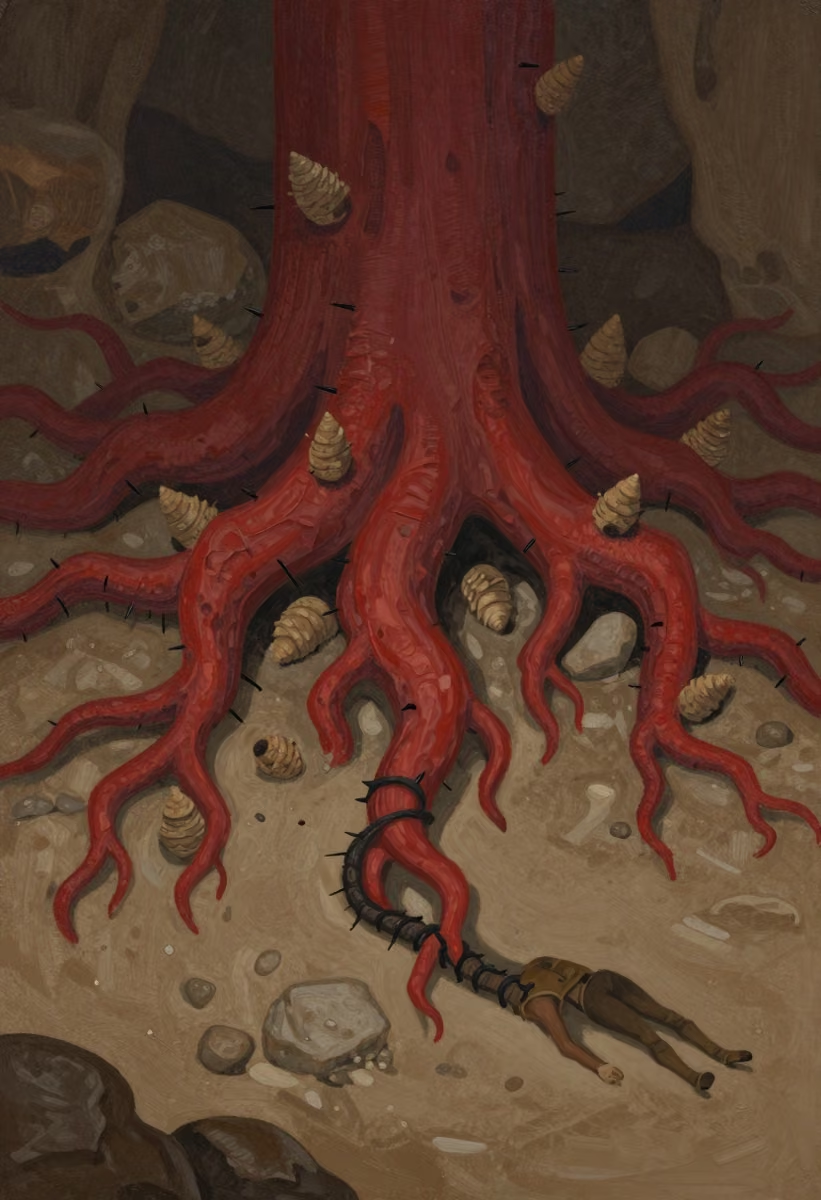
A hardy, leaf-less plant with deep red-hued bark has grown and spread into an extensive mass that resembles a giant root system. Many of the thicker branches sprout pale brown cones that are partly enclosed in a basket shell.
The ginkgosa is a vine-like species that has evolved for dwelling underground. The ginkgosa draws all of its energy directly from its pale, bulb-like appendages. These bulbs draw magical energy out of the environment and convert it into nutrition for the plant. The ginkgosa has no need for leaves, but it does grow an extensive network of tough roots and limbs that seek out sources of the minerals it requires. Most of these sources can be found in the surrounding rock, but one variety of ginkgosa has become carnivorous and partially animated in order to capture the required nutrients and sources of magic.
There are several varieties of ginkgosa to be found, but all resemble the branching roots of an old tree. The limbs vary in thickness from slender growths up to branches as thick as a human thigh. They are covered by a tough, red bark that can be difficult to cut. In addition, the limbs are covered in long black thorns that make them unpleasant to grasp without thick gloves.
Here and there the odd, magical bulbs of this plant will appear, while their small, budding seeds can be found erupting from a multitude of locations. The magical bulbs resemble the closed flower heads of artichokes, although they are pale brown in hue and partly enclosed in a hard shell basket.
The ginkgosa can grow in a variety of different conditions underground, emerging out of narrow cracks and resiliently clinging to virtually any stone surface. In some places the plant can smother entire walls in their strong, spiny branches, while in neighboring passages only a few wilted limbs might appear.
The plant propagates itself by growing many small seeds that ripen to form a bland but edible nut. Once ripe the dark brown nut can be consumed and it will provide a modicum of nutrition to the consumer. However the hard, inner seeds can cause a digestive disorder very similar to diarrhea. As a result the creature will quickly pass the seed through the system and deposits it in a new location. If culled when they first sprout, the young ginkgosa bulbs can also serve as an ingredient in several alchemical formulas, as well as medicinal herbs.
Combat
The carnivorous ginkgosa lies in wait patiently until it senses a source of magic within reach. It then strikes out with its powerful tendrils to grab the target and draw it toward the body. The victim is then constricted by the limbs until life is snuffed out. The plant slowly grows its body around a source of magic until it is completely buried. Those seeking magical treasures captured by a carnivorous ginkgosa will need to chop away at the dense layers of bark and wood surrounding the core.
An opponent can attack a ginkgosa's tentacles with a sunder attack as if they were weapons. Each carnivorous ginkgosa's tentacles has 10 hit points. If the tentacle is currently grabbing an opponent, the ginkgosa takes a -4 penalty on its opposed attack roll to resist the sunder attempt.
If a carnivorous ginkgosa is currently grappling a target with the tentacle that is being attacked, it usually uses another limb to make its attack of opportunity against the opponent making the sunder attack. The carnivorous ginkgosa regrows severed tentacles in 2d10 days.
Constrict (Ex): A carnivorous ginkgosa deals 1d6+7 points of damage with a successful grapple check.
Improved Grab (Ex): To use this ability, a carnivorous ginkgosa must hit with its tentacle attack. It can then attempt to start a grapple as a free action without provoking an attack of opportunity. If it wins the grapple check, it establishes a hold and can constrict.
Detect Magic (Ex): A carnivorous ginkgosa can detect magic as the spell (caster level 8th) at will as a free action.
Limited Spell Resistance (Ex): A carnivorous ginkgosa has spell resistance equal to its Hit Dice + 10 (maximum 25). However it does not have spell resistance against spells that are from the plant domain or specifically target plants.
Poisonous Bulbs (Ex): Ingested, Fortitude DC 14, initial and secondary damage 1d2 Con. The save DC is Constitution-based with a -4 modifier. On a successful save, a creature is no longer poisoned by ingesting the bulbs. The poison can be neutralized by cooking the bulbs properly.