Druther
| Statistic | Value |
|---|---|
| Size/Type | Medium Construct |
| Hit Dice | 9d10+20 (69 hp) |
| Initiative | -1 |
| Speed | 20 ft. (4 squares) |
| Armor Class | 17 (-1 Dex, +8 natural), touch 9, flat-footed 17 |
| Base Attack/Grapple | +6/+11 |
| Attack | Slam +11 melee (2d6+5) |
| Full Attack | 2 slams +11 melee (2d6+5) |
| Space/Reach | 5 ft./5 ft. |
| Special Attacks | ― |
| Special Qualities | Construct traits, damage reduction 10/magic, darkvision 60 ft., low-light vision, immunities, fire vulnerability |
| Saves | Fort +3, Ref +2, Will +3 |
| Abilities | Str 20, Dex 9, Con ―, Int ―, Wis 11, Cha 3 |
| Skills | ― |
| Feats | ― |
| Environment | Any |
| Organization | Solitary |
| Challenge Rating | 6 |
| Treasure | None |
| Alignment | Always neutral |
| Advancement | 10–15 (Large); 15–20 (Huge) |
| Level Adjustment | ― |
Description
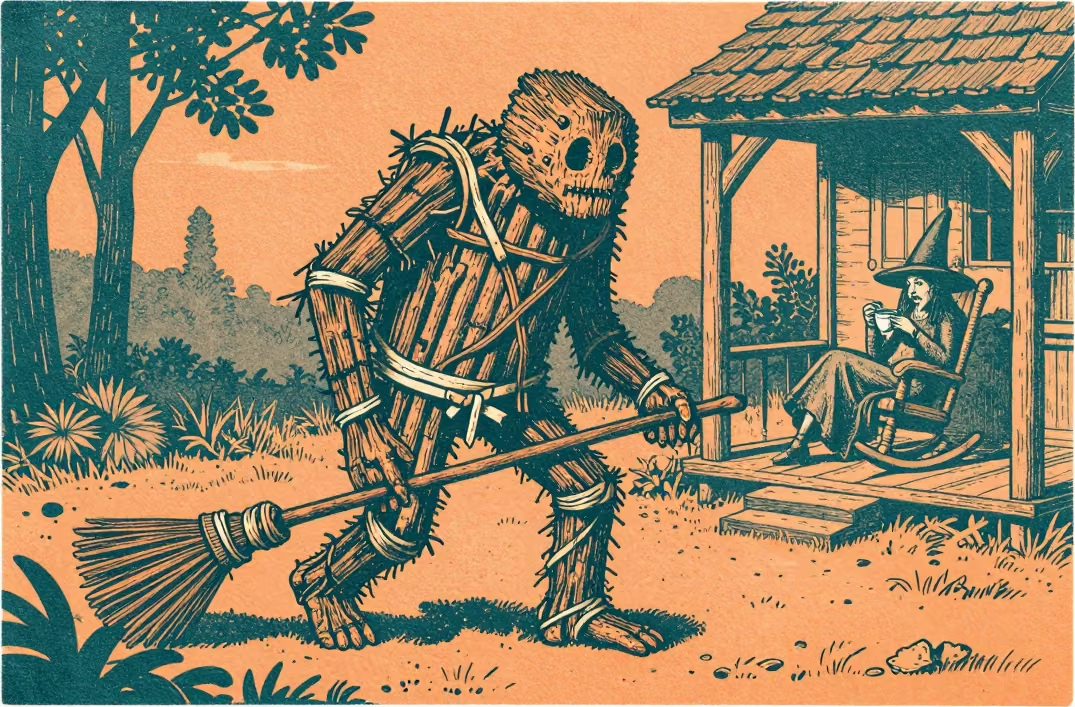
This bulky stick figure is formed from various pieces of wood bundled together with strips of bark, vine, and other fibrous materials. It moves under its own power, making various creaking sounds as the joints bend and stretch.
A Druther is a type of weaker wood golem that can only be created by a witch. The name comes from an old piece of doggerel often muttered by witches,
"If I really had my druthers,
I'd have my wooden druthers too."
A wooden druther is a corrupt form of "wouldn't I'd rathers", or something the witch doesn't want. So the wooden druther performs tasks that the witch would rather not do herself. The druther can understand simple command phrases of about 15 words each. Typically druthers are used for menial labor or to perform a task that the witch can not do or won't do herself, like killing or scaring an enemy. Often a witch will have a few druthers protecting her home while disguised as trees, requiring a DC 25 Spot check to notice.
A druther cannot communicate at all. Some witches have used woody reeds in the construction of their druthers. When the wind blows across the druther it sounds like a deep bassoon.
Druthers can appear in any form. Usually they are biped and always made of wood. The wood can be carved or a collection of sticks tied together. The appendages need to be attached separately if the druther is to move at all. They can be precisely carved to appear as anything the witch wants, but they typically look like walking bunches of sticks.
Legend has it that there was a witch that had such beautifully carved druthers that they were often mistaken for wood nymphs.
Treants, dryads, and wood nymphs view a druther in the same manner a human views the undead or a flesh golem. Most will attempt to destroy them when they can. Some witches and wizards value the wood from an inanimate druther to use to make magical fires.
Sometimes druthers are referred to as "Drudges", mostly due to their ability to menial work, usually around the home. While a druther may be used to do the witch's dirty work, a drudge will do the witch's dirty laundry. Adventurers have reported of a witch with intricately carved wood drudges as her household staff. A drudge butler was so well made that they could not tell it was a magical construct at all.
The druther has a great tie to its animating elemental force. But sometimes the druther will break free of the witch's control, but not of its wooden body. These druthers are known as rogues and take out their frustration the only way know, to throw themselves into any combative situation it can.
Combat
A druther is mindless in combat. It instinctively strikes with its wooden fists with almost no regard to what else is going on.
Immunities: A druther is immune to cold and water. Piercing weapons only do 1 point of damage per hit.
Construction
Witches can construct a druther. If the witch has access to a manual of druthers, then she can create a druther from that work. Otherwise a witch may opt to create one from scratch. The witch will need at least 200 pounds of wood, either as sticks, planks or individually carved pieces. She must gather these herself. The witch will need her consecrated witch tools and fine incense. After creating the body for the druther, the witch will have to cast spells, then sprinkle the ashes from the burned incense on the wood.
CL 10th; Craft Construct, air walk, bless growth, feral spirit, lesser strengthening rite, minor creation, caster must be at least 10th level; Price 3,600 gp; Cost 2,000 gp + 1,000 XP.
Also in this section of the source
Elder Spirits
Author: Robert J. Hall.
An elder spirit is a divine being that is periodically reborn as a member of the fey. Only by assuming the form of a fey creature can these beings serve the needs for which they are created, and the rebirth of a spirit is always a significant event in the fey realms. They are always reborn into a physical form and their spirit can never be utterly destroyed, regardless of their total age, physical appearance, or the manner of their death.
Each elder spirit represents some particular aspect of nature or the world at large, such as ocean waves, a river, paths, structures, and so forth. But there are likely to be several such spirits for each major aspect of nature. The associations of elder spirits interact with one another, sometimes cooperating and at other times clashing. Stable alliance of spirits often serve specific divine powers that the fey worship as deities.
There are literally thousands of elder spirits among the fey, and few if any of these spirits are truly predominant over the others. Instead most of the elder spirits are more often closely linked to a certain geographic region. Such elder spirits can be found in locations such as a sacred grove or spring, or close to a prominent terrain feature such as a mountain river. These elder spirits can be sought out in person so as to plead for their personal aid. Whether it is granted or not will depend a great deal on the nature of the elder spirit, the personality of the form that they inhabit, and the type of aid needed.
The appearance of an elder spirit is very similar to that of the creature from which it was formed, yet it is also distinctly different. Humanoid elder spirits display animalistic features on their body, and are powerfully built. Non-humanoid elder spirits have a number of faintly humanoid traits, particularly about the facial area. The face of an elder spirit is much more expressive than most wild creatures.
Sample Elder Spirit
This example uses a 12 HD dire wolf as the base creature.