Genie, Voyager
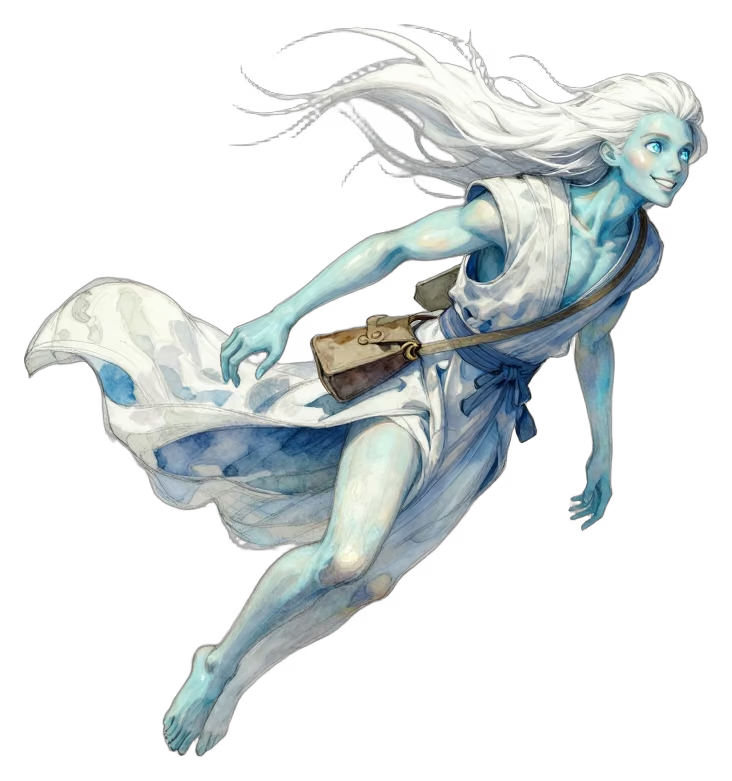
| Statistic | Value |
|---|---|
| Climate/Terrain | Any |
| Movement | 24, Fl 64 (A) |
| Frequency | Very rare |
| HD | 6 |
| Organization | Khanate |
| THAC0 | 15 |
| Activity Cycle | Any |
| No. Attacks | 1 |
| Diet | Omnivore |
| Damage/Attack | d8 or by weapon |
| Intelligence | Normal(10-12) |
| Special Attacks | See below |
| Treasure | U |
| Special Defense | See below |
| Alignment | N (tends to CG / NG) |
| Magic Resistance | Nil |
| No. Appearing | 1-2 |
| Size | L (9' tall) |
| AC | 2 |
| Morale | Average(8-10) |
Description
Voyager genies once were djinns. They are believed to be some cross-breed between unknown flying creatures and messenger genies. Originally, they have served princes and sheikhs for official purpose. Now they serve all persons willing to travel or to exchange informations about foreign habits and weird customs. During their endless journeys, they have developed some features allowing them to travel faster and easier. They can walk and fly at high speed and their moves are not hindered by the terrain type. They walk as fast in the thickest jungle as if he was walking on a well-paved road. Only magical means, to which they have no particular resistance, can slow them and lower their movement rate. Their skin is pale blue, and it might appear translucent sometimes. They have white hair, pale blue eyes and nails. As they tend to dress in blue and white when traveling, they are not easily seen by land travelers (75% of not seeing them).
Combat
For the above mentioned reasons, land-based attacks incur a -4 to hit. When avoiding magical land-based attacks taking a physical shape (cone, beam, ...), they are allowed a saving throw even if none applies normally, and save at +2 if a saving throw is permitted. These features only apply if the genie is flying at normal speed and if the attacks are land-based. They will always avoid direct combat, except if a fellow genie is concerned. In such case they first make full use of their magical abilities. Then, they attack gaining a -2 to their initiative roll due to their high speed. They always try to remain in the air as long as possible. The voyager genies also have the following spell-like abilities, each as if they were 11th level. They cast the following at will: Alter Normal Winds, Gust of Wind, Ride the Wind*, Murdock's Feather Flyer*, Tenser's Floating Disk, Traceless Travel, Wind Compass. Once per day, they have the possibility to cast: Aura of Comfort, Leomund's Tiny Hut, Teleport. And once per week they can cast Control Weather and Leomund's Secure Shelter. ( * = TOM spells)
Habitat/Society
Curious, open-minded, generally friendly, polite and handsome, with a strong taste for endless talks, they roamed the Lands of Fate for centuries, meeting people, asking about their habits, customs and way of life. As such they are a source of quasi infinite knowledge, but they seldom share it. They tend to respect the etiquette, though they prefer meeting common people than kings. They dress very simply, and have many of different clothes with them so that they can always appear as if they were from the neighborhood. This is not, in their mind, intended to con people but to make them feel comfortable when dealing with the genies. They are a bit naive and can be fooled easily. In such cases, they do not learn fast and may rarely seek vengeance. In such case, it is only aimed at the person who tricked them. They do so in refined ways, making use of the knowledge they have acquired.
Ecology
Voyager genies can often be trapped in genie prisons, because of their naive nature. They are then more than happy to get freed and often grant a wish that must take the form of a particular journey (remember this is just a one-way ticket). A well-known voyager genie prison is Abdol's Wine Jug. This is an item used normally to store wine, it is enchanted but does not radiate magic. It contains a couple of voyager genies 25% of the time. The jug is difficult to discern from a normal wine jug. The only difference is the presence of small holes near the top. They indicate the number of free journeys that the genie will grant. Sometimes, though, if well-paid the genie might wish to transport some adventurers for jewels, pearls, or art items. No dinars are accepted (no cheques and no credit cards too). A limited number of Abdol's Wine Jugs are still in use in Zakhara.
Though it has been said that originally voyager genies were djinns, it has been held by some sha'irs that djinns are voyager genies who are compelled to travel through the air. Some daos and marids have been perverted in the same way and have become voyager genies too, but only through their very element. It has never been proved that some efreetis have become voyager genies too. Some would say they are not handsome enough ...
Also in this section of the source
Cann (Genie of the Plane of Ice)
| Statistic | Value |
|---|---|
| Climate | Ice |
| HD | 9+2 |
| Frequency | very rare |
| THAC0 | 9 |
| Organization | Khanate |
| No. Attacks | 1 |
| Activity Cycle | day |
| Damage/Attack | 4d5 |
| Diet | Omnivore |
| Special Attacks | See below |
| Intelligence | high to genius (13-18) |
| Special Defenses | See below |
| Treasure | Nil |
| Magic Resistance | Nil |
| Alignment | N |
| Size | L (12' tall) |
| No. Appearing | 1 |
| Morale | Champion (15-16) |
| AC | 2 |
| XP Value | 9,000 |
| Movement | 9, fl 20 A, Sw 18 |
The Cann (plural Canni) are the genies of the Plane of Ice. They are pure white with blue veins showing through. They have silver eyes and no hair.
Combat
Canni perform as 22nd level spell casters. They can call forth a Cone of Cold twice per day. They can Detect Alignment, Magic, and Create Illusions at will. They are capable of producing 100 gallons of near-frozen water every day. They can Walk on Water at will, and may call forth a powerful snow storm once per week.
They can carry up to 800 pounds with little to no effort on foot or flying. Double or more wait causes them to tire.
Habitat/Society
The Khan of the Canni makes tight and restrictive rules, but rarely cares whether or not they are followed. When the Khan dies or is killed somehow the throne often goes empty for years before some one claims it, no one really cares.
Canni is lounge around the Great Ice Palace trying not to do too much. One of the more respected Canni has not moved more than three inches in a decade. The only thing they really care about is invaders, which they will all defend against.
Ecology
Canni tolerate anything and everything as long as it does not make too much of a stir. They do not regard anything as equal, superior, or lesser to themselves. They are rarely summoned because it is hard to motivate them.
3.4 Klingons in Al-Qadim
By Samuel P Cattle
I've never liked orcs, and so when I started my current Al-Qadim campaign, I globally replace all orcs with Klingons. Generally, I have them as Bedouin sheiks and nomadic horse- and camel-riding types. Culturally, it's worked out very nicely. I've always suspected that Roddenberry's Klingons were some sort of weird caricature of a 1960's American stereotype of Middle-Eastern cultures, anyway.
The first place I looked for info was The AD&D Guide to Star Trek, but with T$R's prohibitions, that probably doesn't exist anywhere on the net anymore. At any rate, it gave Klingon stat modifiers as STR:+3 CHA:-1. I thought this was a little exaggerated, so I went with STR:+1 CON:+1 WIS:-1 CHA:-1. The Guide also gives a lot of cultural information (email me, I might still have it somewhere) on Klingons (being the type seen in the movies and since, not ST:TOS). The information is a conglomeration of information from the old Starfleet Officer's Manual and observations from movies and Next Gen. episodes. There was also a lot of info on other races, stats for characters on the first three series, and info of phasers, as well as a strange D&D/ST:TOS/ST:TNG adventure with the Borg.
At any rate, the main Klingon character in my campaign is a PC named Ha'DIbaH (I forget what that translates to in English...look it up in a good Klingon dictionary). He's the son of a nomadic sheik, and uses the Desert Rider kit, his tribe's main form of commerce being trading in fine Arabian horses.
As for weapons, of course, his weapon of choice is the betleh handed down to him from his father's father, but he also fights with a pair of taj, florentine style. I don't know if anyone else has ever done this, but I ruled that since the betleh (Worf's huge sword/scythe blade) is such a complicated and versatile weapon, that I give him a number of options with it in combat. We play with proficiencies, single specialization, and weapon speeds, so I required specialization (two proficiencies) in betleh to avoid any penalties, and that gave him access to only the downswipe hack (used by Worf to slay Duras) with a speed of 9 and a damage of 2d8/4d4. One other benefit from the betleh is that it is a natural parrying weapon, so I rule it counts as a shield in melee combat. A third proficiency spent on betleh gives Ha'DIbaH access to both slashing and jabbing attacks, at speed of 5 with damage of 1d8/1d6 and speed of 3 with damage of 1d4/1d4, respectively. The taj has a speed of 2 with damage of 1d4/1d4.
How this works in combat is that the warrior with his betleh at the ready has until his initiative number to decide how he will attack, whether he needs speed over damage, and allows a little more role-playing flavor. I suppose it would be appropriate to remove the AC bonus when in the process of making a downswipe hack, as the warrior is busy with the windup for the attack until 9 segments later.
Well, that's how I integrated Klingons into my campaign, and it has been rather successful, giving a nice bit of distinction to my campaign, and providing much more fun than standard orcs!
3.5 Shajarran, Greater
By Bernard Delhausse / CREPP
| Statistic | Value |
|---|---|
| Climate/Terrain | Tropical/Jungle |
| Movement | 9, Sw 9 |
| Frequency | Very rare |
| HD | 9+ (3-12) |
| Organization | Solitary |
| THAC0 | As fighter of the same level |
| Activity Cycle | Any |
| No. Attacks | 1 or 2 |
| Diet | Herbivore |
| Damage/Attack | by weapon +8 or 2d8/2d8 |
| Intelligence | Very to high (11-16) |
| Special Attacks | See below |
| Treasure | A |
| Special Defense | See below |
| Alignment | CN (tends towards CE) |
| Magic Resistance | 25 % |
| No. Appearing | 1-2 |
| Size | M (6' tall) or L (12' tall) |
| AC | 0 |
| Morale | Fearless (20) |
Shajarrans are followers of Shajar, the forgotten hippopotamus god. Few followers still exist in the jungle, far above Dihliz, near the Doors of Shajar. They tend to gather in places where deep rivers can be found, so that they can swim in animal form. In some locations, huge stone buildings and walls used to keep large and deep pools of water. These were very special sites, where initiation rites were taking place. Most of the time, the walls have collapsed, but it is said that some sacred places still remain untouched by decay. Shajarrans do not venture outside their sacred grounds, few have been seen or have been reported as, though they are herbivorous, they are fierceful creatures when it comes to protect their site. Uninitiated persons entering the pool and its neighborhood must die. Due to this secluded life, only an old form of Midani is spoken (and even with a 25% chance for every 10 shajarrans) by shajarrans. Speaking with a shajarran, if possible, requires an Ancient Language roll, or magical means.
It is quite unclear how a greater shajarran comes to life. Some say lesser shajarran are granted this honor, others consider that through particular rituals, a man and an animal fusion to make only one being. Other explanations have been stated like the fact that these greater shajarrans were in fact animals changed into humans and not the contrary. The reports available in the Mosque of Zann in Dihliz do not signal any difference between real hippopotamus and greater shajarrans. All those explanations share one element: the pool. The transformation is linked to the water pool. If destroyed, no greater shajarrans can come to life anymore.
Like many other followers of the forgotten gods, shajarrans can Shapechange at will (taking one full round) from human to animal form, or vice versa. It is nevertheless believed that their animal form is the most frequently assumed, to be able to stay in the water.
Combat
Another reason why they favor water is that they are less vulnerable in the holy pool. They regenerate 1 hp/turn while in it and save all attacks with a +2 bonus. Furthermore, water-based attacks cannot harm them. If out of the water, but still on sacred ground, they do not regenerate anymore and save all attacks, including water-based, at +1. They fight as fighters of the same level (10th to 13th), using a weapon while in human form or their fists in animal form, and cast spells as clerics of the same level. They are limited to the following spheres in which they have major access: Animal, Divination, Elemental (Water), Guardian, Healing, Plant and Weather. All other spheres are forbidden. Note that they cannot cast 7th level spells due to their level. Even if, by very powerful means, they were able to become 14th level priest, they would not be allowed to pray for 7th level spells. Due to their great resistance to pain, they fight for 2 rounds when their hit points are between 0 and -10. They enter in a comatose sleep at this moment, and regeneration brings them back to life. If taken out of the pool, the regeneration stops and they slowly decay. If their hps fall under -10 hps, they die instantly. At this point regeneration has no effect.
Habitat/Society
Only male can become a priest of Shajar. Centuries ago, they were enjoying a much more comfortable position in the society than followers from other gods, perceived as more cruel. Nevertheless, shajarrans have proved to be merciless too. Some shrines have no entrance except by the pool. These are the most sacred temples devoted to Shajar. Usually they are protected by glyphs and other sorts of protective devices, so that a number of such unvisited temples has been reported since expeditions are launched from Dihliz. Smaller, less important, shrines, involving only two levels and a few rooms, are open to visitors (peasants, pilgrims, etc.) and thus can be accessed by the ground.
Ecology
Greater shajarrans can mate with hippopotamus when in animal form. This union is not sterile as some have believed. 50% of the time, the result is a normal hippopotamus; 35% of the time, a lesser shajarran comes, and the last 15% indicate a strange creature, usually female, mixing human and animal features with some magical abilities. This is, to some extent, equivalent to the Yuan-ti. As this creature is female, it is abandoned rather than killed. It is highly unlikely that many have survived in the jungle. If the pool is destroyed, a greater shajarran goes berserk for one full turn and then dies, or his brain crushes, losing all memories of Shajar. In the latter case, the greater shajarran becomes a true hippopotamus.
3.6 Shajarran, Lesser
By Bernard Delhausse / CREPP
| Statistic | Value |
|---|---|
| Climate/Terrain | Tropical/Jungle |
| Movement | 9 |
| Frequency | Very rare |
| HD | 6+4 |
| Organization | Cadres |
| THAC0 | 13 |
| Activity Cycle | Any |
| No. Attacks | 1 or 2 |
| Diet | Herbivore |
| Damage/Attack | by weapon +3 or 2d6/2d6 |
| Intelligence | Average (8-10) |
| Special Attacks | See below |
| Treasure | Nil |
| Special Defense | See below |
| Alignment | Neutral (tends to CN) |
| Magic Resistance | 10% |
| No. Appearing | 2-16 |
| Size | L (6' tall, but heavy) |
| AC | 4 |
| Morale | Fearless (20) or Elite (14) |
Shajarran, or hippopotaman, appear to be a cross-breed between human and hippopotamus. Like the Forgotten God Shajar that they still worship in the depths of the Ruined Kingdom jungle, they have a human body, though more massive than its human counterpart with heavy legs and arms, and an hippopotamus head. Their feet are more animal than human, too Originally, the hippopotamen are either human, or hippopotamus. Chosen by high priests at birth, they are breeded in a particular way, in the faith of Shajar, thereby undergoing major physical change. Most of them do not speak Midani (75%), they only speak a difficult watery dialect. No human has ever been reported to have learned it.
Combat
As they have undergone major physical changes, some hippopotamen have not the ability to handle weapons, only 25% of them are still able to use normal weapon. Due to their strength, they have a reduced THAC0 and gain + 3 to damage. The other hippopotamen use both fists to strike the opponent. They have 10% magic resistance while in the immediate surroundings of Shajar temples. Due to their sturdy nature and heavy complexion, they make their saving throws against mental spells (ESP, illusions, ...) with a +2 bonus, but have a malus of -2 when making saving throws against directed attacks (beams, rays, breath, ...).
Habitat/Society
As for segarrans, the hippopotamen are no longer able to transform into pure humans. This implies that they have some difficulties in traveling far from their cult sites. As they are not forced to feed on raw flesh, this does not pose any problem. Most of the time, the greatest activity is held at night or during the last hours of the day, during which they have ritual baths and feed on river plants. The cult sites are located near water, they favor deep rivers. They defend their shrines with the utmost ardor. In such places their morale checks never fail (20), otherwise, when they are far from their shrine, their morale is reduced though quite high (14). 10% of lesser shajarrans have been granted an access to 1st level priest spells from the healing, plant, elemental and weather spheres.
Ecology
All shajarrans are herbivores. This does not mean they are peaceful if threatened. Enemies, i.e. each intruder entering the shrine zone, are killed properly and their death are dedicated to Shajar. The more they kill enemies, the sooner they will be able to reach a higher status, and the better the place at Shajar's feast after death. When they die, they return to their original form. Not much is known about hippopotamen but it is believed that each lesser shajarran has only one cult site, to which he holds all his life. If the site is destroyed or desacralised, the shajarran dies.
3.7 Werepanthers - Disciples of Kiga
By Bernard Delhausse / CREPP
| Statistic | Value |
|---|---|
| Climate/Terrain | Tropical/Jungle |
| Movement | 18, Jump 9 |
| Frequency | Very rare |
| HD | adult 6+4, young 4+2 |
| Organization | Family |
| THAC0 | adult 14, young 16 |
| Activity Cycle | Night |
| No. Attacks | 3 (5) |
| Diet | Carnivore |
| Damage/Attack | d4+1/d4+1/2d4 |
| Intelligence | High (13-14) |
| Special Attacks | Leap, rear claws (2-5), hit and run (see below) |
| Treasure | U in 2-5 different lairs |
| Special Defense | Hit only by +1 weapons, -3 on surprise rolls, camouflage |
| Alignment | CE |
| Magic Resistance | Standard |
| No. Appearing | 1 adult + 0-3 youngs |
| Size | M (5-6' tall) |
| AC | 4 |
| Morale | Elite (14) |
| XP Value | adult 4000 XPs, young 2000 XPs |
Werepanthers are panthers, always female, who can transform themselves into human forms. Though they seldom do. They are believed to be related to the forgotten cult of Kiga, and as such to have been enchanted to fit the purpose of the evil goddess. The objective followed by Kiga's priestesses has been forgotten. Some scholars believe that this lycanthropy enchantment was supposed to extend the domination of Kiga both in cities and jungles. They were supposed to infiltrate the administration services of the Ruined Kingdom cities. Due to the very independant and selfish nature of werepanthers this project failed. Nevertheless, they attended the ceremonies devoted to Kiga in human form.
The official position is that werepanthers have been destroyed when the Lions of Tomorrow have run through the Grey Jungle. The last ones have been defeated when Suhail min Zann and his companions arrived near Majlis. But some adventurers report that they still exist. Having watched rites devoted to Kiga, they have explained that women in the assembly were obviously not priestesses though they were sharing most of the offerings and prayers. They concluded that those women were werepanthers. This information cannot be confirmed anyway, as it only comes from adventurers notes found on dead, mutilated, bodies.
In panther form, they are difficult to distinguish from real panthers. Only their eyes are human. In human form, they appear as beautiful, tall women, with long, natted, black hair, green to yellow eyes, moving swiftly with grace. They speak with a low, sensual voice In human form, they retain their animal physical characteristics (16 STR, 16 CON and 18 DEX), as well as their higher senses (hearing, sight and smell).They keep the same organization in both forms, which might explain why they have not succeeded in infiltrating courts in the Enlightened world. They are never found with normal panthers, except during the mating season, and rarely with Sabu Lords. They are not immune to the call of the Sabu Lord, but usually when the reason of the call is over, they begin to argue with the remaining felines. Things do not always finish in real fights, though both sides display their power to assess which one is stronger.
Combat
Werepanthers always hunt in pack, comprising the mother and the daughters. All the youngs are assumed to be able to fight, there is 25% that one will fight as a 6+4 HD monster. Only one daughter can be fully grown-up at the same time. This moment lasts only a few weeks, after which the werepanther leaves her family to find a mate. When she is alone, the werepanther will usually avoid an encounter, as her combat tactics relies in the advantage that the whole family gains from the knowledge of the jungle. This tactics is based on the 'hit and run' procedure. They only attack where the jungle is very dense, and try to isolate some adventurers, easier to kill thereafter. A werepanther attacks, with only one claw, the last adventurer of the group or one of the sleeping characters, usually by surprise, and then moves back into the jungle. This can be repeated until the attention has been attracted by this first werepanther, and then the second werepanther comes into play, doing the same. If they gain the initiative (which should not prove too difficult as they attack by surprise during the night), they have the time to get undercover before the adventurers can strike back (a Scimitar of Speed allows a simultaneous attack if the wielder is not surprised). If the party is dislocated, all the werepanthers will concentrate on one (sometimes two) adventurer, tormenting him until the will to live has left him. Remember that, at night, the chance of getting lost in such conditions is high. Alternately, one werepanther will attract the stronger fighters far from the weaker members of the party, who will in turn be attacked by the remaining werepanthers. They move at full speed even through the thickest jungle vegetation using their ability to leap, thereby reducing the probabilities of getting caught. This little game goes on until the party is able to show its strength (e.g. by killing a werepanther, or showing powerful magic), or until they leave the werepanthers' territory. Adopting a defensive strategy (i.e. standing back to back) will only delay the werepanthers' attack.
When fighting, the werepanthers always try to remain undercover, which explains their low AC, and their lower THAC0 (1 point under the normal THAC0). If forced to fight in plain (rare and strange idea indeed), their natural AC is 6, and their THAC0 is raised by one (15 and 17). Their ability to surprise disappears too. In such a case, though, their first move will be to flee. The only exception is when the mother protects the escape of the youngs. Otherwise, they never fight on a one-to-one basis. The rear claws can be used on two occasions. First, if forced in a one-to-one melee, the werepanther will jump on her adversary and try to hit with her rear claws, regardless of the result of the front claws. Second, in the final melee combat resulting from the 'hit and run' tactics, if both front claws hit, the werepanther will try to hit with their rear claws.
Habitat/Society
The werepanthers have several lairs scattered on their territory. These lairs are built above the ground in the most dense parts of the jungle. When they find interesting possessions on their preys, they always take them back to the closest lair. No link seems to exist between the location of the lairs and temples devoted to Kiga. The actual werepanthers do not seem to show some kind of attachment to the evil goddess, by roaming around sacred places to protect them. Up to now, nobody knows how the disease is spread. No adventurer has lived long enough to tell he was wounded by werepanthers. Some have claimed to have survived to wounds made by werepanthers, but a closer inspection has lead to the conclusion that the encountered beast were true panthers. They are merciless and cruel. They love to play with their human prey, fooling him, getting some pleasure by seeing him lost in the jungle, begging for help, crying in vain. The game is part of the hunt.
Ecology
During the mating season, the werepanther looks for a male. Once the babies are born, she kills both the male and the babies which are not werepanthers. Only female survive to this selection. She feels rather than she knows exactly which babies will become werepanthers. That's why werepanthers are very rare, and can only be encountered in the deepest parts of the Grey Jungle.
Words of the existence of werepanthers have spread in Dihliz and some scholars have argued, based on old texts, that werepanther eyes or ears could improve Clairvoyance and Clairaudience potions respectively, and that its blood would nearly double the effects of a potion of Speed.